BRUSSELS, — April 22, 2026 : The Belgian government has confirmed it will acquire and transfer 15 refurbished Gepard self-propelled anti-aircraft systems to Ukraine as part of a €1 billion military assistance package approved earlier in April 2026. The decision formalizes a procurement process involving the reacquisition of decommissioned systems currently held within Belgium’s private defence inventory.
The Gepard systems will be purchased from OIP Land Systems, a Belgian company that operates as a subsidiary of Elbit Systems. The vehicles were originally part of the Belgian Army’s inventory before being retired in the 1990s and sold to private industry in the early 2000s. The transaction represents a domestic acquisition rather than a drawdown from active military stocks.
Procurement Structure and Validation
The procurement was approved under Belgium’s broader €1 billion aid envelope announced in early April 2026. Minister of Defence Theo Francken validated the structure of the acquisition, indicating a preference for sourcing equipment from domestically held private inventories rather than relying on external suppliers. The approach is intended to reduce procurement timelines and limit dependency on foreign supply chains.
No official figures have been released regarding the acquisition cost, refurbishment expenses, or the delivery schedule. Belgian parliamentary disclosures have also not provided a detailed financial breakdown for the Gepard component within the overall aid package.
Inventory Background and Storage
The 15 systems selected for transfer originate from a larger stock of approximately 38 Gepard vehicles currently held by OIP Land Systems. These systems are stored alongside other armoured vehicles in facilities near Tournai. The vehicles have remained in storage for roughly two decades.
Belgium initially acquired 55 Gepard units between 1977 and 1980. Manufactured in the 1970s by a German industrial consortium, the systems formed part of Belgium’s Cold War-era air defence network. Following the end of the Cold War and subsequent reductions in defence spending, the Belgian Army began phasing out the Gepard fleet after 1994. The systems were fully retired in the early 2000s and sold to the private firm Sabiex, which was later integrated into OIP Land Systems.
Refurbishment and Transfer Plan
The refurbishment process will be conducted in two stages across Belgium and Ukraine. Belgian contractors will carry out initial restoration work focused on the vehicle chassis and propulsion systems. After this phase, the systems will be transferred to Ukraine, where further work will be undertaken on the turret assemblies and systems integration.
The division of refurbishment responsibilities reflects both logistical considerations and Ukraine’s existing technical capacity to complete integration work domestically.
Technical Characteristics and Operational Role
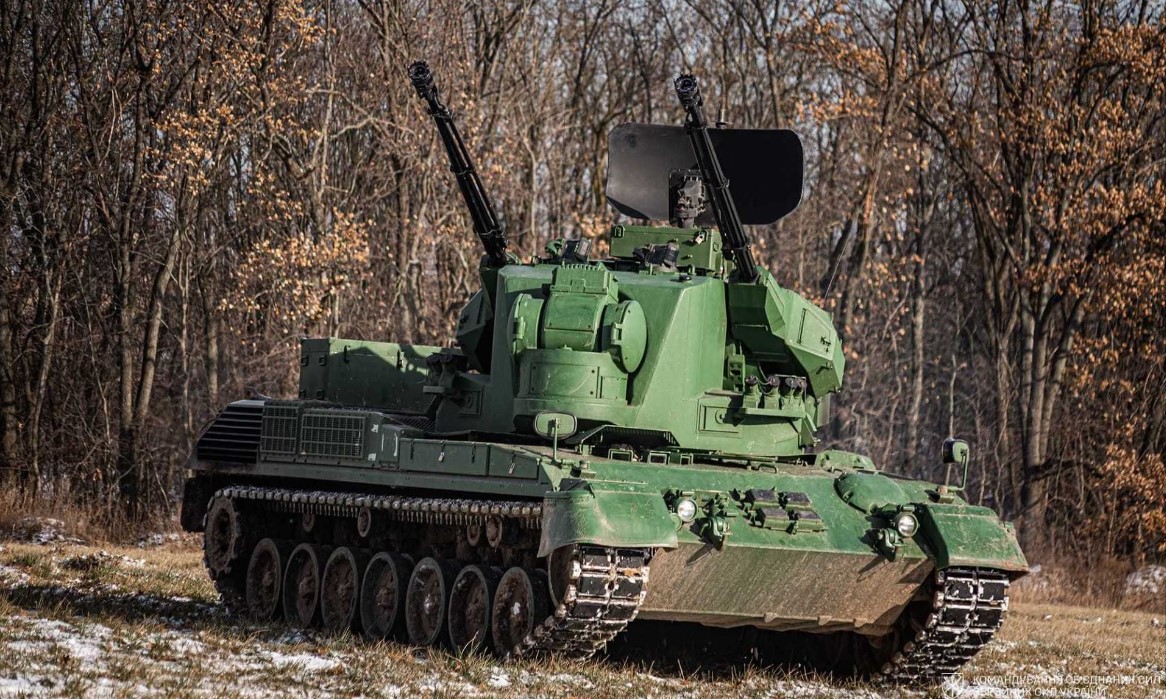
The Gepard is a tracked self-propelled anti-aircraft platform based on the Leopard 1 main battle tank chassis. It is equipped with twin 35 mm Oerlikon KDA autocannons capable of a combined rate of fire of approximately 1,100 rounds per minute. The system incorporates an S-band search radar and a Ku-band tracking radar, each with an operational range of around 15 kilometers.
The platform is designed for short-range air defence, with an effective engagement range of up to 5.5 kilometers. Its configuration enables sustained rapid-fire engagement against low-altitude threats, including unmanned aerial vehicles (UAVs), helicopters, and cruise missiles, under all-weather conditions.
Although the system was phased out by NATO operators between the 2000s and 2010s in favor of missile-based air defence solutions, recent operational use has demonstrated its continued relevance in countering high-volume, low-cost aerial threats. The Gepard offers a lower cost per engagement compared to surface-to-air missile systems, making it suitable for sustained defensive operations.
NATO Service History and Exports
Belgium, Germany, and the Netherlands were the primary NATO operators of the Gepard system during its service life. The platform was also exported in limited numbers to countries including Romania, Brazil, and Jordan. Its gradual withdrawal from service reflected a broader shift toward missile-centric air defence architectures in the post-Cold War period.
Context Within Ongoing Military Support
Belgium’s decision follows earlier transfers of Gepard systems to Ukraine, primarily led by Germany through both national stocks and third-party arrangements. Those systems have reportedly been used to counter drones and cruise missiles.
Initial constraints related to ammunition supply—previously affected by Swiss export restrictions—have been addressed through resumed production in Germany, enabling continued operational use of the platform.
Belgium had previously assessed the potential transfer of its former Gepard inventory but did not proceed at that time. The current decision marks the first confirmed transfer of Belgian-origin Gepard systems to Ukraine under a structured procurement and refurbishment framework aligned with the April 2026 aid package.
——— End of Article ———