BRUSSELS — May 9, 2026 : Belgium has established a phased schedule to transfer its entire fleet of 53 F-16 fighter jets to Ukraine by the end of 2029, according to information confirmed by the office of Belgian Defense Minister Theo Francken. The transfer plan is directly tied to the gradual introduction of new Lockheed Martin F-35A Lightning II fighters into Belgian Air Force service.
Under the current roadmap, Belgium plans to deliver seven F-16s in 2026, five aircraft in 2027, 14 in 2028, and the remaining 27 aircraft in 2029. Four of the aircraft scheduled for the first transfer phase have already been withdrawn from operational use and will instead be used as training platforms for Ukrainian maintenance personnel and technicians.
Belgian defense officials stated that the timeline could still be adjusted depending on the operational requirements of the Belgian Air Force and Belgium’s commitments within NATO. Although Belgium previously committed to supplying F-16s under multinational agreements signed in 2024, no operational aircraft have yet been transferred to Ukraine.
Belgium continues to participate in the international F-16 training program for Ukrainian personnel. In March 2024, the Belgian Air Force deployed two F-16BM two-seat trainer aircraft to Denmark to support pilot instruction efforts. Belgian instructors are also currently training Ukrainian pilots at the Fetești Air Base training center in Romania.
F-35 Deliveries Driving Transfer Schedule
The pace of the F-16 handover remains dependent on the delivery of Belgium’s replacement F-35 fighters. Belgium signed a contract in 2018 for 34 F-35A aircraft, with original deliveries expected to begin in 2023. However, the Belgian Air Force only received its first four aircraft in October 2025. The jets are currently based at Florennes Air Base.
In February 2026, Belgium confirmed plans to expand the procurement by ordering an additional 11 F-35A aircraft, increasing the planned fleet to 45 fighters. The additional acquisition, valued at approximately €1.67 billion, includes a requirement for final assembly and testing to take place at the Italian FACO facility in Cameri.
Defense analysts have noted that production rates at the Cameri facility are slower than those of U.S.-based assembly lines, which could further affect the operational transition schedule and delay the retirement of Belgium’s remaining F-16 fleet.
U.S.-Supported Maintenance Framework
To support the long-term operation of the aircraft transferred to Ukraine, the United States Department of Defense awarded a $235.4 million maintenance contract in January 2026 to Belgian aerospace company Sabena Aerospace Engineering.
The agreement covers medium-level and depot-level maintenance, engine servicing, logistics management, and material support for Ukrainian-operated F-16s through January 2029. Maintenance work will be conducted at the company’s facility in Woluwe-Saint-Lambert.
Continued Modernization of the F-16 Fleet
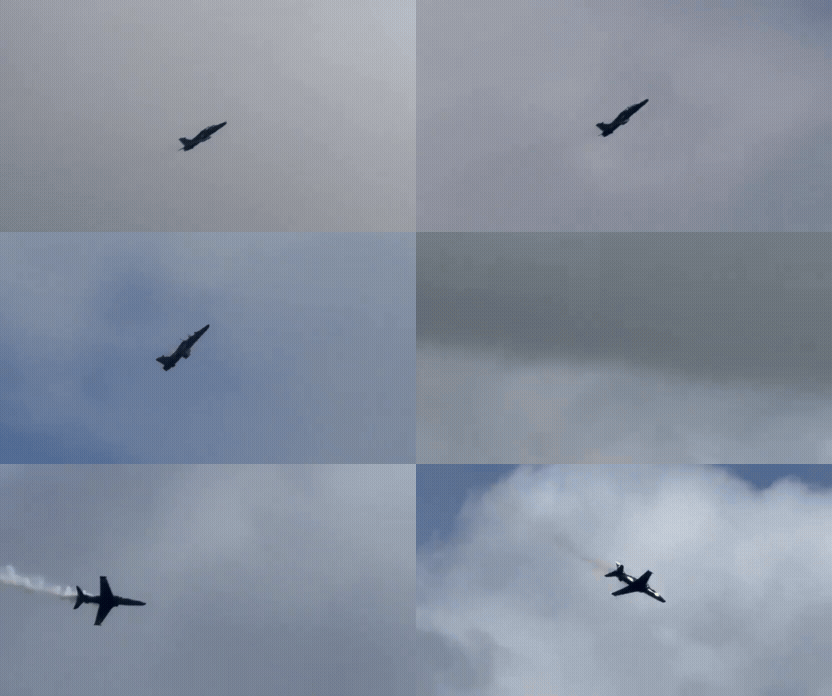
Despite the planned retirement of the aircraft, Belgium continues testing new capabilities on its F-16 fleet. The Belgian Air Force has recently evaluated the integration of 70mm FZ275 Laser Guided Rockets developed by Forges de Zeebrugge and Thales on F-16AM fighters.
The trials focused on improving counter-unmanned aerial systems capabilities by allowing aircraft to engage smaller drones with lower-cost precision-guided rockets instead of using more expensive missiles such as the AIM-120 AMRAAM.
Belgium first received General Dynamics F-16 Fighting Falcon aircraft in 1979 as part of a joint NATO procurement program, with official service entry beginning in 1980. The country acquired approximately 160 aircraft in multiple variants, many of which were assembled domestically by the Belgian aerospace company SABCA.
During the 1990s, the fleet underwent extensive Mid-Life Update modernization programs that upgraded avionics, radar systems, and weapons integration, extending the operational lifespan of the aircraft for more than four decades.
——— End of Article ———