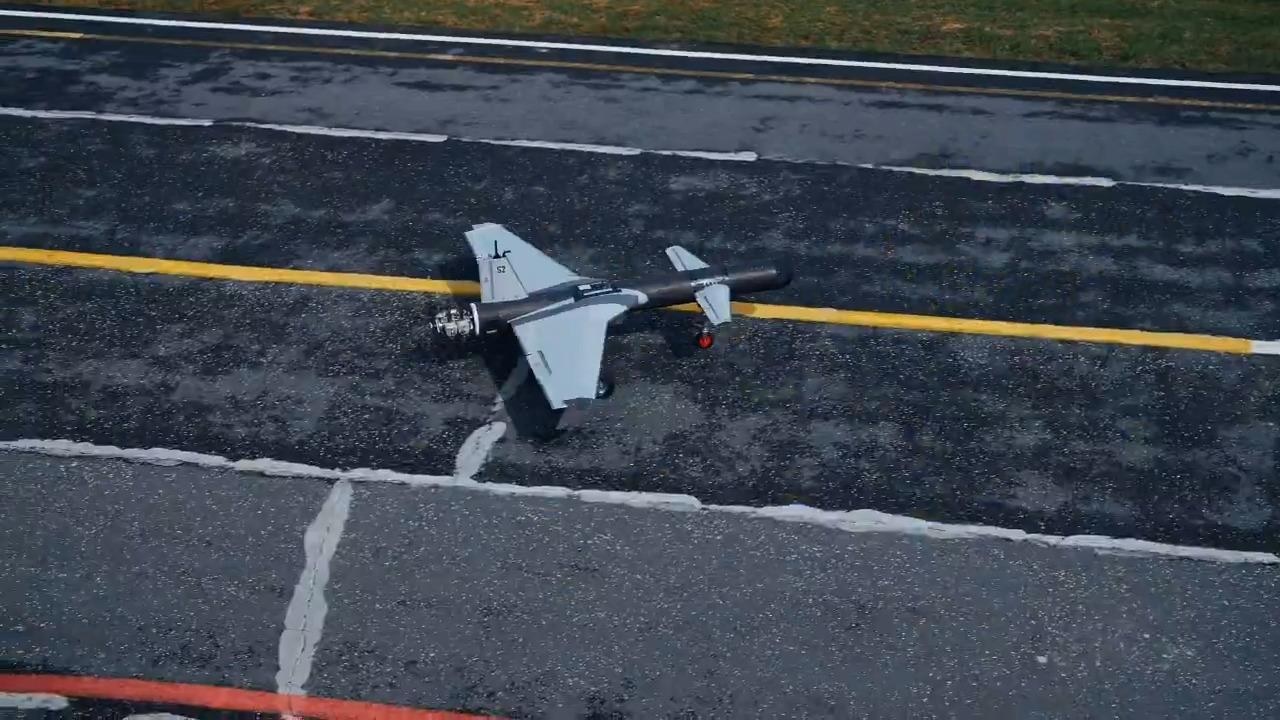
ISTANBUL — April 30, 2026 : Turkish defense manufacturer Baykar has introduced a new artificial intelligence-enabled loitering munition, MIZRAK, following the completion of a live-fire strike test. The system is scheduled to make its first public appearance at SAHA EXPO 2026, which will take place from May 5 to 9 in Istanbul.
The MIZRAK, named after the Turkish word for “spear,” is designed as a long-range tactical strike platform capable of conducting deep surface-to-surface missions while maintaining extended surveillance over target areas. The system combines autonomous navigation, target detection, and strike capabilities, including operation in environments where satellite-based navigation systems are degraded or unavailable.
Platform Design and Technical Characteristics
MIZRAK is significantly larger than conventional expendable loitering munitions and is categorized as a tactical unmanned strike system. It features a wingspan of 4 meters (13.1 feet) and a maximum takeoff weight of 200 kilograms (440.9 pounds). The platform operates at a service ceiling of 10,000 feet and can reach speeds of approximately 185 kilometers per hour (115 mph or 100 knots).
The munition is equipped with interchangeable in-house electro-optical and infrared sensor payloads, enabling reconnaissance and target verification prior to engagement. These sensors support both day and night operations and contribute to the system’s autonomous targeting capabilities.
Variants and Payload Configurations
MIZRAK will be produced in two primary configurations tailored for different mission profiles.
The heavy-strike variant is designed for maximum destructive effect and carries twin warheads with a combined payload of 40 kilograms (88.1 pounds). This configuration is intended for engagements requiring higher impact against fortified or high-value targets.
The precision variant is equipped with a single 20-kilogram (44-pound) warhead and incorporates a radio frequency (RF) seeker. This enables autonomous detection and engagement of radar-emitting systems and electronic warfare assets, making it suitable for suppression of enemy air defenses and similar missions.
Range, Endurance, and Launch Options
The system is optimized for long-range operations, with an operational reach exceeding 1,000 kilometers (621 miles) and an endurance of more than seven hours. These characteristics allow it to loiter over distant target areas for extended periods before executing a strike.
MIZRAK offers flexible launch options. It can take off conventionally using integrated landing gear from standard runways. In addition, it features a rocket-assisted takeoff (RATO) capability, allowing deployment from confined environments, rugged terrain, or locations without prepared airstrips.
Autonomous Navigation and GPS-Denied Capability
A central feature of MIZRAK is its ability to operate in contested electromagnetic environments. The system uses an AI-powered autopilot combined with optical guidance and visual terrain mapping to navigate independently of GPS.
By relying on inertial navigation and visual positioning, MIZRAK can autonomously reach designated areas, identify targets, and conduct precision strikes even under heavy electronic jamming or in fully GPS-denied conditions. This capability is intended to maintain operational effectiveness against adversaries employing advanced electronic warfare measures.
Network Integration and Operational Connectivity
MIZRAK is designed to function within a network-centric operational framework rather than as a standalone system. It maintains a line-of-sight communications range of approximately 80 kilometers and supports integration with other Baykar unmanned platforms, including the Bayraktar TB2, Bayraktar TB3, and Bayraktar Akıncı.
Through this integration, larger unmanned aerial vehicles can provide target designation and situational awareness, enabling coordinated mission execution. For long-range operations beyond line-of-sight limits, the system can utilize satellite communication links to remain connected with command networks. This allows operators to update mission parameters or adjust targeting data during flight.
Swarm Capability and Mission Role
The AI architecture supporting MIZRAK includes provisions for swarm operations. Multiple units can communicate and coordinate to conduct synchronized, multi-axis attacks against defended targets. This approach is intended to increase effectiveness against complex air defense systems by saturating or overwhelming defensive responses.
The system is positioned for use in both strike and persistent surveillance roles, supporting coordinated operations over extended distances. Its combination of endurance, autonomy, and network integration reflects a shift toward distributed and collaborative unmanned systems in modern combat environments.
Baykar has not disclosed production timelines or export plans for MIZRAK. The system’s upcoming presentation at SAHA EXPO 2026 is expected to provide additional context regarding its operational deployment and potential market positioning.
——— End of Article ———