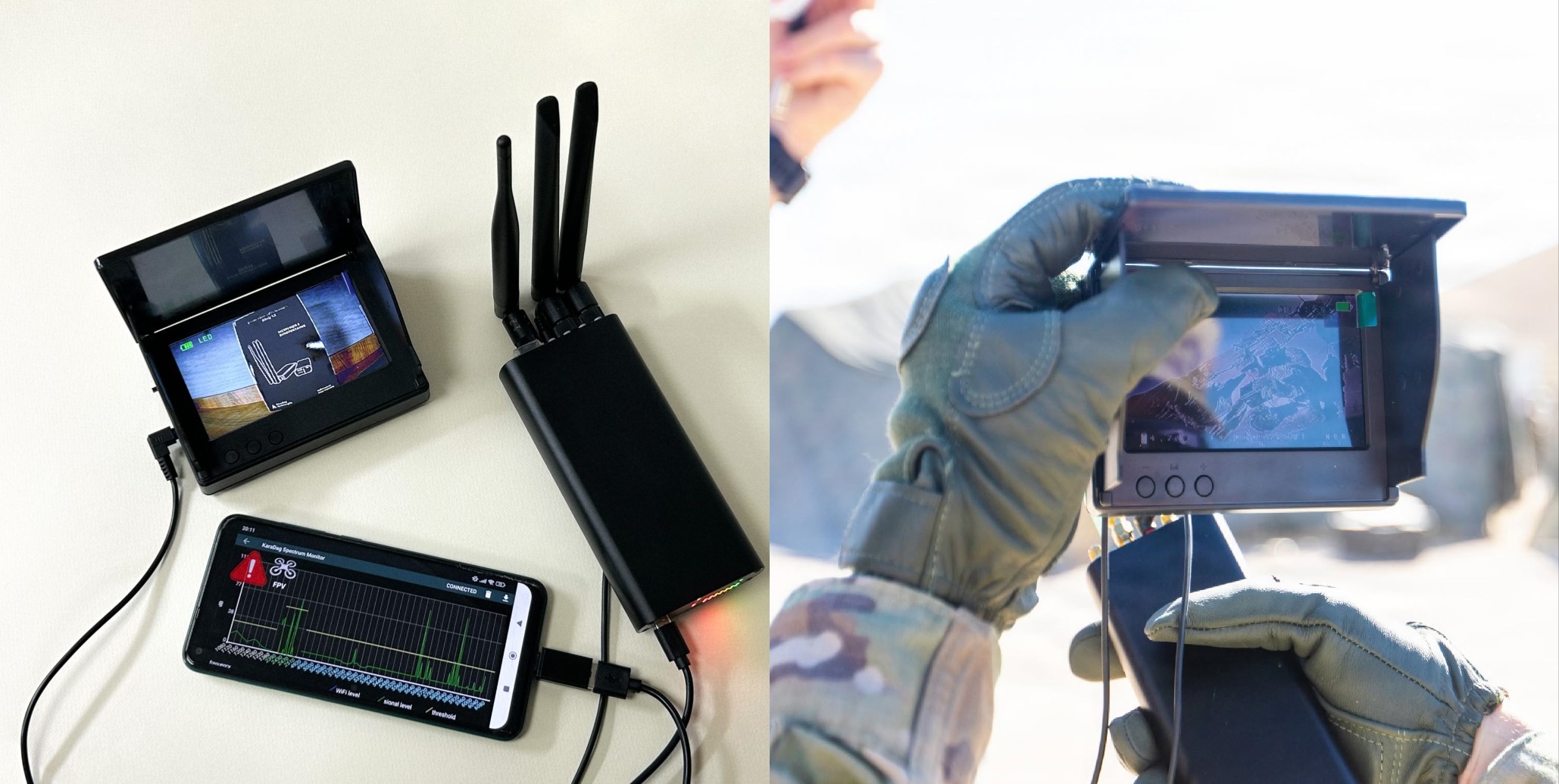
FORT IRWIN, California — June 06, 2026 : A drone detection device closely resembling Ukraine's battlefield-proven Obriy 1.3 system was reportedly observed during a U.S. Army training exercise at Fort Irwin's National Training Center (NTC) in California in late October and early November 2025.
The device appeared under the designation "BlackSky Guardian-1", with its original branding obscured. While neither the U.S. Army nor Ukrainian manufacturer Kara Dag Technologies has confirmed its identity, observers familiar with the Obriy 1.3 noted that the device's physical design, antenna configuration, and overall layout closely matched the Ukrainian system.
Battlefield-Proven Ukrainian Technology
Developed by Kyiv-area company Kara Dag Technologies, the Obriy 1.3 is a personal drone detector widely used during the war in Ukraine. The system is designed to provide early warning of approaching FPV drones and other small unmanned aerial systems.
According to the manufacturer, the detector typically identifies drone signals at ranges of up to 2.5 kilometers, with detection distances potentially reaching 5 kilometers under favorable conditions. It monitors the 1.2 GHz, 2.4 GHz, and 4.9–6.0 GHz frequency bands commonly used by FPV and commercial drones.
The system includes direction-finding capabilities, WiFi filtering to reduce false alarms, FPV-only scanning modes, adjustable sensitivity settings, and a "Blackout" mode that disables visual indicators while maintaining detection functions. It can also integrate with electronic warfare systems and support automatic activation of jamming equipment.
Observed During Fort Irwin Exercise
The reported sighting occurred during NTC Rotation 26-02, the U.S. Army's first armored Transforming in Contact (TiC) 2.0 National Training Center rotation. The exercise involved soldiers from the 2nd Armored Brigade Combat Team, 1st Cavalry Division, and focused on testing new technologies and operational concepts in realistic combat scenarios.
Counter-drone operations were a key element of the exercise, which also included the use of advanced drones, electronic warfare systems, and updated force structures designed to improve battlefield effectiveness against near-peer threats.
The Army's Transforming in Contact initiative aims to rapidly introduce emerging capabilities, including drones, counter-drone systems, and electromagnetic warfare tools, into operational units before major training events and deployments.
Growing Demand for Personal Drone Detection
The reported presence of a device matching the Obriy 1.3 aligns with broader U.S. Army efforts to improve protection against small drones. The Army's C5ISR Center has been researching radio-frequency and acoustic detection systems for dismounted soldiers, reflecting lessons learned from modern conflicts where FPV drones have become a significant battlefield threat.
Ukraine's experience has demonstrated the importance of early-warning systems, as low-cost FPV drones can be launched from several kilometers away and provide little reaction time for soldiers without dedicated detection equipment.
Kara Dag Partnership With Anduril
In March 2026, approximately five months after the Fort Irwin exercise, Kara Dag Technologies announced a strategic partnership with California-based defense technology company Anduril Industries.
The partnership combines Kara Dag's battlefield-tested drone detection technology and extensive radio-frequency signature database with Anduril's defense software and procurement capabilities. The collaboration could provide a pathway for Ukrainian counter-drone technologies to enter U.S. military testing and procurement programs.
Identity Remains Unconfirmed
Whether BlackSky Guardian-1 is a rebranded version of the Obriy 1.3, a test designation, or a separate system has not been confirmed. No publicly available U.S. defense procurement records currently identify a system under that name.
However, the observation indicates that a device physically consistent with a Ukrainian battlefield-proven drone detector was present during a major U.S. Army combat training exercise, highlighting continued interest in technologies developed and validated during the war in Ukraine.
——— End of Article ———