BENGALURU — May 6, 2026 : On May 5, 2026 Bharat Electronics Limited (BEL) has signed a ₹1,251 crore contract, excluding taxes, with the Ministry of Defence for the supply of Ground Based Mobile Electronic Intelligence Systems (GBMES) to the Indian Army. The programme is intended to strengthen the Army’s electronic warfare and battlefield surveillance capabilities while expanding India’s indigenous defence manufacturing base.
The GBMES is a fully indigenous electronic intelligence platform designed and developed by the Defence Electronics Research Laboratory (DLRL), a specialised laboratory under the Defence Research and Development Organisation (DRDO). BEL will serve as the primary manufacturing and system integration agency for the project.
Indigenous Electronic Warfare Platform
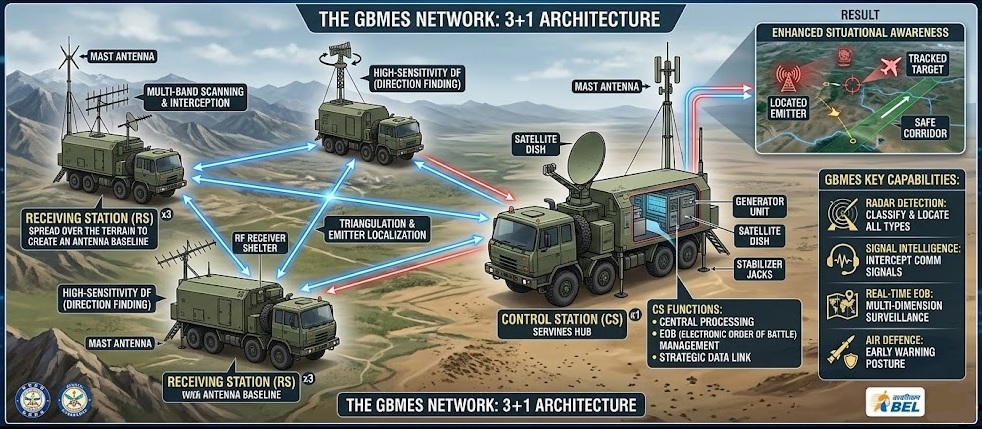
The Ground Based Mobile ELINT System is a vehicle-mounted electronic intelligence platform developed for deployment in operational and forward battlefield environments. The system architecture consists of multiple receiving stations and a central control station mounted on high-mobility vehicles, enabling rapid deployment and relocation across varied terrain.
The configuration includes Receiving Stations (RxS-1 and RxS-2), a Receiving Station with Communication Support Base (RxS-CSB), and a Control Station (CS), all linked through secure communication networks. The system is designed to operate in a distributed manner, allowing multiple mobile nodes to work together during intelligence-gathering operations.
According to available technical details, the GBMES is capable of detection, monitoring, location fixing and complete analysis of radio frequency signals across a frequency range of 70 MHz to 40 GHz. The platform uses indigenously developed antenna systems, direction-finding equipment and advanced receiver technologies.
Passive Electronic Intelligence Operations
Electronic Intelligence (ELINT) involves gathering intelligence through the interception and analysis of electromagnetic emissions generated by military systems such as radars, communication equipment and air defence networks.
Unlike conventional radar systems that emit radio waves and expose their own location, the GBMES functions as a passive surveillance system. The platform does not transmit signals of its own, allowing it to operate covertly while continuously monitoring the electromagnetic spectrum.
The system uses highly sensitive antennas, advanced digital receivers and signal processing units to detect hostile electromagnetic emissions in real time. Once a signal is intercepted, the system analyses multiple parameters including operating frequency, pulse width, pulse repetition interval, modulation patterns and waveform characteristics.
This analysis allows operators to identify the type of hostile equipment generating the signal, including surveillance radars, fire-control radars, surface-to-air missile guidance systems, artillery tracking radars and battlefield communication nodes.
Detection and Geolocation Capabilities
One of the key operational features of the GBMES is its ability to accurately locate hostile emitters. The system uses multiple receiving stations operating together in a networked configuration to determine the geographical coordinates of enemy radar and communication systems.
The platform uses triangulation and phase-difference measurement techniques to establish precise emitter locations. This capability allows military formations to map hostile radar sites, command centres and communication infrastructure without alerting the adversary.
In addition to radar intelligence gathering, the GBMES can intercept voice and data communication signals for further classification and operational analysis. The collected information contributes to the development of a comprehensive electronic intelligence picture of the battlefield environment.
Technical Specifications
Technical information associated with the system indicates that the GBMES is fully automated and software-intensive, while also retaining manual override capability when required during operations.
The system is capable of intercepting radar emitters across the 70 MHz to 40 GHz spectrum and can simultaneously monitor at least 200 emitters during operational deployment. The platform is designed to support continuous monitoring, signal analysis and electronic threat identification under battlefield conditions.
Its mobile configuration enables rapid deployment to operational sectors, including remote border regions and high-threat environments. The ability to reposition quickly also improves survivability against enemy artillery and counter-electronic warfare measures.
Operational Role in Wartime
The GBMES is expected to play an important role in modern battlefield operations where control of the electromagnetic spectrum is increasingly critical.
The system can support the creation of an Electronic Order of Battle (EOB), which involves mapping enemy radar systems, air defence assets, artillery radars and communication networks before and during combat operations. By passively identifying hostile electronic assets, the Indian Army can improve situational awareness without exposing its own position.
The intelligence generated by the system can support suppression of enemy air defence operations by identifying hostile radar locations and missile guidance systems. The information can also assist the Indian Air Force and other formations in planning safer operational routes for aircraft, helicopters and unmanned aerial systems operating near contested airspace.
The platform additionally supports electronic warfare operations by enabling selective jamming of hostile radar and communication frequencies. Once enemy systems are identified and classified, electronic warfare units can deploy targeted countermeasures to disrupt adversary surveillance, targeting and command networks.
Strategic and Industrial Significance
The ₹1,251 crore contract further strengthens BEL’s defence production pipeline and supports the government’s broader objective of increasing indigenous defence manufacturing capabilities.
The programme reduces dependence on foreign original equipment manufacturers by retaining system design, production and integration capabilities within India. The development and deployment of the GBMES also contributes to long-term strategic autonomy in advanced electronic warfare technologies.
The induction of the Ground Based Mobile ELINT Systems is expected to enhance the Indian Army’s electronic surveillance, electromagnetic spectrum monitoring and battlefield intelligence capabilities as part of ongoing force modernisation efforts across multiple operational theatres.
——— End of Article ———