WASHINGTON, D.C. — April 29, 2026 : AeroVironment, Inc. (NASDAQ: AVAV) has launched Halo_Shield, a modular counter-unmanned aircraft system designed to detect, track, identify and defeat drones, drone swarms and subsonic cruise missiles targeting military forces and critical infrastructure.
The company announced the system on April 28 during the Modern Day Marine 2026 at the Walter E. Washington Convention Center. According to AeroVironment, the platform is intended for deployment across U.S. and allied operations, including border security, military installations and other high-value sites.
System Scope and Deployment Status
Halo_Shield is part of AeroVironment’s broader counter-UAS strategy and is engineered to address a wide spectrum of aerial threats. The system covers targets ranging from small Group 1 drones to larger Group 5 unmanned aircraft, as well as coordinated drone swarms and subsonic cruise missiles. The company stated that the system is currently undergoing demonstrations and has already been deployed at selected critical locations.
Wahid Nawabi, chairman, president and chief executive officer of AeroVironment, said the system was developed in response to evolving aerial threats characterized by low-cost and coordinated platforms that challenge conventional point-defense systems.
Modular Tile-Based Architecture
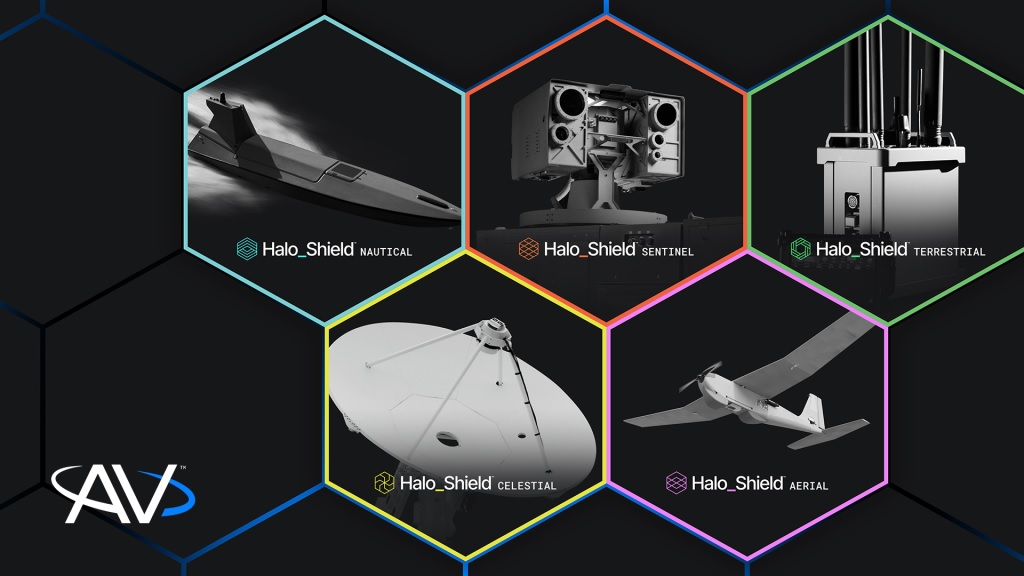
Halo_Shield is built on a distributed, tile-based architecture designed to extend coverage across air, land, sea and space domains. The system consists of five primary components, each tailored to specific operational roles:
- Sentinel Tile: Provides point defense against Group 1–5 threats with configurations for fixed and mobile deployments.
- Terrestrial Tile: Enables passive and scalable detection and tracking around borders and ground assets.
- Nautical Tile: Supports maritime environments such as coastlines, ports and inland waterways.
- Aerial Tile: Uses elevated sensing to fill detection gaps in complex terrain and along known threat corridors.
- Celestial Tile: Delivers early warning and “left-of-launch” intelligence using satellite-based GEOINT and SIGINT capabilities.
Each tile integrates sensors, effectors and command-and-control systems into a self-contained unit that can operate independently or as part of a larger network.
Command, Control and Integration
The system is powered by AV_Halo, AeroVironment’s AI-enabled command-and-control platform. AV_Halo enables operators to manage multiple tiles and systems through a unified interface while automating detection, classification and response processes. The architecture is designed to reduce personnel requirements and simplify operational workflows.
Halo_Shield supports plug-and-play integration and can be deployed through portable fly-away kits. It is also designed to integrate with existing customer sensors, weapons and command systems, allowing interoperability with legacy defense architectures.
Larry Lloyd, senior vice president of strategic initiatives at AeroVironment, said the system’s modular design allows operators to scale and reconfigure capabilities in real time without requiring system redesign or additional training.
Sensors, Effectors and Existing Systems Integration
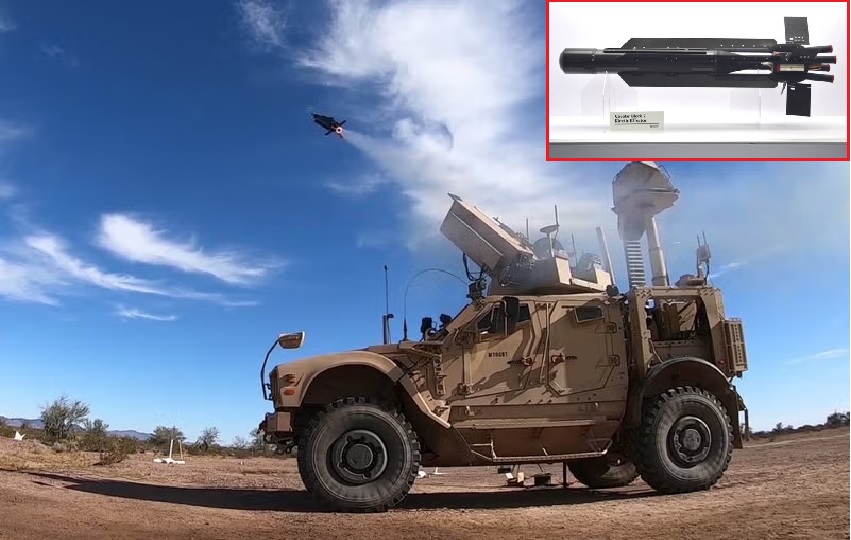
The system incorporates a range of sensor technologies, including electro-optical/infrared, radar, passive radio frequency, acoustic systems and satellite-derived intelligence. Its layered defense approach combines multiple effector types, including radio frequency disruption, directed energy and kinetic interception.
Halo_Shield integrates several existing AeroVironment systems, including the LOCUST directed-energy laser weapon, Switchblade loitering munitions and Titan 4 and Titan MS radio frequency counter-UAS systems. The integration of these systems is intended to improve detection ranges, accelerate response times and expand defensive coverage across large operational areas.
Operational Design and Future Expansion
AeroVironment describes Halo_Shield as a modular, distributed and cost-effective system capable of autonomous operation. The architecture is designed to support multi-domain operations and remain adaptable as threats evolve. The system’s hardware-agnostic approach allows for the integration of future technologies without requiring major structural changes.
The company stated that additional details on individual tiles and system capabilities will be released in future announcements. Further information is available on AeroVironment’s official website.
——— End of Article ———