ARLINGTON, Va. — March 22, 2026 : AeroVironment is preparing to submit its LOCUST X3 directed-energy system in response to the U.S. Army’s Enduring High Energy Laser (E-HEL) requirement, which calls for the production and fielding of an initial batch of 24 systems designed to counter unmanned aerial threats.
The requirement follows a Request for Information issued by the Army’s Rapid Capabilities and Critical Technologies Office and its Directed Energy Project Office, as part of broader efforts to transition laser-based air defence systems from prototype to operational deployment.
U.S. Army E-HEL Requirement and Operational Scope
The E-HEL programme is intended to provide scalable and mobile protection against Group 1 to Group 3 unmanned aircraft systems (UAS), ranging from small commercial quadcopters to larger fixed-wing drones weighing up to approximately 1,320 pounds.
Under the Army’s outlined parameters, candidate systems must demonstrate the ability to:
- Detect, track, and defeat Group 1–3 UAS across varied operational environments
- Achieve a hard kill effect against Group 1 and 2 drones, rendering them incapable of flight
- Neutralise Group 3 one-way attack drones, including loitering munitions
- Operate in both semi-fixed and manoeuvre configurations, including palletised deployment or integration onto platforms such as the Joint Light Tactical Vehicle
- Integrate within a Modular Open Systems Approach (MOSA) framework and accept external targeting cues from systems such as Forward Area Air Defense (FAAD) radars
The Army’s objective is to field a system capable of operating in complex airspace conditions, including cluttered environments, while maintaining compatibility with existing command-and-control networks.
LOCUST X3 System Capabilities
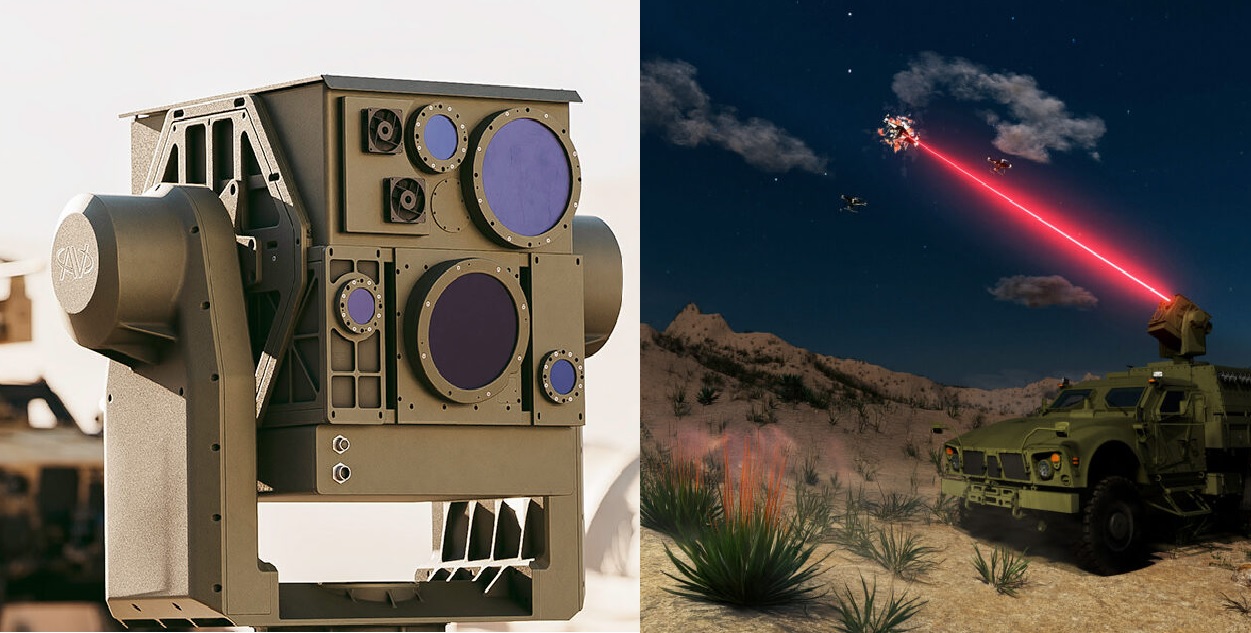
AeroVironment’s LOCUST X3 is described as a third-generation 20–35+ kilowatt class directed-energy laser weapon system, designed to address both current and emerging aerial threats.
The system incorporates advanced electro-optical/infrared (EO/IR) sensors and the company’s AV_Halo™ Pinpoint fire control software, enabling precise targeting and stable energy delivery against fast-moving and manoeuvring aerial targets.
Key technical features include:
- Precision tracking and targeting, supported by high-bandwidth sensor fusion and real-time engagement overlays
- Artificial intelligence-enabled detection and engagement, allowing prioritisation of threats in high-density swarm scenarios
- Sensor-agnostic architecture, enabling integration with multiple radar and sensor inputs, including FAAD cueing
- Automated engagement workflows, reducing operator workload and response times
The system is also designed for logistical efficiency, using electrical power rather than interceptor missiles. This allows engagements at a marginal cost estimated at approximately $0.18 per shot, significantly reducing the supply chain burden associated with traditional kinetic air defence systems.
Integration, Mobility, and Deployment Options
LOCUST X3 is built to support both fixed-site and mobile operations. It can be deployed in a 463L-compliant palletised configuration or mounted on tactical vehicles, including JLTV platforms.
Previous system variants have demonstrated integration across multiple mobility platforms. Under the Army’s Multi-Purpose High Energy Laser (AMP-HEL) programme, AeroVironment delivered 20 kW-class LOCUST systems mounted on Infantry Squad Vehicles and later on JLTVs with upgraded beam director apertures to improve engagement effectiveness.
The system’s architecture supports plug-and-play integration, allowing it to be incorporated into existing air defence networks without extensive redesign.
Development Background and Operational Experience
The LOCUST X3 builds directly on earlier generations of the LOCUST high-energy laser systems, including the 10–20 kW class systems developed under the Army’s Palletized High Energy Laser (P-HEL) programme.
These earlier systems have been operationally deployed in overseas environments since at least 2023, where they have demonstrated high availability rates and conducted real-world engagements against unmanned aerial threats.
AeroVironment has stated that the development of the X3 variant incorporates operational data and lessons learned from these deployments, with the aim of improving performance, scalability, and reliability.
In 2025, AeroVironment expanded its directed-energy portfolio through the acquisition of BlueHalo, the original developer of the LOCUST system family.
Programme Timeline and Industry Context
The E-HEL initiative follows an RFI issued in October 2025 and a draft Request for Proposal released in January 2026. The programme is intended to transition directed-energy systems from limited prototypes to full-scale production and rapid fielding.
The initial requirement for 24 systems represents a key step in integrating laser weapons into frontline operations, particularly for counter-UAS missions.
No official timeline has been announced for contract awards under the programme.
Strategic Context
The U.S. Army’s investment in directed-energy systems reflects a broader shift toward cost-effective and scalable air defence solutions capable of countering the increasing use of unmanned systems in modern conflicts.
Laser-based systems such as LOCUST X3 are being developed to complement traditional missile-based defences, offering sustained engagement capability without reliance on expendable munitions.
The outcome of the E-HEL competition is expected to play a significant role in shaping future U.S. Army air defence architecture, particularly in environments characterised by high-volume drone threats.
——— End of Article ———