HELSINKI — May 14, 2026 : German electronic warfare technology company Aaronia AG will publicly unveil its new AARTOS DF2 direction-finding system during the AOC Europe 2026 electronic warfare symposium in Helsinki from May 19 to 21. The company will participate as a Gold Sponsor at Booth 4F21, where it plans to showcase its latest counter-unmanned aerial systems (C-UAS), spectrum monitoring, and electromagnetic situational awareness technologies.
Organized by the Association of Old Crows, AOC Europe is one of the leading electronic warfare conferences in Europe, bringing together military officials, government agencies, defense industry companies, and academic specialists. The 2026 event is being held under the theme “Re-Arming Europe for Electromagnetic Spectrum Superiority,” reflecting the growing European focus on electronic warfare and counter-drone capabilities following the widespread battlefield use of Shahed-series drones and FPV attack drones in Ukraine.
SPECTRAN V6 Mobile to Serve as Core Demonstration Platform
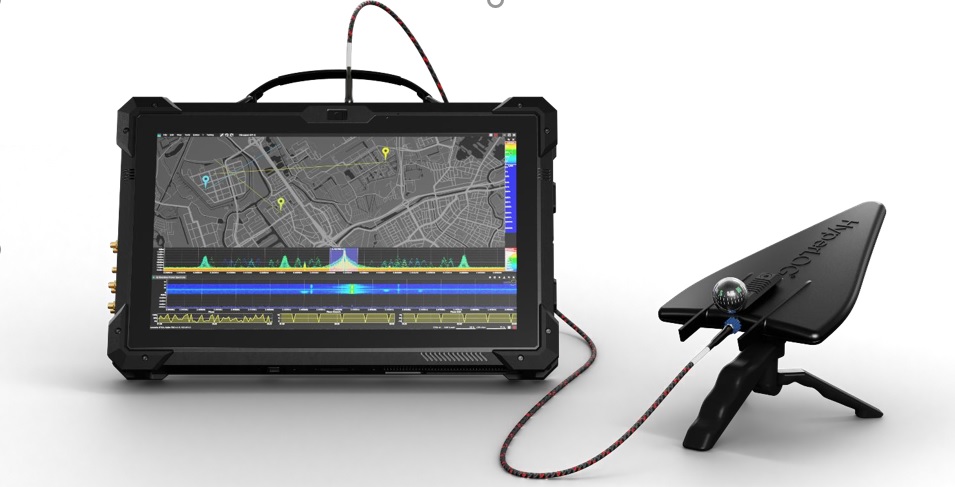
Aaronia’s exhibition will center around the SPECTRAN V6 Mobile portable real-time spectrum analyzer, which serves as the hardware foundation for the company’s AARTOS drone detection and electronic warfare systems.
The portable analyzer covers a frequency range from 9 kilohertz to 140 gigahertz, providing a 490 megahertz real-time bandwidth and a 3 terahertz-per-second sweep speed. These specifications are designed to allow operators to detect short-duration or transient radio-frequency emissions, including drone control links, radar activity, and jamming signals that may be missed by conventional spectrum analyzers.
The system operates on Windows 11 and is powered by an AMD Ryzen 7 Core 8845HS processor with an AMD Radeon 780M GPU. The platform includes 64 gigabytes of DDR5 RAM and an integrated 2-terabyte M.2 NVMe storage drive, with additional expansion available through extra M.2 slots.
Connectivity features include USB Power Delivery ports, HDMI output, dual 2.5-gigabit Ethernet interfaces, and an SD card reader, all protected by weather-resistant covers intended for field operations. The unit also incorporates a 15-inch display with 1,500 nits brightness for outdoor visibility and a hot-swappable battery system capable of delivering up to 4.5 hours of continuous runtime.
The standard package includes the OmniLOG 30800 omnidirectional broadband antenna, designed for isotropic measurements between 300 megahertz and 8 gigahertz without requiring manual antenna alignment.
RTSA-Suite PRO Enables Multi-Sensor Networking
The SPECTRAN V6 platform is operated through Aaronia’s RTSA-Suite PRO software, which supports networking multiple spectrum analyzers into distributed sensor architectures.
According to the company, the software provides automatic pulse classification, real-time demodulation and decoding, 3D map visualization, RF propagation analysis, and Smart Buffering for extended full I/Q recording. The software can also integrate terrain data and building models to improve signal visualization and geolocation performance.
Aaronia stated that networking multiple SPECTRAN V6 systems allows coverage areas and detection sensitivity to scale according to the number of deployed sensors rather than being limited to a single platform.
AARTOS DF2 Expands Direction-Finding Capabilities
The newly introduced AARTOS DF2 forms part of the wider AARTOS DDS product family, which ranges from the X2 to X9 variants and supports integrated drone detection, RF classification, tracking, and geolocation.
The AARTOS direction-finding lineup also includes the DF4 and DF9 systems, ranging from handheld operator units to networked multi-sensor configurations intended for large-area monitoring and electronic surveillance missions.
The systems utilize Aaronia’s latest IsoLOG DF antenna series, supporting real-time angle-of-arrival direction finding up to 18 gigahertz, while a future extension to 40 gigahertz is currently under development.
For higher-frequency applications, the company’s PowerLOG horn antenna series extends monitoring capability up to 70 gigahertz, supporting the detection of advanced radar and communications systems operating in millimeter-wave frequency bands.
Integrated RF Detection and Optical Verification
For lower-frequency signal localization, the AARTOS systems combine Power of Arrival (POA) and Time Difference of Arrival (TDOA) algorithms. According to Aaronia, this enables automatic three-dimensional triangulation of transmitters, real-time flight-path recording, and simultaneous localization of multiple emitters, including GPS position and altitude data.
The systems also integrate camera platforms capable of automatically tracking detected aerial objects and providing optical verification of drones and payloads.
Aaronia stated that the integrated RF detection, geolocation, and optical verification architecture is intended to support military and security operators operating in complex electromagnetic environments where drone control links, radar emissions, and electronic attack signals must be identified and localized in real time.
The company added that the systems are designed for both mobile and stationary deployments, supporting operational requirements for counter-UAS, electronic warfare, and electromagnetic spectrum monitoring missions.
——— End of Article ———