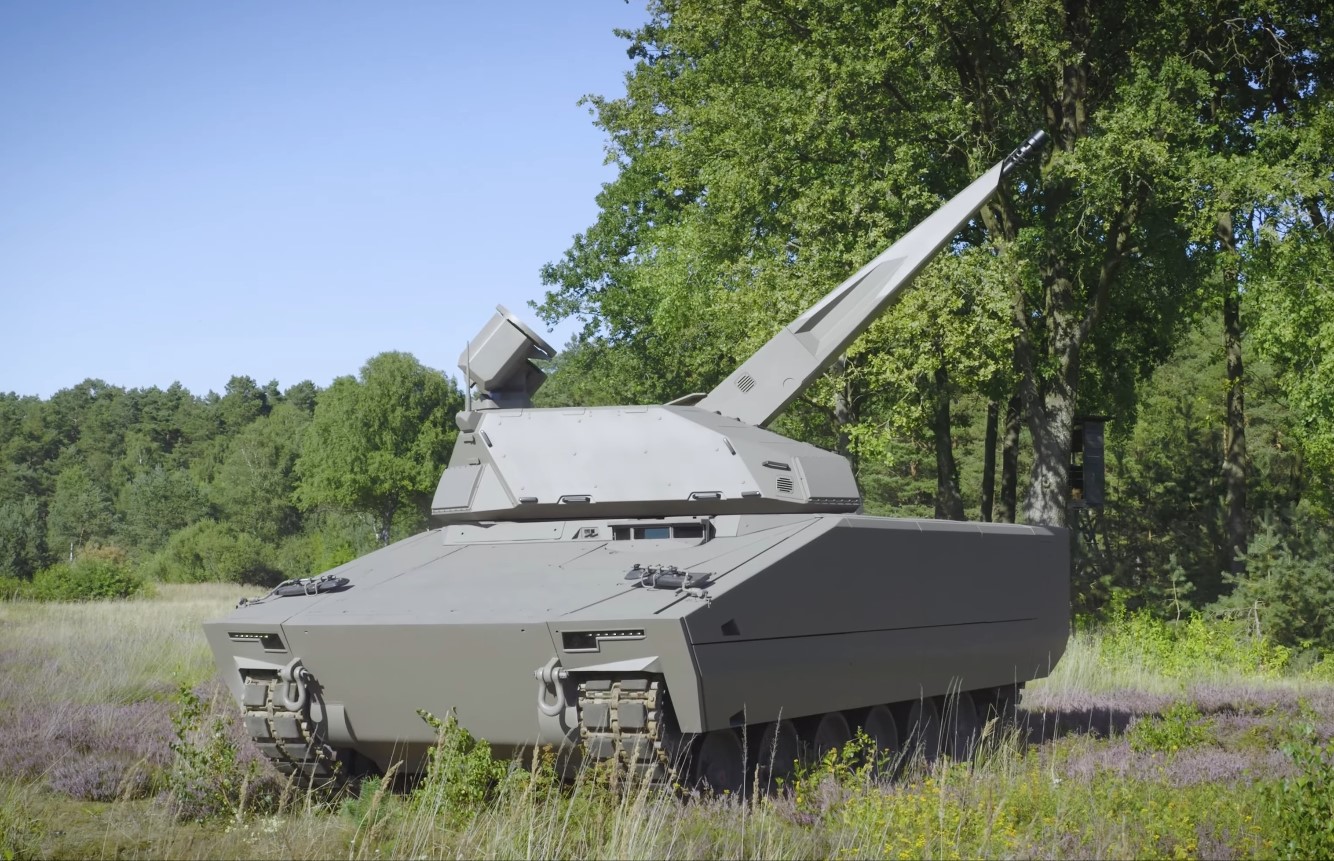
WASHINGTON / FALLS CHURCH : The U.S. Army has formally accelerated its shift toward higher-caliber direct-fire weapons, placing an order for 16 XM913 50mm Bushmaster Chain Guns from Northrop Grumman to support the ongoing XM30 Mechanized Infantry Combat Vehicle (MICV) competition. Deliveries of the cannons are already underway to Army test units, underscoring the service’s intent to validate a new lethality baseline as it prepares to replace the aging Bradley Infantry Fighting Vehicle fleet.
Northrop Grumman confirmed in January 2026 that the 16 cannons are tied to a fresh round of XM30 trials and are being supplied as Government Furnished Equipment (GFE). The guns are being provided to both American Rheinmetall Vehicles and General Dynamics Land Systems, the two competing industry teams vying to deliver the Army’s next-generation mechanized infantry platform. According to the company, initial deliveries have begun to DEVCOM test elements, where the weapons will be integrated into prototype turrets and subjected to live-fire, mobility, and reliability evaluations.
A Deliberate Move Beyond the Bradley
Army leaders have increasingly framed XM30 as more than a one-for-one replacement for the Bradley. Instead, the program is positioned as a reset in lethality, survivability, and growth margin for Armored Brigade Combat Teams operating against peer and near-peer threats. Central to that reset is caliber. By selecting the XM913, the Army is testing the largest medium-caliber weapon in Northrop Grumman’s Bushmaster family, moving decisively beyond the Bradley’s 25×137 mm M242.
The XM913 fires 50×228 mm ammunition, offering a substantial increase in projectile mass, range, and terminal effect. As a chain gun with an external drive, the weapon is designed for high reliability, controlled cycling, and predictable recoil, attributes that are critical for stabilized turrets expected to engage targets accurately while on the move. Northrop Grumman emphasizes that these characteristics support consistent performance across long firing sequences and under harsh battlefield conditions.
Ammunition Flexibility and First-Round Effects
Where the XM913 distinguishes itself is in its ammunition suite and fire-control integration. The Army’s 50×228 mm family includes both High Explosive Air Bursting (HE-AB) and Armor-Piercing Fin-Stabilized Discarding Sabot (APFSDS) rounds, allowing a single weapon to address a wide spectrum of threats.
The HE-AB round can be programmed for point detonation, delayed point detonation, or air burst, enabling gunners to defeat dismounted infantry in cover, engage reverse-slope positions, or neutralize light structures without changing ammunition types. The APFSDS round, by contrast, is optimized for hard and armored targets, extending the vehicle’s ability to counter modern infantry fighting vehicles and other battlefield systems at greater standoff ranges.
The gun itself incorporates dual-feed, first-round-select capability, allowing instantaneous switching between ammunition types without breaking contact. In practical terms, this compresses the sensor-to-shooter timeline: the gunner can tailor effects to the target immediately rather than relying on volume of fire or calling for indirect support.
Integration With XM30’s Digital Architecture
On XM30 prototypes, the XM913 is paired with a computerized fire-control system intended to deliver high first-round-hit probability against both stationary and moving targets. The system supports single-shot, burst, and automatic fire, while spent cases are ejected forward and out of the turret to reduce internal clutter and improve crew safety.
Army officials view this combination as critical to survivability. Greater accuracy at longer ranges means shorter exposure times, reducing vulnerability to enemy anti-tank guided missiles, loitering munitions, and direct-fire responses. The increased caliber also provides a growth path, allowing future ammunition developments to be fielded without redesigning the primary weapon.
Signaling the Army’s Future Direction
The decision to procure 16 XM913 cannons for XM30 trials sends a clear signal about the Army’s priorities. As threats evolve and battlefield environments become more lethal, the service is betting that higher-caliber, programmable direct-fire weapons will be essential to maintaining overmatch. The ongoing tests at DEVCOM, supported by Northrop Grumman and the two XM30 industry teams, will determine whether the 50 mm solution becomes the new standard for U.S. mechanized infantry in the decades ahead.
With deliveries now in progress and live-fire evaluations expanding through 2026, the XM913 is no longer a paper capability. It is a central contender in the Army’s effort to redefine how its future infantry combat vehicles fight, survive, and dominate on the modern battlefield.
——— End of Article ———