MANASSAS, Virginia, June 24, 2026 — The Defense Advanced Research Projects Agency (DARPA) and Boeing subsidiary Aurora Flight Sciences have reached a significant milestone in the development of the X-65 experimental aircraft, marking the transition from component manufacturing to full-scale airframe integration under the Control of Revolutionary Aircraft with Novel Effectors (CRANE) program.
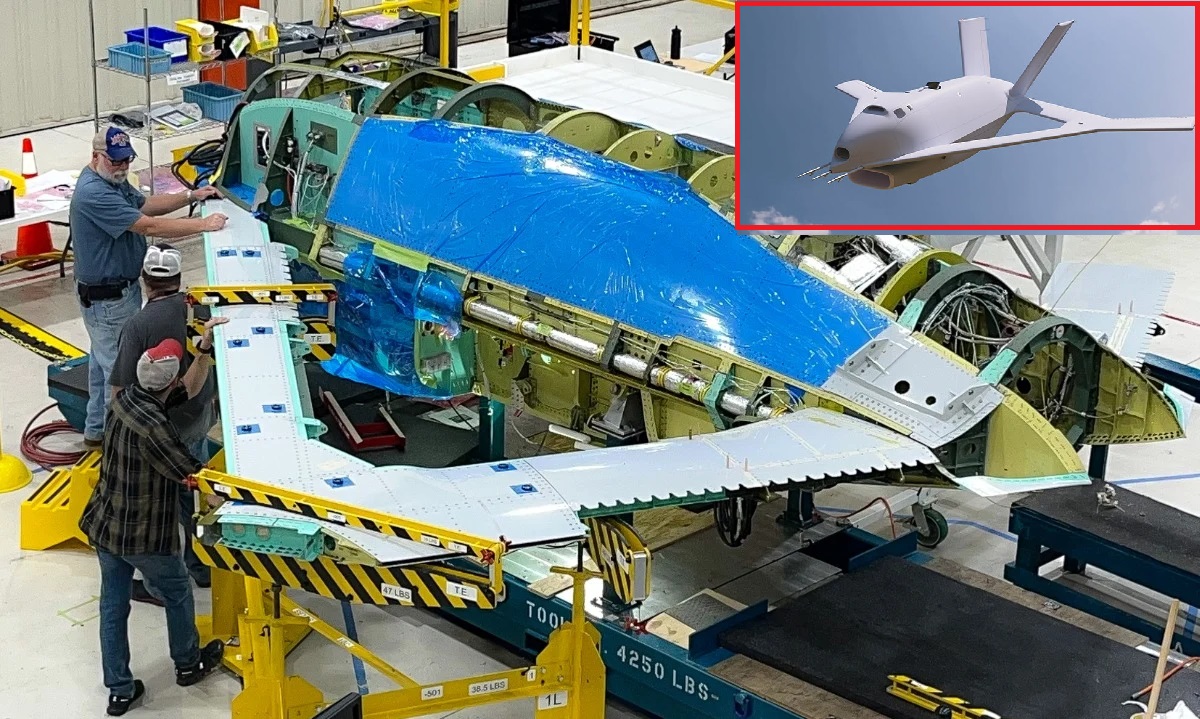
In June 2026, Aurora Flight Sciences received the aircraft’s specialized triangular wings at its integration facility in Manassas, Virginia. Engineers have begun mating the wings to the fuselage, advancing the project toward ground testing later this year and a planned first flight in late 2027.
The X-65 is an uncrewed technology demonstrator designed to validate Active Flow Control (AFC) as the primary method of aircraft control at a tactically relevant scale. The program seeks to generate flight data that could influence the design of future military and commercial aircraft by replacing conventional moving flight-control surfaces with airflow-based control systems.
Wing Integration Marks Key Development Stage
The newly delivered wings were manufactured at Aurora’s facility in West Virginia and feature a delta-derived triangular planform with modular outboard sections. The design allows engineers to modify wing configurations between test campaigns and evaluate AFC performance across multiple sweep angles and aerodynamic arrangements.
The wings incorporate internal pathways that distribute pressurized air to 14 AFC effectors embedded across the aircraft’s wing and tail surfaces. These effectors enable aircraft control without relying on traditional ailerons, elevators, or rudders.
Wing integration follows the arrival of the fuselage in Virginia earlier in 2026. Engineering teams have been installing propulsion, electrical, and AFC systems while manufacturing of additional wing and tail components continued in parallel.
Active Flow Control Replaces Conventional Flight Controls
Unlike traditional aircraft that use mechanically actuated control surfaces, the AFC system works by releasing precisely directed jets of pressurized air through 14 embedded effectors. These air jets modify airflow patterns in real time, enabling the aircraft to perform pitch, roll, and yaw maneuvers without moving external control surfaces.
According to DARPA, eliminating conventional flight-control mechanisms offers several potential advantages, including reduced aircraft weight, lower aerodynamic drag, simplified maintenance requirements, and increased design flexibility. The absence of hinges, actuators, and moving surfaces could also allow engineers to develop aircraft shapes that are difficult or impossible to achieve using traditional control systems.
Designed for Operationally Relevant Testing
Previous AFC research has largely been limited to wind-tunnel experiments and small unmanned aircraft. The X-65 is intended to demonstrate the technology at a scale more representative of future operational aircraft.
The demonstrator features a wingspan of 30 feet (9.1 meters), a gross weight of approximately 7,000 pounds (3,175 kilograms), and a projected top speed of Mach 0.7, or roughly 532 mph (857 km/h). These characteristics place it in a category comparable to light military trainer aircraft or unmanned combat air vehicles.
To support safe testing, the X-65 will initially operate under Federal Aviation Administration (FAA) experimental certification and retain conventional control surfaces during early flight trials as a safety backup while engineers validate AFC performance.
Once baseline flight characteristics are confirmed, the traditional control surfaces will be locked in place, allowing the aircraft to operate using the AFC system alone.
Modular Design Supports Continued Research
A key feature of the aircraft is its modular architecture. Engineers can replace outboard wing sections and AFC effectors between test campaigns, allowing multiple aerodynamic configurations to be evaluated using the same aircraft.
This flexibility is expected to support a broader range of research objectives beyond the initial CRANE program goals and provide a reusable platform for future AFC experimentation.
Funding and Program Timeline
DARPA selected Aurora Flight Sciences as the sole contractor for Phase 3 of the CRANE program in January 2024. The agency allocated approximately $38 million for the program during fiscal year 2024 and an additional $23.8 million in fiscal year 2025.
In August 2025, DARPA and Aurora restructured the project under a co-investment agreement, with Aurora assuming a share of the funding responsibility for completing the aircraft and conducting its inaugural flight. The arrangement is intended to support the aircraft’s long-term use as a research platform rather than a single-use demonstrator.
Following fuselage delivery in April 2026 and wing integration in June 2026, the program's planned schedule includes:
- Late 2026: Ground testing at Manassas Regional Airport, Virginia
- Early 2027: Taxi testing
- Late 2027: First flight of the X-65 demonstrator
CRANE Program Manager Chris Kent has previously confirmed these target milestones.
Potential Applications for Future Stealth Aircraft
The program is attracting attention from the Air Force Research Laboratory, NASA, Naval Air Systems Command, and the Office of Naval Research.
One area of interest is the potential application of Active Flow Control technology to low-observable aircraft design. Conventional control surfaces require hinges, gaps, and joints that can create radar-reflecting discontinuities on an aircraft’s exterior.
By enabling aircraft control through airflow manipulation rather than moving external surfaces, AFC could allow future aircraft to maintain smoother outer mold lines. Such designs may help reduce radar cross-sections while preserving maneuverability, offering potential benefits for next-generation stealth aircraft.
As integration work continues in Virginia, the upcoming ground and flight test campaigns are expected to provide critical data on whether airflow-based control systems can serve as a practical alternative to conventional aircraft flight controls.
——— End of Article ———