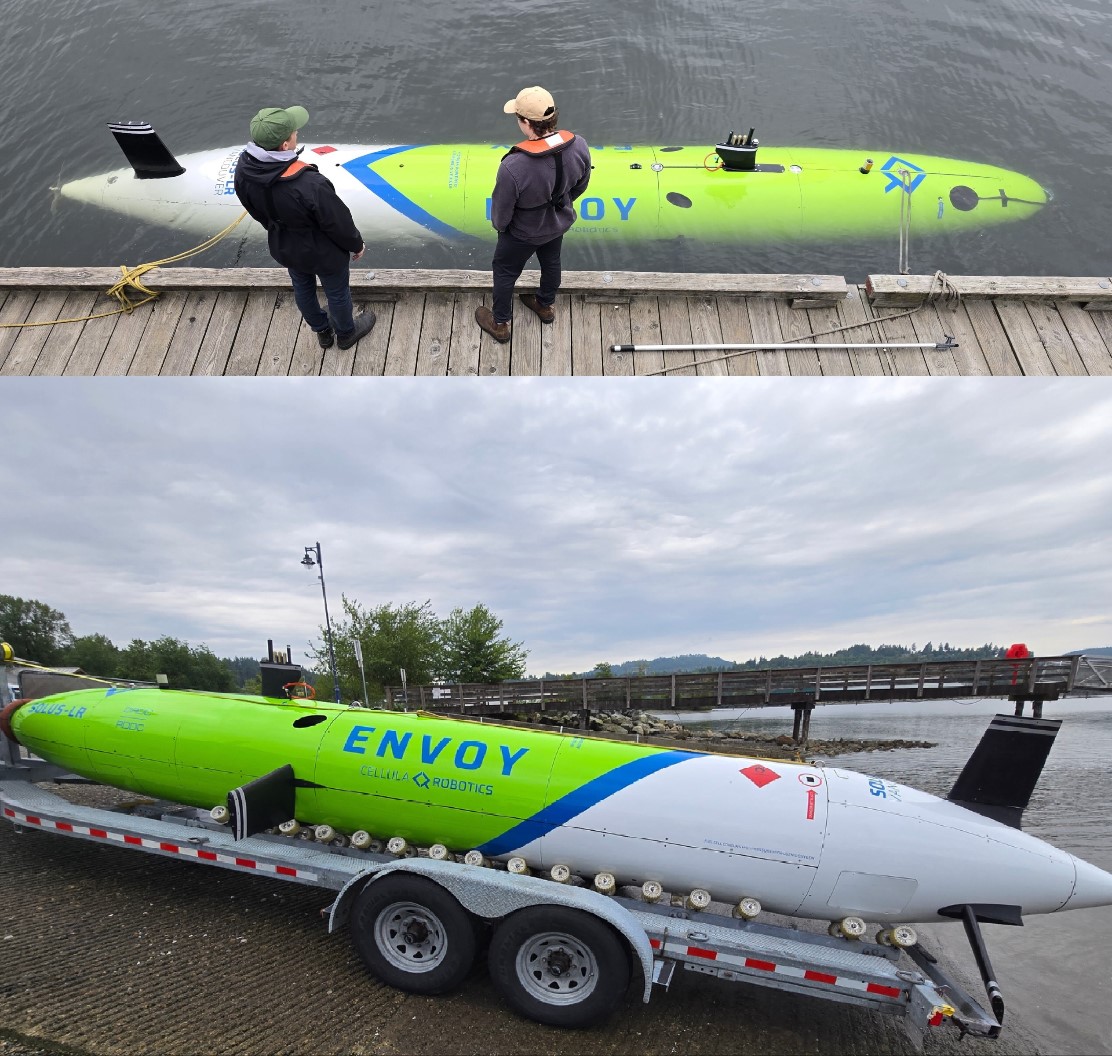
BURNABY, British Columbia, June 24, 2026 — Cellula Robotics has successfully completed a 2,023-kilometer fully submerged mission with its Envoy Autonomous Underwater Vehicle (AUV), marking a significant advancement in long-endurance underwater operations. Powered by a proton exchange membrane (PEM) hydrogen fuel cell system, the vehicle remained underwater for 385 continuous hours while performing a demanding operational profile designed to simulate real-world subsea missions.
The achievement demonstrates the ability of hydrogen fuel cell technology to overcome long-standing limitations faced by battery-powered autonomous underwater vehicles. By combining extended endurance, deep-water capability, and a low acoustic signature, the Envoy completed a mission profile that has remained difficult to achieve with conventional lithium-ion battery systems.
Unlike traditional endurance demonstrations that rely on straight-line transit routes, the Envoy's mission involved a complex operational pattern featuring more than 4,000 turns and maneuvers. Frequent course changes significantly increase power consumption compared to steady travel, making the test a more realistic representation of actual subsea operations. Despite these demanding conditions, the vehicle exceeded its published performance specifications while remaining fully submerged throughout the mission.
The Envoy AUV is owned by Defence Research and Development Canada (DRDC/RDDC), which has worked with Cellula Robotics over several years to advance long-endurance autonomous underwater technologies. The successful demonstration highlights the progress achieved through this collaboration and validates the operational potential of hydrogen-powered underwater systems.
Measuring approximately 8.5 meters in length and about 1 meter in diameter, the Envoy has a displacement of around 3,700 kilograms. The platform is designed to operate at depths of up to 3,000 meters, with some references indicating potential capability for deeper operations. The vehicle uses a 1.2-kilowatt PEM hydrogen fuel cell system developed in partnership with Infinity Fuel Cell and Hydrogen, Inc.
For more than a decade, AUV designers have faced a trade-off between endurance, depth capability, and vehicle size. Increasing battery capacity generally adds weight and drag, reducing efficiency and limiting overall performance. Likewise, strengthening a vehicle for deeper dives requires heavier pressure-resistant structures that further consume the available energy budget.
The Envoy addresses these challenges through hydrogen fuel cell technology, which provides more than twice the energy density of conventional lithium-ion batteries. This allows the platform to undertake extended missions without frequent surfacing, recovery, or support from surface vessels. The fuel cell generates electricity through a reaction between hydrogen and oxygen, producing only water as a byproduct.
The system also offers operational advantages for defense and sensitive commercial missions. Because the electricity generation process occurs without combustion, the vehicle produces minimal acoustic emissions, reducing the likelihood of detection during underwater operations. The absence of exhaust emissions further enhances its suitability for covert or environmentally sensitive missions.
A key feature of the Envoy is its ability to remain stationary on the seabed using a suction anchor system. Rather than continuously expending energy to maintain position against ocean currents, the vehicle can attach itself to the ocean floor and conduct long-duration monitoring activities. This capability enables extended observation of undersea infrastructure such as pipelines, telecommunications cables, offshore energy installations, and strategic maritime locations.
Potential applications include pipeline inspection, underwater cable monitoring, ocean floor mapping, scientific research, environmental monitoring, and naval surveillance missions. The ability to remain on station for extended periods without support vessels could reduce operational costs while expanding mission flexibility for both defense and commercial operators.
The Envoy, previously known as Solus-LR, forms part of Cellula Robotics’ broader family of modular autonomous underwater vehicles. The company also develops larger platforms, including the Guardian and Porter AUVs, which are designed to provide even greater endurance and operational persistence for complex subsea missions.
The successful completion of the 2,023-kilometer mission in April 2026 represents an important milestone in the development of air-independent propulsion systems for autonomous underwater vehicles. As hydrogen fuel cell technology continues to mature, it is expected to support future underwater platforms capable of operating for weeks or even months with minimal logistical support.
The demonstration underscores the growing role of hydrogen-powered systems in maritime autonomy and highlights their potential to transform how governments, research organizations, and offshore industries monitor critical undersea infrastructure, conduct scientific surveys, and maintain awareness of activities beneath the ocean surface.
——— End of Article ———