CANNON AIR FORCE BASE, N.M. — May 19, 2026 : The U.S. Air Force Special Operations Command (AFSOC) has officially integrated the GBU-39B Small Diameter Bomb (SDB) weapon system onto MQ-9 Reaper aircraft assigned to the 27th Special Operations Wing (SOW), significantly expanding the drone’s long-range precision strike capabilities in support of special operations missions.
The capability reached operational status within the wing during the spring of 2026 as part of broader Air Commando modernization efforts aimed at improving survivability and precision engagement options in increasingly contested operational environments.
Precision Strike Capability for MQ-9 Fleet
Manufactured by Boeing, the GBU-39B is a 250-pound, low-yield, all-weather precision-guided glide bomb designed to strike targets while limiting collateral damage. The weapon uses a combined GPS and inertial navigation guidance system and deploys folding wings after release, allowing it to glide extended distances toward designated targets.
According to U.S. Air Force data, the munition carries approximately 36 pounds of high explosive and can penetrate up to one meter of steel-reinforced concrete. When released from sufficient altitude and speed, the GBU-39B can glide up to 60 miles and strike within one meter of its intended target.
The extended standoff range allows MQ-9 Reaper aircraft to engage targets while remaining outside the reach of many ground-based air defense systems, improving aircraft survivability during operations in contested airspace.
“In this shifting battlespace, adversaries layer lethal obstacles to deny us,” said U.S. Air Force Lt. Col. Joshua Swann, an MQ-9 squadron commander assigned to the 27th Special Operations Wing. “The GBU-39’s reach guarantees we can stay in a fight under hostile threats and continue to solve the joint force’s hard tactical problems.”
BRU-78 Dual Carriage System Expands Weapon Loadout
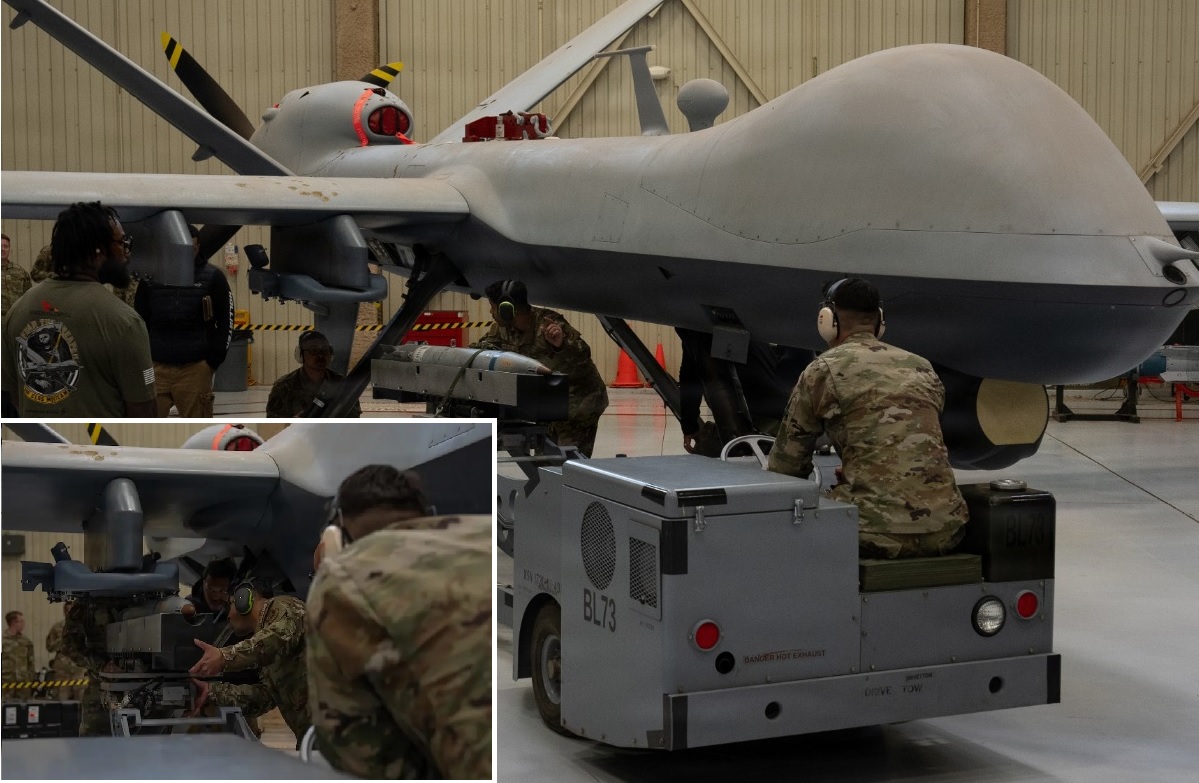
To field the GBU-39B effectively, the MQ-9 utilizes the BRU-78 Dual Carriage System developed by L3Harris specifically for the Reaper platform. The 88-pound carriage system integrates two BRU-71 pneumatic ejector units, enabling the drone to carry two GBU-39B munitions on a single hardpoint without requiring structural modifications to the aircraft.
Before the introduction of the BRU-78 system, each MQ-9 pylon was limited to carrying a single conventional munition. The upgraded configuration doubles the number of weapons available on a given station, allowing the aircraft to remain on station longer and prosecute multiple targets during a single sortie.
“When striking targets, our intent is to maximize effects and minimize collateral damage,” said an MQ-9 pilot assigned to the 27th Special Operations Wing. “Carrying a higher number of low-yield munitions allows us to stay on station longer and provide more effective support to our troops on the ground.”
GBU-39B Service History and Combat Use
The GBU-39B first entered U.S. Air Force service in 2006 and has since become one of the military’s widely used precision-guided standoff weapons. According to Air Force information, the United States and partner nations have employed more than 17,000 Small Diameter Bombs across operations ranging from counterterrorism missions to large-scale conventional warfare.
The weapon has previously been integrated onto multiple combat aircraft, including the F-15E Strike Eagle, F-16 Fighting Falcon, F-22 Raptor, F-35 Lightning II, B-1B Lancer, and B-2 Spirit bomber fleets.
Within the 27th Special Operations Wing, the GBU-39B is also carried by AC-130 Ghostrider II gunships, which can carry up to eight of the munitions on wing-mounted stations.
“The GBU-39 is one of our most versatile munitions,” said U.S. Air Force Lt. Col. Clifford Lucas, an AC-130 squadron commander assigned to the 27th Special Operations Wing. “By putting this level of adaptable firepower under our wings, we ensure our warfighters always have the exact tool needed to eliminate the threat.”
Broader Modernization Effort
The MQ-9 Reaper, manufactured by General Atomics Aeronautical Systems, has served as a primary intelligence, surveillance, reconnaissance, and strike platform for the U.S. military for nearly two decades. Valued at approximately $34 million per aircraft depending on configuration, the platform has been extensively employed in both counterterrorism and conventional military operations.
Air Force officials stated that integrating long-range glide munitions onto the MQ-9 forms part of a broader effort to adapt legacy platforms to evolving operational requirements and increasingly sophisticated threats.
Previous testing involving GBU-39B integration and BRU-78 dual carriage configurations was conducted during 2025 at multiple Air Force facilities before the capability entered operational service with the 27th Special Operations Wing.
“This capability gives our crews greater flexibility to deliver precision effects while supporting the Joint Force across the spectrum of conflict,” said U.S. Air Force Col. Robert Johnston, commander of the 27th Special Operations Wing. “Our Air Commandos remain focused on providing relevant, ready and lethal options for today’s fight and while preparing for tomorrow’s challenges.”
The 27th Special Operations Wing, based at Cannon Air Force Base, New Mexico, operates MQ-9 Reaper aircraft in support of global special operations missions, including intelligence gathering, armed overwatch, and precision strike operations.
——— End of Article ———