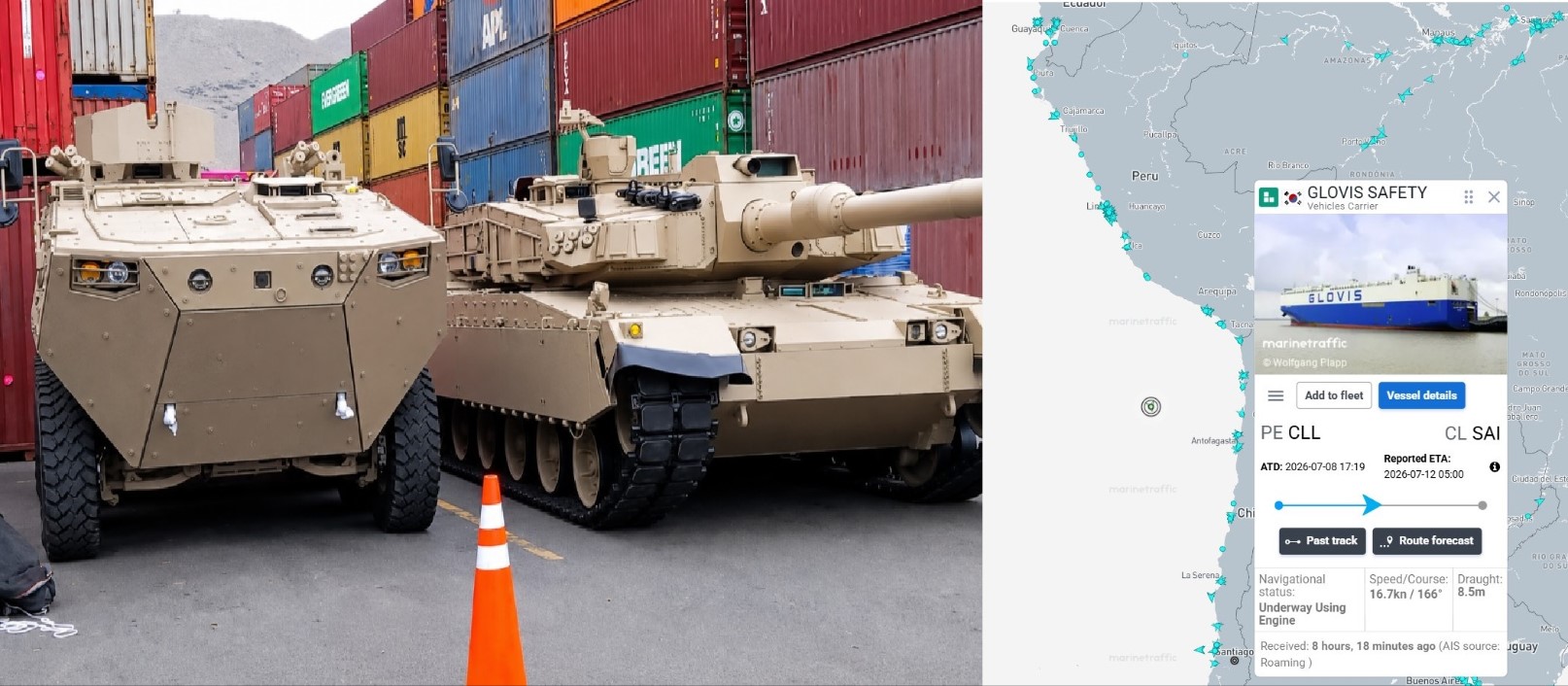
LIMA, Peru — The first batch of South Korean K2 Black Panther main battle tanks and K808 8×8 armored personnel carriers has arrived in Peru, marking a significant step in the country's armored force modernization program.
The shipment reached the Port of Callao this week aboard the South Korean vehicle carrier GLOVIS SAFETY, according to vessel-tracking data and images shared by defense observers. The cargo includes at least two K2 Black Panther main battle tanks and six K808 armored personnel carriers (APCs).
The delivery comes before the signing of the final implementation contract between Peru and South Korea and is intended to support testing and evaluation of the vehicles under local operating conditions.
Early Delivery Ahead of Final Contract
The arrival follows a strategic framework agreement signed on December 9, 2025, between South Korean defense manufacturer Hyundai Rotem and Peru's state-owned defense company FAME S.A.C.
The agreement, valued at more than $1.4 billion, outlines Peru's planned acquisition of 54 K2 Black Panther tanks and 141 K808 armored personnel carriers, making it South Korea's largest land defense export to Latin America.
While the framework agreement defines the scope of the program, the final implementation contract—which will establish delivery schedules, pricing, and legal terms—remains under negotiation. Reports previously indicated that the agreement was expected to be finalized between June and July 2026.
Sending a limited number of vehicles before the full contract is a common practice in international defense procurement. It allows the customer to conduct operational trials before proceeding with larger deliveries.
Testing in Peru's Operational Environment
The newly delivered vehicles will undergo a series of field evaluations by the Peruvian Army. Planned testing includes cold-start trials, crew training, maintenance assessments, and high-altitude mobility tests in the Andes Mountains.
The evaluations are intended to determine how the vehicles perform in Peru's diverse terrain and climate while allowing military personnel to gain experience operating and maintaining the platforms.
The K2 Black Panther is expected to replace Peru's aging fleet of Soviet-era T-54 and T-55 tanks, which have been in service since the 1970s.
K2 Black Panther Capabilities
Developed by South Korea's Agency for Defense Development and manufactured by Hyundai Rotem, the K2 Black Panther is powered by a 1,500-horsepower diesel engine.
The tank is equipped with an advanced hydropneumatic suspension system that allows the hull height to be adjusted to suit different terrain conditions. It can reach road speeds of up to 70 km/h.
Its primary armament is a 120 mm smoothbore gun fitted with a domestically developed automatic loader, enabling the tank to maintain a high rate of fire while moving over uneven terrain and reducing crew workload during combat operations.
The combination of high mobility and adjustable suspension is designed to support operations in challenging environments, including mountainous regions such as those found in Peru.
K808 Armored Personnel Carriers
Alongside the tanks, Peru received six K808 8×8 armored personnel carriers, which are designed for infantry transport and battlefield mobility.
The standard K808 can travel at speeds of up to 100 km/h on roads and approximately 8 km/h in water during amphibious operations.
Images of the newly arrived vehicles indicate possible design changes compared with standard K808s used by the South Korean Army. Defense observers have referred to the vehicles as a possible K808-PE configuration, citing differences in the front hull design and turret arrangement.
The modifications may have been made to meet the Peruvian Army's operational requirements, climate, and equipment standards. However, Hyundai Rotem and the Peruvian Army have not officially confirmed the specifications or designation of the vehicles.
Technology Transfer and Local Production
A key element of the Peru-South Korea defense partnership is technology transfer and local industrial participation.
Under the broader program, South Korean partners plan to invest approximately $270 million to establish a specialized armored vehicle assembly facility in Peru.
According to the planned production schedule, fully assembled vehicles will be imported for training and operational use between 2026 and 2028. Beginning in 2029, production is expected to transition to licensed assembly in Peru.
The long-term objective is to achieve 30 percent local content in the manufacturing process, strengthening Peru's domestic defense industry while supporting maintenance and future production capabilities.
Part of Peru's Armored Modernization
Peru has relied on older armored platforms, including the T-54, T-55, and M113 armored personnel carriers, for decades. The introduction of the K2 and K808 is intended to improve the army's mobility, protection, and operational capability.
The current shipment provides Peru with the opportunity to evaluate the South Korean platforms under local conditions before the full acquisition program moves forward.
As of now, neither the Peruvian government nor Hyundai Rotem has announced the signing date for the final implementation contract or confirmed the timeline for future deliveries. However, the arrival of the first K2 tanks and K808 armored vehicles represents an important milestone in the defense partnership between Peru and South Korea.
Source: X
——— End of Article ———