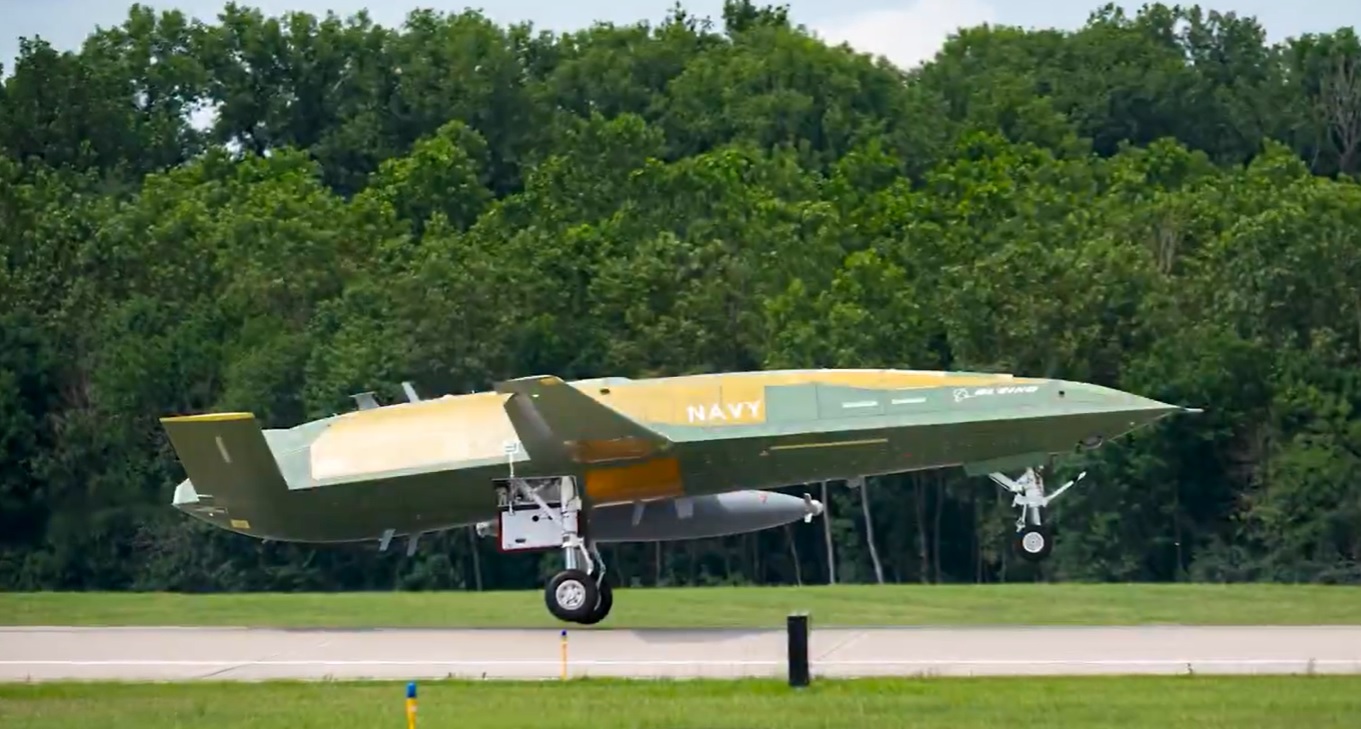
ST. LOUIS, Missouri — The U.S. Navy's first production Boeing MQ-25A Stingray uncrewed aerial refueling aircraft has successfully completed its second test flight, marking another milestone in the development of the Navy's first operational carrier-based unmanned aircraft.
The flight, conducted on July 10, included the aircraft's first airborne landing gear cycles, during which the landing gear was extended and retracted while in flight. According to Boeing, the test confirmed the performance of the aircraft's autonomous flight control system and provided additional data needed as the MQ-25A moves closer to future carrier operations.
The test was carried out from the Unmanned Carrier Aviation Mission Control System (MD-5) ground control station at MidAmerica St. Louis Airport in Mascoutah, Illinois. During the mission, Navy air vehicle pilots issued flight commands from the ground station while the MQ-25A autonomously managed its propulsion, onboard systems, navigation, guidance, and flight controls throughout the planned mission.
Before the flight, Boeing and U.S. Navy teams installed a new software package that upgraded the aircraft's vehicle management system and mission computers. During the mission, Boeing engineers and Navy pilots monitored the aircraft's performance and collected data from the landing gear tests. Boeing said the successful airborne landing gear cycles helped verify the interoperability between the aircraft's mechanical systems and its autonomous flight control software.
The MQ-25A Stingray is designed primarily to provide uncrewed aerial refueling for carrier-based aircraft. By taking over the aerial tanker mission, the aircraft will extend the operational range of the carrier air wing while allowing manned fighter aircraft, including the F/A-18 Super Hornet, to return to their primary combat missions instead of performing refueling duties.
The production MQ-25A builds on experience gained from the earlier MQ-25 T1 test aircraft. During previous flight testing, the T1 demonstrator successfully refueled three different carrier-based aircraft using the Navy's hose-and-drogue system: the F/A-18 Super Hornet, E-2D Hawkeye, and F-35C Lightning II. Those demonstrations validated the aircraft's ability to safely refuel multiple types of naval aircraft in flight.
Powered by a Rolls-Royce AE 3007N turbofan engine, the MQ-25A is designed to deliver up to 15,000 pounds of fuel at a distance of 500 nautical miles from the carrier. In addition to aerial refueling, the aircraft is designed to autonomously perform carrier deck operations, including taxiing, takeoff, and landing, while operating alongside manned aircraft in the demanding carrier environment.
The MQ-25A program has continued to progress through a series of developmental milestones. The first production aircraft completed its initial taxi test in January 2026, followed by its first flight in April 2026. The latest second flight further expands the flight-test program by validating additional aircraft systems and software.
Known as the Carrier-Based Aerial Refueling System (CBARS) program, the MQ-25A was developed to provide dedicated aerial refueling support for carrier air wings while introducing autonomous aircraft into routine carrier operations. The U.S. Navy is continuing flight testing with Boeing as it works toward achieving the aircraft's planned initial operational capability around February 2029.
The successful completion of the second test flight adds new flight data that will support further testing and certification as the MQ-25A progresses toward operational service aboard U.S. Navy aircraft carriers.
Source: Boeing
——— End of Article ———