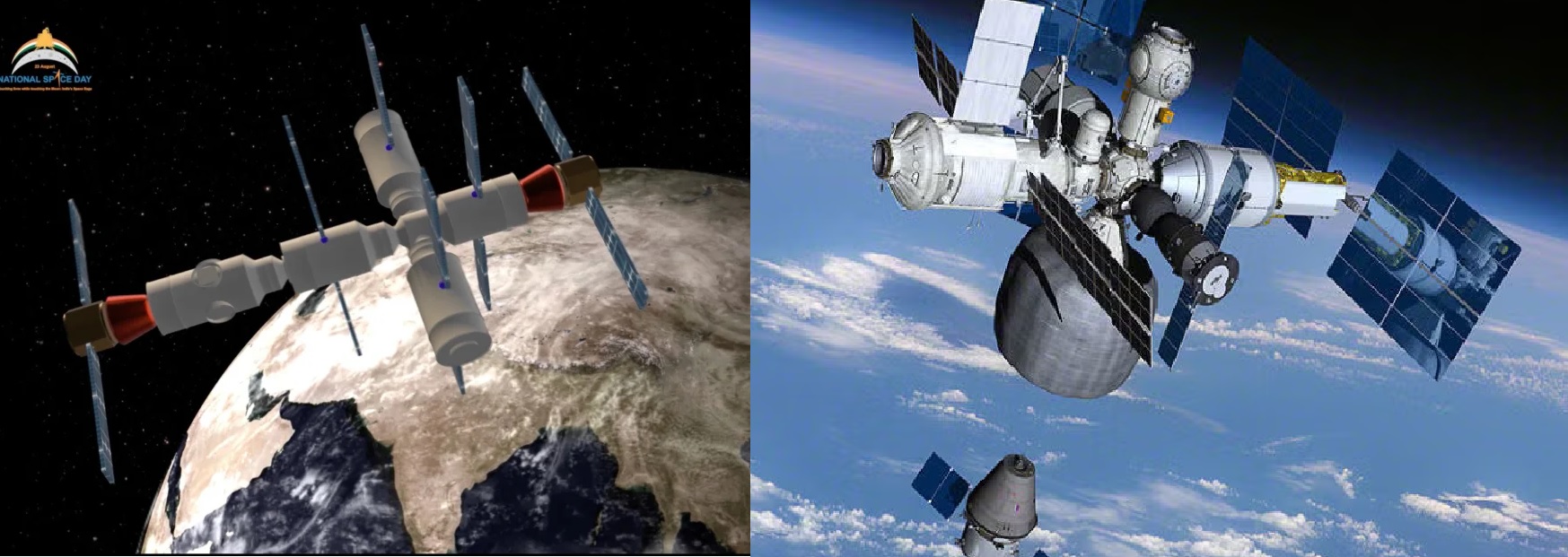
Russia and India Plan Matching Orbits for Their Post-ISS Space Stations
Russia and India are preparing to keep human spaceflight in low Earth orbit on a familiar path after the retirement of the International Space Station (ISS), agreeing in principle to place their future space stations in the same 51.6° orbital inclination once the ISS is decommissioned.
According to social-media reports from space analysts who tracked the visit, Roscosmos chief Dmitry Bakanov told journalists in New Delhi that the planned Russian Orbital Station (ROS) and India’s Bharatiya Antariksh Station (BAS) will share that inclination, mirroring the ISS orbit and enabling close operational cooperation between the two outposts.
A Shared Lane in the Sky After the ISS
The ISS currently circles Earth at an inclination of 51.6°, a compromise chosen so Russian Soyuz and Progress vehicles could reach it from Baikonur while still giving broad coverage of the populated world. NASA and its partners have committed to operating the ISS through 2030, after which a dedicated deorbit vehicle will guide the station into the Pacific, ending more than three decades of continuous operations.
By choosing the same orbital geometry for ROS and BAS, Moscow and New Delhi are effectively planning a continuous “replacement belt” in low Earth orbit. After the ISS is retired, crewed spacecraft launched from Russia and India would still be able to reach a major laboratory complex without radically changing launch trajectories or infrastructure, and—crucially—could, in principle, travel between the two stations with relatively modest maneuvers compared with a full plane-change.
Bakanov’s New Delhi comments build on a broader Roscosmos–ISRO understanding that the two stations should be able to support cross-visits, resource sharing and coordinated operations once both are flying.
Bharatiya Antariksh Station: India’s 52-Ton Orbital Laboratory
India’s planned Bharatiya Antariksh Station (BAS) is now in an advanced design phase at the Indian Space Research Organisation (ISRO). Government documents and recent briefings outline a modular outpost of about 52 tonnes, operating at 400–450 km altitude and an inclination of about 51.5–51.6°, with a nominal crew of 3–4 astronauts and short-duration capacity for up to six.
Key milestones have recently been firmed up at cabinet level. In September 2024, India’s Union Cabinet approved the development and launch of the first station module, BAS-01, with a target launch around 2028. That base module—unveiled as a full-scale mock-up during National Space Day 2025 in New Delhi—will test India’s indigenous life-support systems, docking and berthing mechanisms, and power systems in orbit before additional science and laboratory modules are added through the 2030s.
ISRO’s current roadmap foresees:
-
Launch of BAS-01 in 2028
-
Progressive addition of core, science, lab and common-berthing modules using LVM3 and upgraded launchers
-
Full operational capability by around 2035, assuming Gaganyaan crewed flights ramp up as planned and associated technologies—robotic arms, docking systems, and long-duration life support—are validated in earlier missions.
By keeping BAS near the ISS-style orbit, India gains the same advantages that made 51.6° attractive to NASA and Roscosmos: overflights of roughly 90–95% of inhabited Earth, broad ground-station visibility, and compatibility with a wide range of launch sites and visiting vehicles.
Russian Orbital Station: From Polar Orbit to an ISS-Like Track
Russia’s Russian Orbital Service/Orbital Station (ROS/ROSS) has been under development as Moscow’s post-ISS foothold in low Earth orbit. Official plans call for the first science-power module (NEM-1) to launch around 2027 atop an Angara-A5M rocket from the Vostochny Cosmodrome, with three more core modules forming a complete station by about 2030, and additional “special-purpose” segments arriving by 2033.
Until recently, public design documents and statements described ROS in a near-polar, sun-synchronous orbit around 97–98° inclination, optimized for sweeping coverage of the entire Earth and particularly the Arctic. However, Russian officials have now indicated that the station’s orbit is being reconsidered. According to an Interfax report circulated in Russian and international space forums, First Deputy Prime Minister Denis Manturov said a decision had been taken to change ROS’s planned orbit from a near-polar track to 51.6°, aligning it with the ISS and, by extension, India’s BAS.
Bakanov’s New Delhi remarks appear to confirm that shift, explicitly tying the new inclination to joint operations with India. In practice, such a configuration would still allow Russia to conduct Earth-observation and technology-demonstration missions, but with the added benefit of easy access from traditional launch corridors and the ability to host foreign crews and spacecraft on a familiar orbital plane.
Why 51.6° Matters for Cooperation
For both countries, matching orbits is about more than convenience. A shared inclination at roughly ISS parameters offers several strategic and technical advantages:
-
Inter-station logistics and cross-visits: Visiting vehicles launched from India or Russia could, after servicing one station, be retasked to the other with relatively minor adjustments in altitude and phasing, rather than performing fuel-intensive plane changes. That opens the door to joint resupply, contingency support and “hopping” crews between ROS and BAS.
-
Common visiting vehicles: If future commercial crew or cargo systems are certified for 51.6° operations—following the template of Crew Dragon, Cygnus and other ISS vehicles—it becomes easier to negotiate multi-destination missions serving both outposts, especially as commercial LEO services mature.
-
Rescue and redundancy: In the event of an emergency on one station, the other could, in principle, serve as a safe haven, provided compatible docking systems and life-support margins are built into the design. That kind of redundancy was never possible with China’s Tiangong, which flies in a different orbital plane.
-
Shared science campaigns: Coordinated experiments—such as long-baseline Earth observations, simultaneous microgravity studies on different crews, or cross-calibration of instruments—become far easier when both platforms experience similar lighting cycles, altitudes and ground-track patterns.
Spaceflight experts note that while ISS-style orbits don’t offer the complete polar coverage once envisioned for ROS, they strike a practical balance between scientific utility, crew access and international cooperation, especially for countries investing heavily in crewed systems for the first time.
Deepening Russia–India Space Ties
The orbital decision comes as Moscow and New Delhi are already expanding cooperation in other space domains. Russian and Indian officials have discussed joint engine projects, possible technology transfers and continued Soyuz-based training for Indian astronauts, even as India pushes ahead with its own Gaganyaan crew vehicle and LVM3-class rockets.
For India, having its first national space station in the same orbital family as both the ISS and ROS is also a diplomatic signal: BAS is conceived not as an isolated outpost, but as a platform that can plug into a wider ecosystem of partners, including Russia and potentially the United States, Europe and Japan, whose launchers and spacecraft are already optimized for 51.6°.
For Russia, which has faced sanctions, budget pressure and technical setbacks—including the recent damage to its main crew launch pad at Baikonur—the prospect of a reliable partner in human spaceflight offers both political and practical benefits as it transitions from the ISS to its own station.
An Emerging Dual-Station Era
The agreement to synchronize the orbits of ROS and BAS is still in its early public stages; formal inter-governmental documents spelling out docking standards, rescue protocols or shared experiments have not yet been released. But Bakanov’s statement in New Delhi, combined with recent Russian decisions on ROS’s orbit and India’s accelerating BAS timeline, point toward a dual-station era in which Russian and Indian crews could routinely work within sight—and reach—of each other in low Earth orbit.
If those plans hold, the familiar 51.6° path of the ISS may remain one of the busiest lanes in space long after the original station has made its final plunge into the Pacific.
——— End of Article ———