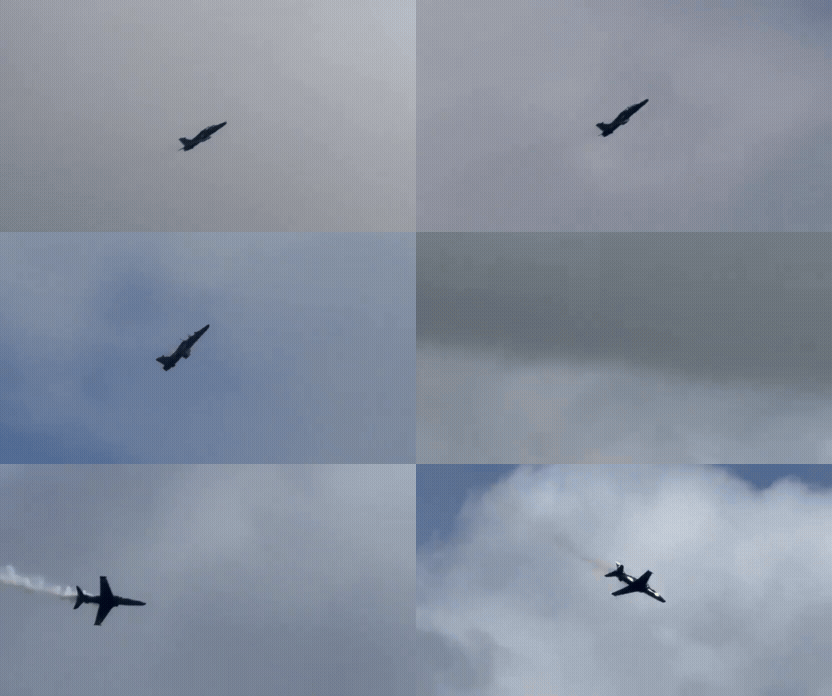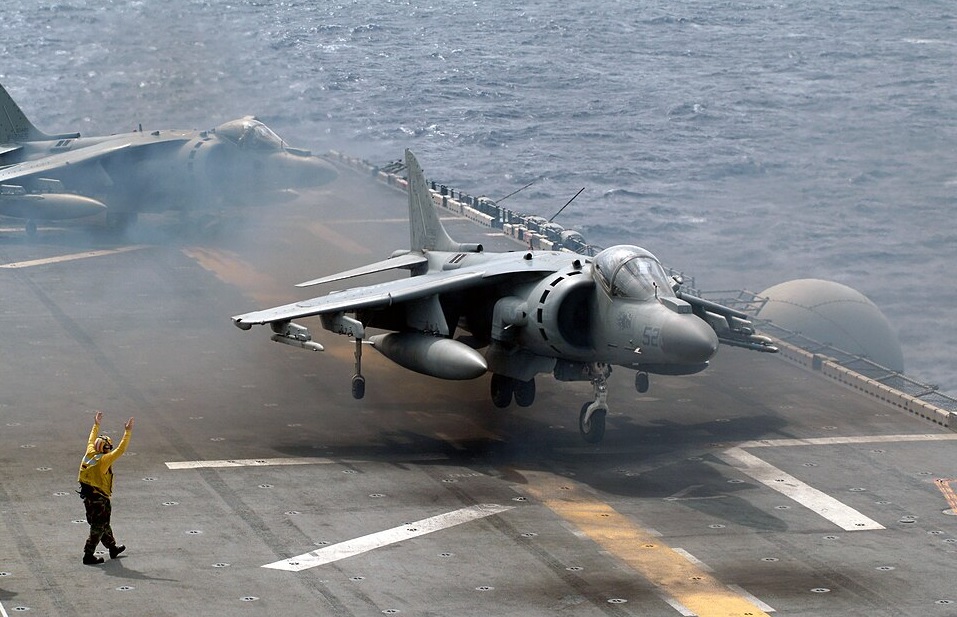
CHERRY POINT, North Carolina — June 07, 2026: The U.S. Marine Corps has officially retired the AV-8B Harrier II, bringing to a close more than five decades of Harrier operations during a formal sundown ceremony held on June 3, 2026, at Marine Corps Air Station (MCAS) Cherry Point. The event marked the end of one of the most distinctive aircraft programs in Marine Corps aviation history and completed the service’s transition to a fifth-generation tactical aircraft fleet centered on the F-35B Lightning II.
Final Operational Flight by VMA-223
The ceremony coincided with the return of a Harrier detachment from Marine Attack Squadron 223 (VMA-223), known as the “Bulldogs,” following a forward deployment with the 22nd Marine Expeditionary Unit (MEU) aboard the amphibious assault ship USS Iwo Jima. During the deployment, the aircraft supported missions in the Caribbean and the U.S. Southern Command area of responsibility.
As part of the retirement event, five AV-8B Harrier II aircraft conducted a final formation flyover before returning to Cherry Point. After landing, the aircraft shut down their engines for the last time in Marine Corps service, officially ending operational Harrier flights within the force.
With the retirement of the aircraft, VMA-223 is entering a period of deactivation and transition. The squadron is scheduled to be redesignated as Marine Fighter Attack Squadron (VMFA)-223 and is expected to return to active service in fiscal year 2028 equipped with the Lockheed Martin F-35B Lightning II.
More Than Five Decades of STOVL Operations
The Marine Corps first introduced the AV-8A Harrier in 1971, establishing a unique Short Takeoff and Vertical Landing (STOVL) capability that allowed fixed-wing combat aircraft to operate from expeditionary airfields, austere locations, and amphibious assault ships without the need for conventional runways.
The first-generation AV-8A remained in service until the 1980s before being replaced by the more capable AV-8B Harrier II, which entered operational service in 1985.
The second-generation aircraft introduced significant improvements in payload capacity, range, survivability, and avionics. Over the following decades, the platform underwent continuous modernization, including the introduction of the Night Attack Harrier and the radar-equipped AV-8B Harrier II Plus, enhancing its effectiveness in both day and night operations.
Combat Service Across Multiple Theaters
Throughout its operational career, the AV-8B Harrier II participated in numerous military campaigns and contingency operations worldwide.
The aircraft saw combat service during the Gulf War (Operation Desert Storm) and later supported operations in the Balkans, Afghanistan, Iraq, and Libya. It also conducted a variety of missions across the Middle East and Caribbean regions.
The aircraft became a key element of Marine Corps expeditionary warfare due to its ability to operate close to frontline forces from temporary bases and amphibious ships, providing responsive air support in environments where traditional fighter aircraft could face operational limitations.
Transition to the F-35B Fleet
The retirement of the AV-8B Harrier II is part of the Marine Corps’ broader Tactical Aircraft Transition Plan, which consolidates tactical aviation capabilities around the F-35B Lightning II.
Like the Harrier, the F-35B retains STOVL capabilities, allowing operations from amphibious assault ships and expeditionary locations. However, it also introduces stealth technology, advanced sensor fusion, networked targeting systems, and significantly enhanced situational awareness.
Most Marine Corps Harrier squadrons had already converted to the F-35B in previous years, making VMA-223 the final operational unit to complete the transition. With the Harrier’s retirement, the Marine Corps now operates an all-fifth-generation tactical aircraft fleet.
Retirement Events at Cherry Point
Activities surrounding the Harrier’s retirement were conducted from June 1 to June 4, 2026, and included an open house, static aircraft displays, simulator tours, and commemorative events attended by active-duty personnel, veterans, former Harrier pilots, and family members.
The June 3 ceremony served as both a farewell to the aircraft and a recognition of the generations of pilots, maintainers, and support personnel who operated the platform throughout its service life.
Harrier Continues Service Overseas
Following its withdrawal from U.S. Marine Corps service, the AV-8B Harrier II remains operational only with the naval aviation forces of Italy and Spain.
Italy is currently replacing its Harrier fleet with the F-35B Lightning II as part of its carrier aviation modernization program. Spain has not yet announced a final replacement decision for its carrier-based Harrier force, although defense analysts widely expect Madrid to select the F-35B to maintain its fixed-wing naval aviation capability.
End of an Era in Marine Aviation
The retirement of the AV-8B Harrier II concludes a significant chapter in U.S. Marine Corps aviation history. For more than 50 years, Harrier aircraft provided expeditionary air support from locations where conventional fighter aircraft could not operate, establishing a unique operational capability that will now continue through the F-35B Lightning II as the Marine Corps advances its next generation of tactical aviation.
——— End of Article ———