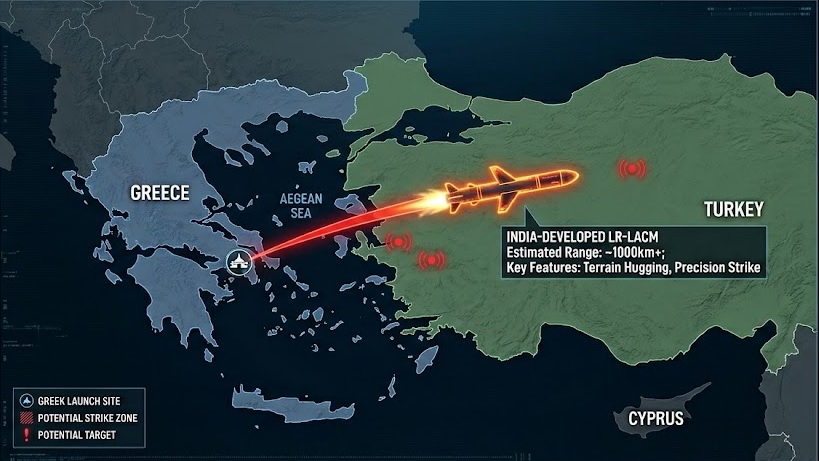
ISTANBUL/ATHENS, — June 07, 2026 : Turkish media outlets and defense commentators have expressed concern over reports suggesting that Greece is exploring the possible acquisition of India’s Long-Range Land Attack Cruise Missile (LR-LACM), a development that analysts in Ankara believe could affect the strategic balance in the Aegean and Eastern Mediterranean.
While neither India nor Greece has officially confirmed any negotiations, reports published by Turkish media, including TR Haber, claim that discussions and defense contacts between Athens and New Delhi have intensified over the past year. According to these reports, Greece is examining options to strengthen its long-range strike capabilities as part of its ongoing military modernization efforts.
The prospect of India becoming a supplier of advanced missile systems to Greece has generated significant attention in Turkish defense circles, where commentators view the reported interest as a potential challenge to Turkey’s growing military capabilities and expanding domestic defense industry.
Concerns Over Strategic Reach
A key focus of Turkish commentary has been the LR-LACM’s operational range of between 1,000 and 1,500 kilometers.
Defense analysts cited by Turkish media argue that such a capability would enable Greece to hold a large portion of Turkey’s strategic infrastructure at risk, including air bases, radar sites, command centers, logistics facilities, and other military installations located well beyond the immediate Aegean region.
According to these assessments, the deployment of a long-range precision-strike missile would significantly expand Greece’s ability to conduct deep-strike operations and project military power beyond its traditional area of operations.
Turkish commentators have also linked the reported Greek interest to efforts aimed at balancing Turkey’s rapidly advancing missile programs and indigenous defense production capabilities, which have expanded considerably in recent years.
Growing India-Greece Defense Partnership
The reports come amid steadily strengthening defense and strategic relations between India and Greece.
Military cooperation between the two countries has increased through high-level visits, defense dialogues, military exchanges, and maritime security discussions. Both nations have also emphasized cooperation in areas related to regional stability and the security of international sea lanes.
Last month, Indian Air Force Chief Air Chief Marshal A.P. Singh visited Athens and held talks with his Greek counterpart, Lieutenant General Dimosthenis Grigoriadis. The visit was viewed as another step in expanding defense engagement between the two countries.
India also presented the LR-LACM to international audiences during the DEFEA-25 defense exhibition in Athens. Turkish media reports noted that the missile attracted attention from Greek military officials attending the event, further fueling speculation regarding possible future defense cooperation.
Turkish analysts have additionally pointed to Prime Minister Narendra Modi’s visits to Greece in 2023 and Cyprus in 2025 as evidence of India’s growing strategic interest in the Mediterranean region.
Some commentators have suggested that closer India-Greece relations have also been influenced by Turkey’s longstanding political and defense ties with Pakistan, although no official connection has been made by either government.
What is the LR-LACM?
The Long-Range Land Attack Cruise Missile (LR-LACM) is an advanced indigenous cruise missile being developed by India’s Defence Research and Development Organisation (DRDO).
Derived from technologies developed under India’s Nirbhay and Indigenous Technology Cruise Missile (ITCM) programs, the LR-LACM represents a major advancement in the country’s long-range precision-strike capabilities.
According to publicly available information, the missile incorporates several advanced features designed to improve survivability, accuracy, and operational flexibility.
Key Features
-
Extended Range: The missile is designed to engage targets at distances ranging from 1,000 to 1,500 kilometers.
-
Indigenous Propulsion: It is powered by the domestically developed Manik turbofan engine, reducing dependence on foreign propulsion systems.
-
Terrain-Hugging Flight Profile: The missile can fly at very low altitudes, helping it avoid radar detection and penetrate enemy air-defense networks.
-
Precision Navigation: Advanced guidance systems enable accurate engagement of strategic and high-value targets.
-
Dual-Warhead Capability: The system is capable of carrying both conventional and unconventional payloads depending on operational requirements.
The LR-LACM forms part of India’s broader effort to expand indigenous defense production and establish itself as a major exporter of advanced military technologies.
No Official Confirmation
Despite the growing speculation, neither the Greek Ministry of National Defence nor India’s Ministry of Defence has announced any negotiations or agreements related to the sale of the LR-LACM.
At present, reports regarding a possible acquisition remain based on media assessments and defense-sector speculation rather than official government statements.
Nevertheless, expanding defense cooperation between India and Greece continues to attract attention across the region. Joint naval activities, military exchanges, diplomatic engagement, and maritime security discussions have contributed to closer strategic ties between the two countries.
For Turkey, the reaction in defense circles highlights the close scrutiny being given to Greece’s modernization efforts and to India’s increasing presence in the global defense market. While no missile deal has been confirmed, the discussion surrounding the LR-LACM reflects broader regional concerns about long-range strike capabilities and the evolving security environment in the Eastern Mediterranean.
——— End of Article ———