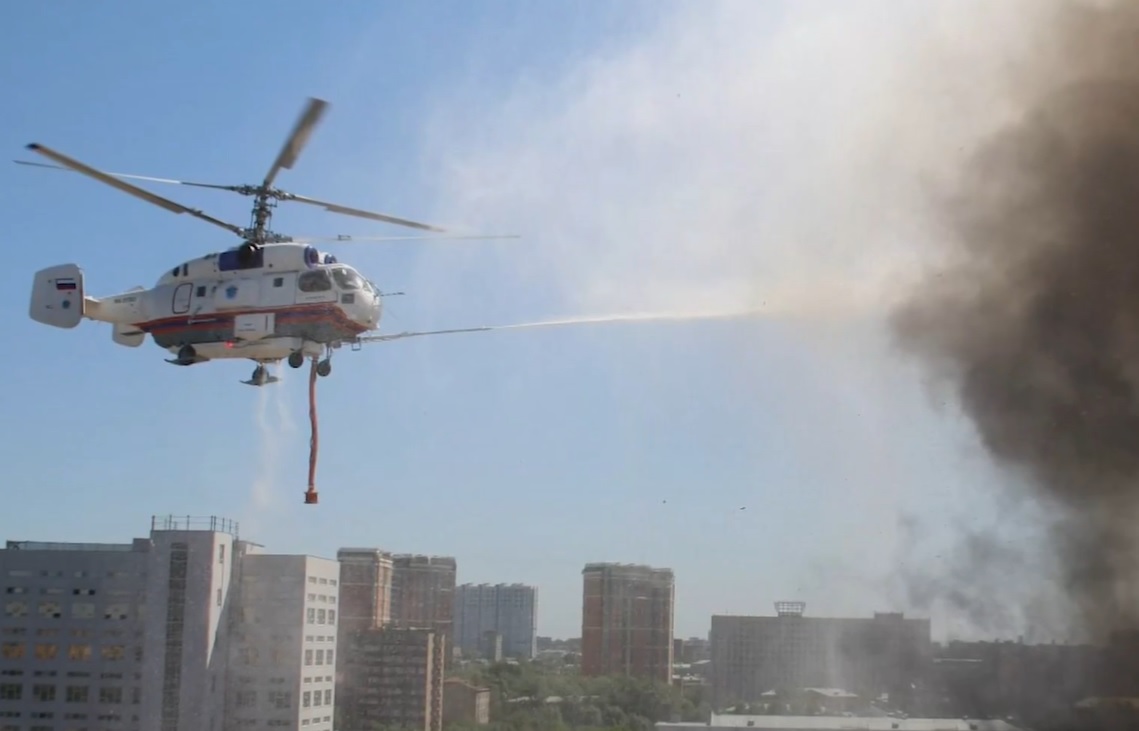
MOSCOW, — May 19, 2026 : Russian state corporation Rostec, through its subsidiary Russian Helicopters, has officially presented the upgraded Ka-32A11M firefighting helicopter, a modernized version of the Ka-32 platform designed for operations in low-temperature environments. The aircraft was displayed during international aerospace exhibitions, including the Russia-China Expo, the China Helicopter Exposition, and IDEX.
The Ka-32A11M is an upgraded variant of the Ka-32 family, which has been used for firefighting, search-and-rescue, cargo transport, and utility missions for several decades. More than 190 helicopters from the Ka-32 series are currently in service across over 20 countries, including Russia, China, Canada, Spain, Switzerland, South Korea, and Indonesia.
New SP-32 Firefighting System
The central upgrade of the Ka-32A11M is the integration of the new SP-32 fire-extinguishing system. The system includes a four-compartment water tank capable of carrying up to 4,000 liters of water and 400 liters of foam agent. According to Russian Helicopters, the helicopter can automatically refill the full water load within approximately 60 seconds.
The SP-32 system incorporates electrically heated components, including the water tank, pipes, water cannon, and water bucket-flap mechanisms. These heating elements are designed to prevent freezing during winter operations and allow the helicopter to conduct firefighting missions in temperatures as low as -20 degrees Celsius.
The helicopter is also equipped with a horizontal water cannon that can operate while hovering. This capability enables crews to direct water streams toward upper floors of high-rise buildings and industrial facilities, including oil and gas infrastructure, while avoiding dense smoke conditions that can complicate vertical water drops.
Avionics and Engine Upgrades
The Ka-32A11M modernization program includes the replacement of previously imported systems with domestically produced components. The helicopter now features a digital “glass cockpit” equipped with multifunction color LCD displays and an upgraded flight and navigation suite intended to reduce pilot workload.
The avionics package is fully compatible with night-vision goggles (NVG), expanding the helicopter’s operational capability during nighttime and low-visibility missions.
The aircraft is powered by VK-2500PS-02 engines managed by the BARK automatic digital control system. Russian Helicopters stated that the upgraded engines improve flight performance in hot and mountainous environments while increasing payload capability by approximately 1,600 kilograms under demanding operating conditions.
Coaxial Rotor Configuration
The Ka-32A11M retains the coaxial twin-rotor configuration developed by the Kamov Design Bureau. The absence of a tail rotor allows the helicopter to maintain a compact airframe while improving maneuverability and hovering stability in confined urban areas and mountainous terrain.
According to the manufacturer, the rotor configuration enables the aircraft to maintain stable positioning near fire zones despite strong updrafts and turbulence, making it suitable for firefighting operations between high-rise buildings and in dense urban environments.
International Display and Market Presence
The Ka-32A11M was presented as part of Rostec’s broader helicopter lineup at the Russia-China Expo alongside other Russian platforms, including the Mi-8/171 series and the Ansat medical evacuation helicopter.
Russian Helicopters stated that more than 450 Russian-made helicopters are currently operating in China. Company representatives also noted continued international interest in the Ka-32 platform for specialized aerial firefighting missions.
Development Background
The modernization program for the Ka-32A11M began several years ago, with initial flight testing of the upgraded prototype conducted in 2021. The program includes certification activities, avionics modernization, propulsion upgrades, and the integration of the new SP-32 firefighting system.
Russian Helicopters did not disclose production schedules, export agreements, or delivery timelines for the upgraded helicopter during the exhibition presentations.
——— End of Article ———