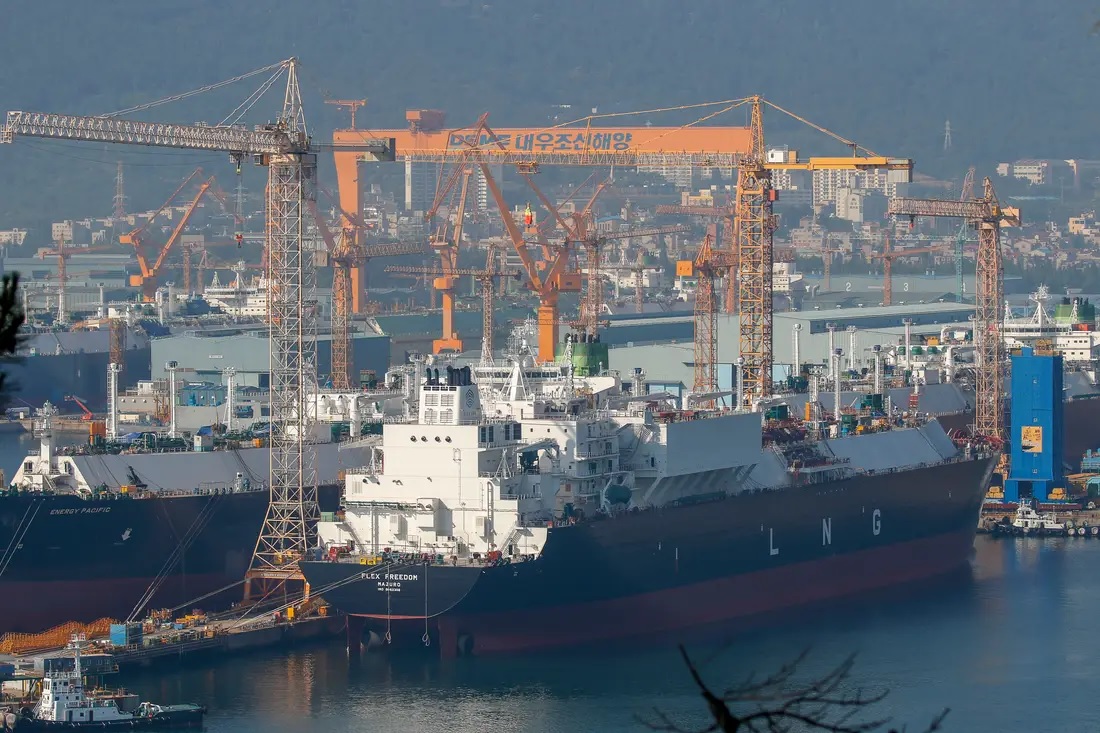
WASHINGTON — The U.S. Navy has issued two Requests for Information (RFIs) to major South Korean shipbuilders to assess their ability to build destroyers and medium-sized fleet replenishment tankers, marking a significant step in exploring allied shipbuilding capacity to support future naval requirements.
According to Naval News, citing initial reporting by South Korea's Yonhap News, the RFIs were issued last month as part of an information-gathering process and do not represent a contract award or procurement decision. One RFI covers destroyer-sized surface combatants, while the second seeks information on medium-sized fuel tankers intended for fleet replenishment.
The U.S. government is seeking details on shipbuilding capabilities, including design expertise, production capacity, pricing, delivery schedules, and other market information, to evaluate whether South Korean shipbuilders could support future U.S. Navy programs.
Three Shipbuilders Submit Responses
Three of South Korea's largest shipbuilders have responded to the U.S. Navy's requests.
Hanwha Ocean and HD Hyundai Heavy Industries (HD HHI) submitted responses for both the destroyer and fleet tanker RFIs, while Samsung Heavy Industries responded only to the request for medium-sized fleet replenishment tankers.
According to industry officials cited by Yonhap News, the companies provided comprehensive information covering their shipbuilding track record, design workforce, engineering expertise, and annual shipbuilding capacity.
Media reports indicate that Hanwha Ocean and HD Hyundai Heavy Industries were asked to provide information related to eight proposed destroyers, while the separate tanker RFI was also sent to Samsung Heavy Industries.
Experience Building Modern Naval Warships
Hanwha Ocean and HD Hyundai Heavy Industries have extensive experience constructing advanced surface combatants for the Republic of Korea Navy.
Both companies have built the approximately 8,500-ton Sejong the Great-class Aegis destroyers, which use the Aegis combat system and are similar in size and capability to the U.S. Navy's Arleigh Burke-class destroyers. The shipyards have also produced Chungmugong Yi Sun-sin-class destroyers and exported frigates to countries including Peru and the Philippines.
The U.S. Navy's RFI process is intended to evaluate these existing shipbuilding capabilities as it considers options for future fleet expansion.
Part of Broader U.S.-South Korea Shipbuilding Cooperation
The RFIs follow growing cooperation between the United States and South Korea in the shipbuilding sector.
According to South Korean media reports, President Donald Trump asked South Korean President Lee Jae Myung during the G7 Summit whether South Korea could quickly build 10 U.S. warships. Reports also stated that the two leaders later agreed to begin working-level consultations on shipbuilding cooperation during meetings held alongside the NATO Summit.
South Korea has committed $150 billion toward the U.S. shipbuilding sector as part of a broader $350 billion investment package in the United States. South Korea's government-backed policy banks have also begun steps to implement the financing plan supporting the initiative.
South Korean shipbuilders have already expanded their presence in the United States.
Hanwha Ocean acquired Philly Shipyard in Pennsylvania and has partnered with Vard U.S. Marine as a subcontractor for design work on the U.S. Navy's Next Generation Logistics Ship program.
HD Hyundai Heavy Industries has established a strategic partnership with Huntington Ingalls Industries, while Samsung Heavy Industries has partnered with General Dynamics NASSCO to expand cooperation in U.S. shipbuilding projects.
Supporting Long-Term Fleet Expansion
According to South Korean estimates cited by Yonhap News, the U.S. Navy plans to expand its fleet from approximately 300 ships today to 381 ships by 2054. Achieving that goal would require building an average of 12 ships per year, or approximately 364 vessels over the next 30 years.
The RFIs are viewed as part of broader efforts to identify additional shipbuilding capacity that could help meet future fleet requirements.
Congressional Approval Still Required
If the current RFI process eventually results in shipbuilding contracts, it could mark the first time since 1947 that foreign-built or foreign-designed combat ships enter service with the U.S. Navy.
For nearly 80 years, U.S. Navy combat ships have been designed and constructed in domestic shipyards under long-standing U.S. legal and procurement requirements.
Recent policy documents—including the National Defense Authorization Act (NDAA) for Fiscal Year 2027, the Navy's five-year shipbuilding plan, and the FY2027 budget proposal—include references to allowing greater flexibility for foreign-built ships. However, any move beyond the current RFI stage would require Congress to approve a national security waiver and provide the necessary funding before overseas construction of U.S. Navy combat ships could proceed.
At this stage, the RFIs remain an initial market assessment rather than a procurement decision, and the U.S. Navy has not announced any contract awards or selected any shipbuilder for future programs.
——— End of Article ———