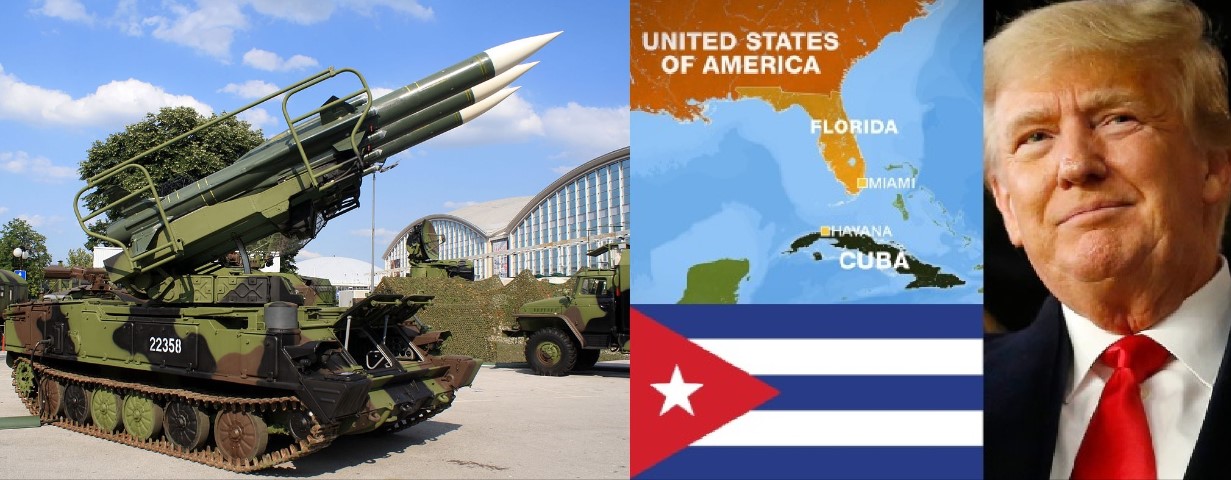
Havana, Cuba: Cuba has quietly moved to prepare and reactivate its Soviet-era 2K12-generation and associated surface-to-air defense systems after renewed political and security pressure from Washington, following sharp warnings issued by former US President Donald Trump. Cuban military activity over recent weeks indicates a precautionary shift toward heightened territorial defense, reviving doctrines and systems rooted in the Cold War but still relevant in a modern asymmetric conflict.
The move underscores Havana’s long-standing view that deterrence, not power projection, remains central to its national survival strategy—particularly at a time when US-Cuba relations are again showing signs of deterioration.
Why Trump Threatened Cuba
The renewed rhetoric from Trump stems from a convergence of geopolitical, ideological, and security concerns. Trump has repeatedly accused Cuba of harboring US fugitives, maintaining intelligence cooperation with US adversaries, and providing political backing to governments opposed to American interests in Latin America. His statements also revive the narrative of Cuba as a hostile actor only 145 kilometers from Florida, a framing deeply embedded in US domestic politics.
Additionally, Trump has criticized Cuba’s ties with Russia and China, particularly intelligence-sharing arrangements and port access granted to foreign naval vessels. In Washington’s strategic calculus, even symbolic military cooperation near US shores is treated as a red-line signaling issue, regardless of Cuba’s limited conventional capabilities.
For Havana, such language recalls decades of sanctions, invasion threats, and covert action—prompting the island nation to demonstrate that any coercive pressure would come at a cost.
A Defensive Military by Design
Cuba’s armed forces, officially known as the Cuban Revolutionary Armed Forces (Fuerzas Armadas Revolucionarias – FAR), operate primarily as a defensive and resistance-oriented force, not an expeditionary military. According to the 2025 Global Firepower Index, Cuba ranks 67th out of 145 countries, reflecting modest conventional strength but significant manpower depth.
At the heart of Cuban strategy lies the doctrine of “War of All the People” (Guerra de Todo el Pueblo)—a system built around a small professional core, reinforced by massive reserves, militias, and paramilitary formations designed to wage nationwide guerrilla warfare in the event of invasion.
Cuba maintains approximately 45,000–50,000 active personnel, supported by 39,000–40,000 reservists. The most striking figure, however, is its paramilitary strength of nearly 1.15 million personnel, drawn from the Territorial Troops Militia and the Youth Labor Army, giving the state an unparalleled capacity for national mobilization in the Caribbean.
Ground Forces: Quantity Over Modernity
The Revolutionary Army, Cuba’s largest service branch, fields 35,000–38,000 active troops. While much of its equipment dates back to the Soviet era, sheer volume remains a key factor.
Cuba possesses over 1,000 main battle tanks in total inventory, with estimates suggesting 300 or more operational at any given time. These consist primarily of T-55 tanks (around 800 active or stored) and T-62 tanks (approximately 380). Armored mobility is further supported by 600+ armored fighting vehicles, notably BTR-60 APCs—many locally modified with anti-aircraft guns or tank turrets—and BMP-1 infantry fighting vehicles.
Artillery strength remains significant, with 500–600+ towed and self-propelled guns, including 122mm and 130mm systems, complemented by BM-21 Grad multiple rocket launchers and indigenous variants. In a defensive war, these systems are intended to saturate landing zones and chokepoints rather than engage in maneuver warfare.
Air Power: Small but Integrated
Cuba’s air arm, the Defensa Antiaérea y Fuerza Aérea Revolucionaria (DAAFAR), has shrunk dramatically since the Cold War, now numbering 8,000–10,000 personnel. Operational combat aircraft are limited to 15–20 jets, but the force compensates through integration with ground-based air defenses.
The most capable aircraft in service are 2–6 operational MiG-29 fighters, supported by a dwindling number of MiG-21 and MiG-23 aircraft, with roughly 12 MiG-21s believed to be flight-ready. Rotary-wing assets include 4–8 Mi-24 Hind attack helicopters, alongside Mi-8 and Mi-17 transport helicopters, which form the logistical backbone of the force.
Navy: Coastal Defense, Not Blue Water
Cuba’s navy, the Marina de Guerra Revolucionaria (MGR), functions as a coastal denial force rather than a blue-water navy. With 3,000–5,000 personnel, its fleet includes two Rio Damuji-class frigates, uniquely converted from Spanish fishing trawlers and armed with missiles and helicopter decks.
Additional assets include one Pauk-class corvette optimized for anti-submarine warfare, one Delfin-class coastal submarine, and 10 or more patrol craft for littoral security. Crucially, the navy operates land-based anti-ship missile systems, including the “Bandera” missile, a domestic adaptation of the Soviet Styx, designed to threaten hostile vessels approaching Cuban waters.
The Backbone: Cuba’s Air Defense Network
The current alert posture centers on Cuba’s layered air defense system, much of it inherited from the Soviet Union but meticulously maintained.
At the strategic level, Cuba fields S-75 Dvina (SA-2) systems for high-altitude interception, complemented by S-125 Pechora (SA-3) batteries optimized for low-to-medium altitude targets. The SA-3, in particular, remains a cornerstone due to its greater resistance to electronic countermeasures.
Mobile and short-range protection is provided by 9K33 Osa (SA-8) systems, capable of autonomous detection and engagement, alongside 9K35 Strela-10 (SA-13) and 9K31 Strela-1 (SA-9) platforms defending maneuver units.
For low-altitude threats—including drones and helicopters—Cuba relies on massed ZSU-23-4 Shilka self-propelled guns, ZU-23-2 autocannons, and widespread distribution of Igla and Strela MANPADS, creating what Cuban planners describe as a “dense threat environment.”
This entire network is coordinated through an island-wide radar and early-warning system, incorporating P-12, P-15, and P-18 radars, enabling centralized command and rapid cueing of SAM batteries and fighter interceptors.
A Message of Deterrence
Cuba’s renewed air defense readiness is less about preparing for imminent war and more about strategic signaling. By activating and publicizing its defensive layers, Havana is reminding Washington that even aging systems can impose real costs, particularly in a confined and radar-saturated battlespace like the Caribbean.
For Cuba, the lesson of history remains unchanged: survival depends not on matching an adversary weapon for weapon, but on making intervention politically, militarily, and economically painful. In that context, the revival of Cold War-era defenses in response to Trump’s warnings is not nostalgia—it is doctrine in action.
——— End of Article ———