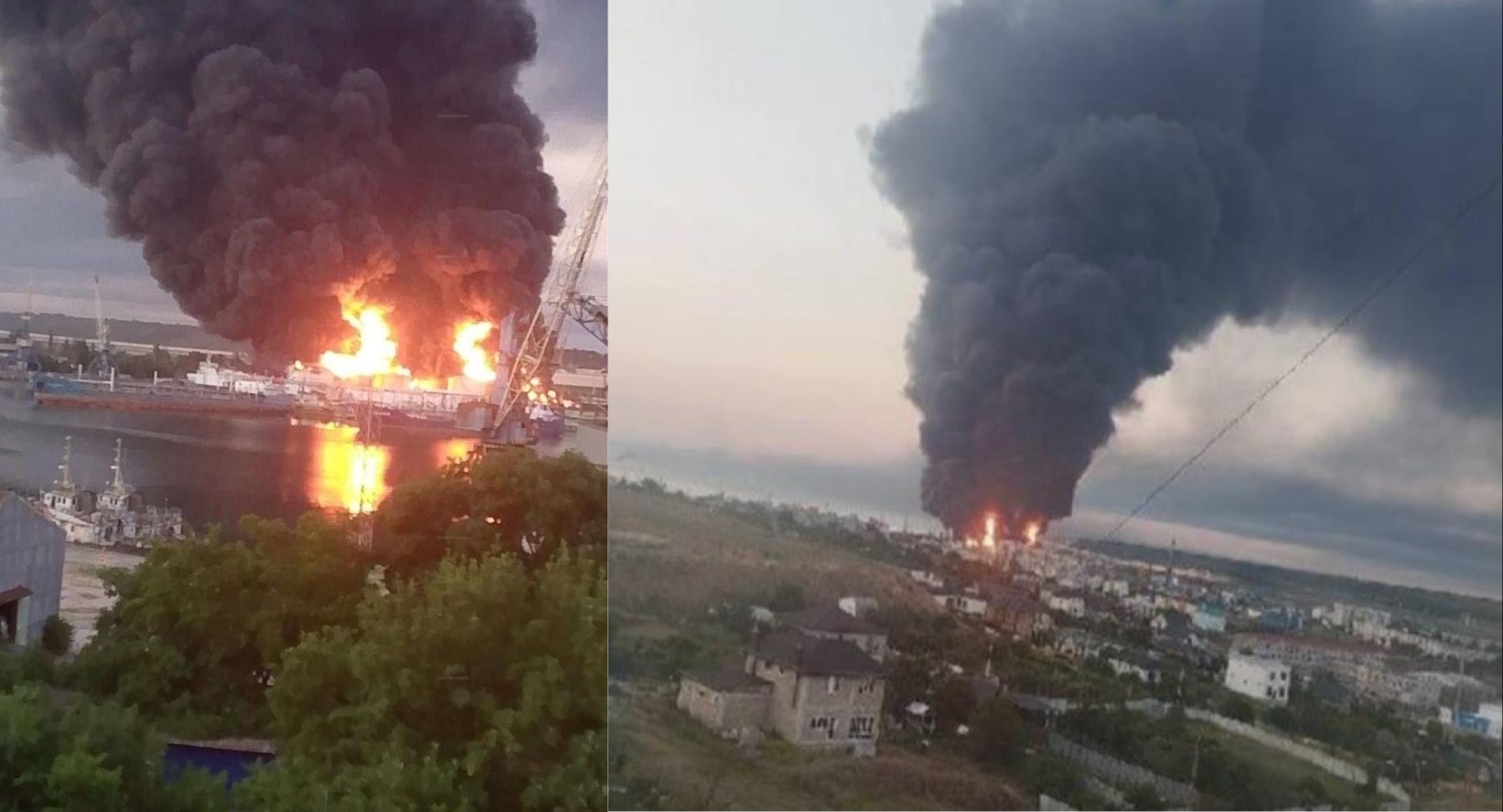
KYIV, — June 21, 2026 : Ukrainian Defense Forces carried out coordinated overnight drone strikes against fuel and maritime logistics facilities at the port of Kerch in Russian-occupied Crimea and Port Kavkaz in Russia’s Krasnodar region, causing major fires and prompting authorities in Crimea to suspend civilian fuel sales across the peninsula.
The attacks occurred during the night of June 20–21 amid active missile and drone alerts across the Kerch Strait area. NASA’s Fire Information for Resource Management System (FIRMS) recorded thermal anomalies indicating fires at both locations. The first fire was detected at the Kerch port facility at approximately 1:29 a.m. local time, followed by another at Port Kavkaz at around 2:24 a.m.
Kerch Port Facility Hit
At the Kerch Commercial Port, the strike targeted an oil storage depot within the AEGAZ Terminal complex, located at coordinates 45.334917, 36.465814. The facility specializes in cargo handling and liquefied gas transshipment and includes a fuel terminal that supports maritime vessels and the Crimea–Kavkaz ferry route.
Photos and videos shared by local residents showed smoke rising from the area. Satellite data indicated that the main concentration of thermal activity was located within the AEGAZ Terminal premises, with additional heat signatures observed near a fuel terminal operated by the Crimean fuel company TES.
Port Kavkaz Strike
Across the Kerch Strait, Ukrainian forces also targeted Port Kavkaz, located on the Chushka Spit in Krasnodar Krai at coordinates 45.342135, 36.673774.
Port Kavkaz is Russia’s fifth-largest port by cargo throughput and the second-largest in the Black Sea–Azov basin after Novorossiysk. The port serves as a major transportation hub connecting mainland Russia with Crimea through ferry, rail, and cargo operations.
Its oil depot is a key fuel supply point for occupied Crimea and Russian-controlled areas in the Kherson, Zaporizhzhia, and Donetsk regions.
Crimea Halts Civilian Fuel Sales
Following the strikes, Russian-appointed authorities in occupied Crimea announced a complete suspension of fuel sales to civilians across the peninsula.
Fuel reserves are being reserved for government agencies, emergency services, and other state needs while authorities assess the impact of the attacks on regional fuel supplies.
Official Statements
The General Staff of the Armed Forces of Ukraine confirmed the operation on June 21, stating that the targeted facilities were heavily used for military transportation and logistical support.
Ukrainian President Volodymyr Zelenskyy said the strikes hit maritime oil transportation infrastructure in Russia’s Krasnodar region and an oil depot in occupied Kerch.
Meanwhile, the Russian Ministry of Defense stated that air defense systems intercepted 239 Ukrainian drones overnight across multiple regions, including Crimea and surrounding waters.
No immediate information on casualties or the full extent of damage was released.
Broader Campaign Against Energy Infrastructure
The attacks are part of Ukraine’s continuing campaign against Russian logistics and energy infrastructure. The Ukrainian General Staff reported that Ukrainian forces also struck the Tyumen oil refinery in Western Siberia, more than 2,000 kilometers from the Ukrainian border, which produces fuel used by the Russian military.
The operation came one day after Ukrainian strikes on energy infrastructure in occupied Crimea during the night of June 19–20. Those attacks reportedly caused fires at the Tavriya Thermal Power Plant, also known as the Simferopol Combined Cycle Gas Turbine Power Plant, and targeted a gas distribution station near Zhuravlivka as well as a TES-operated liquefied gas and petroleum products storage terminal.
The Kerch Strait remains a critical supply corridor linking mainland Russia with Crimea, making fuel depots, ports, and transportation infrastructure key components of regional logistics operations.
——— End of Article ———