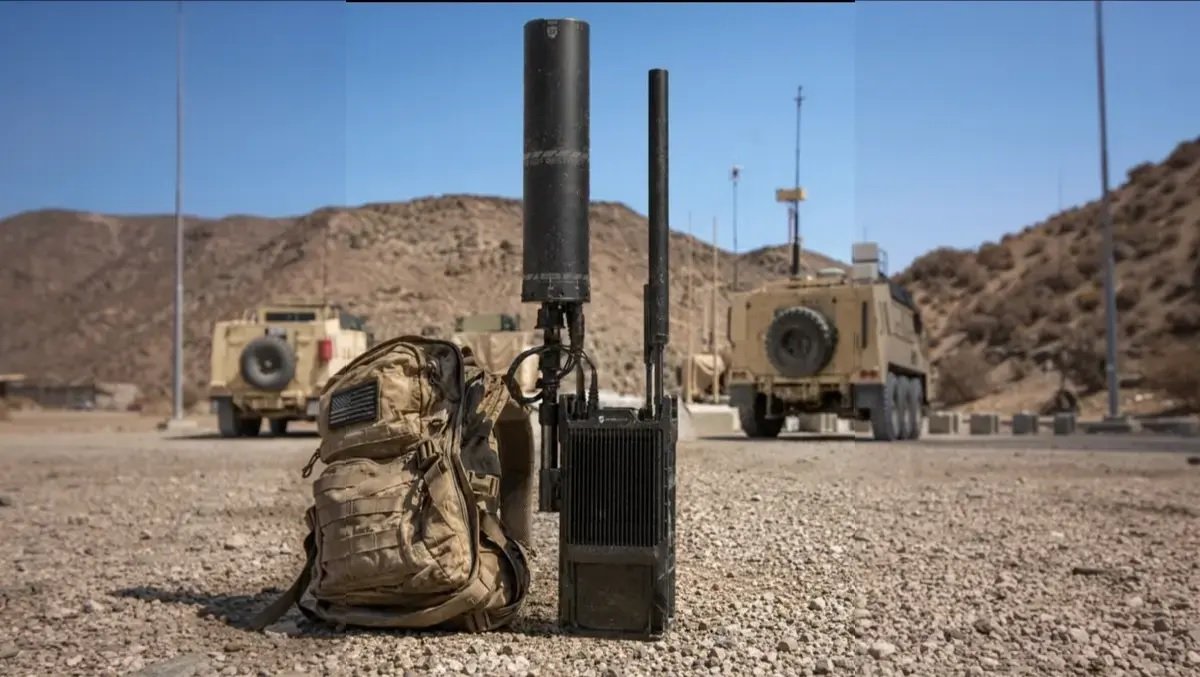
SYDNEY, Australia — Australian defence technology company DroneShield (ASX: DRO) has launched RfRecon, a portable radio frequency (RF) intelligence system designed to help defence, government and security organisations detect, identify, locate and assess activity across the electromagnetic environment.
The new system builds on DroneShield’s recently introduced RfAI-3 intelligence architecture, which was unveiled on July 28, 2026. RfRecon combines wideband RF spectrum awareness, precision direction finding and AI-based signal intelligence in a single portable platform.
The company said the system is intended to provide operators with more than raw spectrum data by helping them understand RF activity and use that information during operations. DroneShield said the increasing use of uncrewed systems, electronic warfare capabilities and wireless communications has made the RF environment more complex for operators.
Higher Processing and RF Coverage
According to DroneShield, RfRecon provides approximately six times greater RF spectrum coverage, four times more processing and AI compute capacity, 31 times more storage and eight times more memory compared with previous industry-adopted solutions cited by the company.
The system also adds several capabilities, including direction finding, Bluetooth and Wi-Fi detection, Remote ID, AIS/ADS-B detection, integrated GNSS and hardware-based security.
These capabilities are intended to allow the device to collect and process RF information while also providing information about the location and nature of detected activity.
Built Around RfAI-3
RfRecon is powered by DroneShield’s third-generation RF intelligence engine, RfAI-3.
DroneShield introduced RfAI-3 on July 28 and said it changes its approach from relying primarily on previously catalogued RF signatures to wideband detection of emissions across the spectrum. When a detected emission matches a known signature, the system can classify it. For unfamiliar emissions, RfAI-3 can generate a new signature and provide a confidence assessment to the operator.
DroneShield said RfAI was originally developed in 2018, while RfAI-2 was released in 2023. The company describes RfAI-3 as the next stage of that development, combining its existing RF intelligence dataset with wideband detection of previously unseen emissions.
The company also says RfAI-3 is designed for edge deployment, allowing RF intelligence to be generated during operations without depending on cloud connectivity. Its software-defined architecture is intended to allow continued improvements through software updates.
Designed for Different Operational Environments
RfRecon can be used in dismounted, vehicle-mounted, expeditionary and fixed-site operations, according to DroneShield.
The system uses an open architecture and supports industry-standard data transfer for integration with existing defence and security systems. DroneShield specifically identifies compatibility with ATAK (Android Team Awareness Kit), third-party command-and-control platforms and complementary sensor technologies.
The company also said RfRecon can operate as part of a layered counter-uncrewed aircraft system (C-UAS) architecture alongside cyber takeover and kinetic defeat capabilities.
DroneShield plans to continue providing software enhancements for the system through its software development roadmap, allowing future RF intelligence improvements to be delivered to the platform.
Available to Qualified Customers
DroneShield said RfRecon is available immediately to qualified defence, government and security customers worldwide.
The launch follows the introduction of RfAI-3, which DroneShield says is designed for its next-generation hardware platforms, with initial releases planned during the second half of 2026 and additional releases expected through 2027.
RfRecon therefore represents the hardware platform through which DroneShield is bringing its latest RF intelligence architecture into a portable system, combining RF detection, direction finding, signal intelligence and integration capabilities for use at the tactical edge.
——— End of Article ———