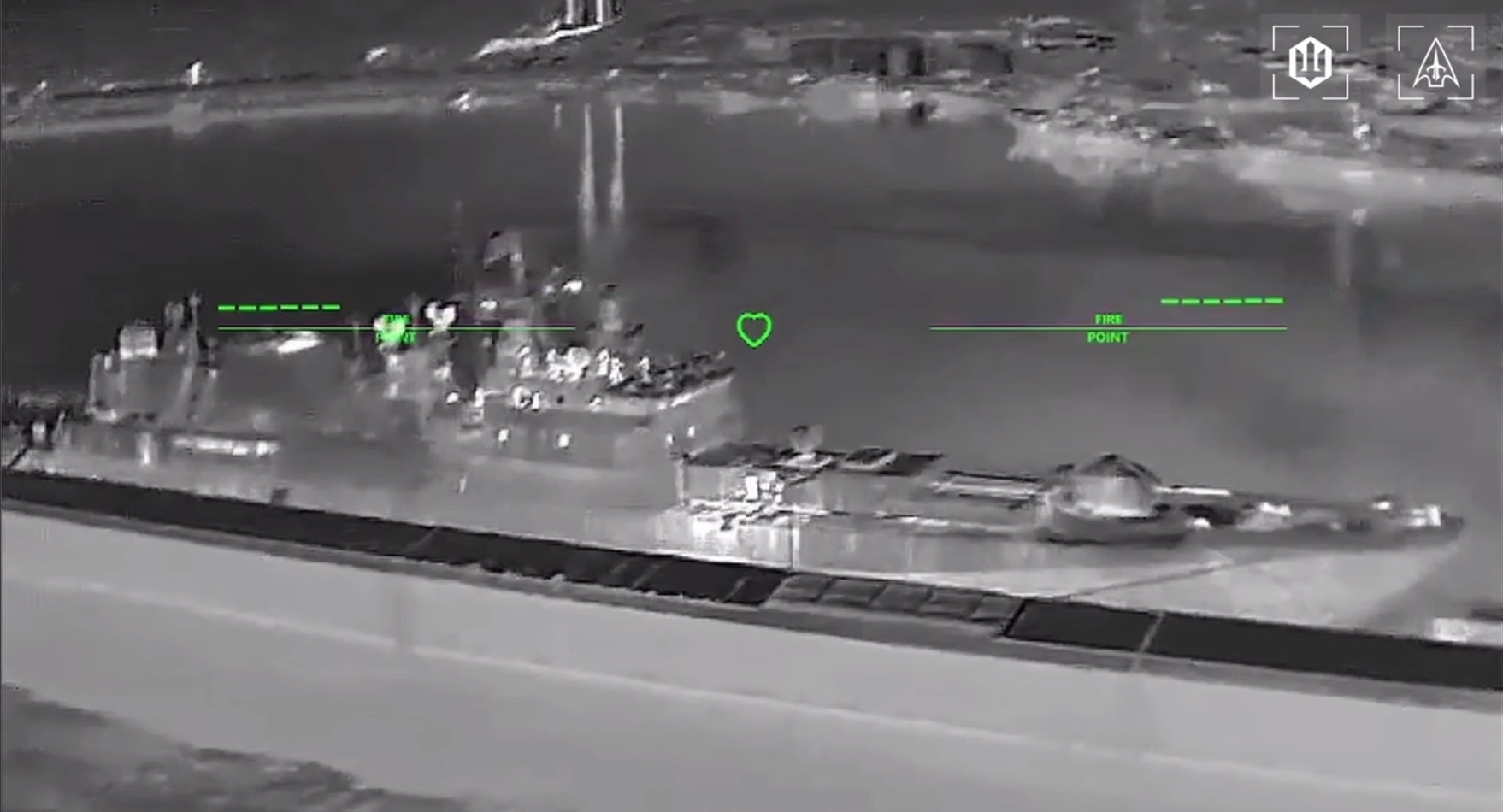
KYIV/NOVOROSSIYSK, — May 24, 2026 : Ukrainian Defense Forces conducted a coordinated overnight unmanned aerial vehicle (UAV) strike on Russian naval assets and energy infrastructure at the Black Sea port of Novorossiysk on the night of May 23, targeting the guided-missile frigate Admiral Essen, a Project 1239 hovercraft missile ship, and major oil storage facilities in Russia’s Krasnodar region.
According to Ukraine’s Unmanned Systems Forces (USF), the operation was executed by the 9th “Kairos” Battalion of the 414th Unmanned Strike Aviation Brigade, widely known as the “Birds of Madyar,” alongside the 1st Center of the USF. The units reportedly operated in coordination with deep-strike elements of Ukraine’s Special Operations Forces. Robert “Madyar” Brovdi, commander of the USF, confirmed the operation and later published video footage showing drone strikes on naval and industrial targets in Novorossiysk.
Strike on Admiral Essen and Russian Naval Assets
Footage released following the operation showed one strike UAV impacting the Admiral Essen, a Project 11356R Burevestnik (Grigorovich-class) guided-missile frigate, near the deck area on the vessel’s side. Ukrainian officials stated the frigate attempted to repel incoming drones using its standard Osa-M air defense system while at least three additional UAVs approached the target.
The Admiral Essen serves as a carrier of 3M14 Kalibr cruise missiles and forms part of Russia’s Black Sea Fleet strike capability. The frigate is equipped with an eight-cell vertical launch system capable of deploying Kalibr, Oniks, and Zircon missiles, alongside a 100 mm A-190 naval gun, Shtil-1 surface-to-air missile system, AK-630 close-in weapon systems, torpedo tubes, and an RBU-6000 anti-submarine rocket launcher. The vessel reportedly operates with a crew of around 180 personnel and has previously participated in Russian missile strikes against targets in Ukraine and Syria.
The May 23 operation marked the fourth reported Ukrainian drone attack against the Admiral Essen since early March 2026. Earlier reported strikes allegedly damaged sections of the ship’s superstructure, radar systems, and bow area. However, the extent of damage caused during the latest strike remains unconfirmed and has not been independently verified.
Ukrainian forces also targeted a Project 1239 hovercraft missile ship of the Sivuch class, also referred to under the NATO reporting name Bora class. Video released after the operation indicated the vessel was struck, although no confirmed assessment regarding structural or operational damage has been issued.
Project 1239 Sivuch-Class Hovercraft Missile Ship
The Project 1239 missile ship was developed by the Almaz Central Marine Design Bureau during the 1980s as an evolution of the Project 1234 Ovod missile ship program. Designed for anti-surface warfare and coastal defense operations, the vessel was intended to destroy large enemy warships and provide cover for naval formations and convoys in coastal and inland maritime areas.
Only two vessels of the planned 16-unit program — Bora and Samum — were ultimately completed and entered service with Russia’s Black Sea Fleet.
The ship has a displacement of approximately 1,000 tons and measures 64 meters in length and 17.2 meters in width. Its draft stands at 3.8 meters, reducing to around one meter while operating in air-cushion mode. The vessel features a dual-hull catamaran structure built from corrosion-resistant aluminum-magnesium alloys linked by a platform measuring roughly 64 meters by 18 meters, with internal bulkheads also constructed using lightweight materials.
A two-tier flexible partition system located in the bow and stern creates an air cushion beneath the vessel, allowing it to transition from catamaran cruising speeds of around 20 knots to hovercraft speeds reaching up to 45 knots. The vessel reportedly has an operational range of 2,500 nautical miles at 12 knots or approximately 800 nautical miles at maximum speed, with endurance of up to 10 days and a crew complement of 68 personnel.
Armament includes one 76 mm AK-176 naval gun, two six-barrel 30 mm AK-630 automatic cannons, two four-cell launchers for supersonic Moskit anti-ship missiles, and a two-cell Osa-M air defense launcher carrying up to 20 missiles.
Strikes on Novorossiysk Oil Infrastructure
In addition to naval targets, Ukrainian forces reported direct strikes on the Sheskharis transshipment complex, which includes the Sheskharis marine terminal and the Grushovaya Balka (Grushova) oil depot in Novorossiysk.
Located on the Black Sea coast, the facility is regarded as one of the largest petroleum storage and export hubs in southern Russia and serves as a terminal point for pipelines operated by the state-controlled company Transneft. The complex reportedly maintains a storage capacity of approximately 1.2 to 1.25 million cubic meters of petroleum products across between 40 and 47 active storage tanks.
Ukraine’s military later reported impacts and fires at both the Sheskharis terminal and the Grushova oil depot following the strike operation.
Russian local authorities, including Novorossiysk Mayor Andrey Kravchenko, stated that falling drone debris caused a fire at the oil terminal and resulted in injuries to two individuals. Russian officials have not released detailed assessments regarding the condition of the naval vessels targeted during the operation.
Wider Overnight Drone Campaign
The Novorossiysk operation formed part of a broader overnight Ukrainian drone offensive, according to Ukrainian military sources. Additional targets reportedly struck included an Osa air defense system in Donetsk, a logistics hub linked to Russia’s 6th Air and Air Defense Forces Army in Rovenky, a drone command center in Oleshky, and multiple fuel trucks and armored vehicles in the Zaporizhzhia region.
The overall extent of damage to Russian naval assets, oil infrastructure, and other military targets remains unconfirmed, and claims made by both sides have not been independently verified.
——— End of Article ———