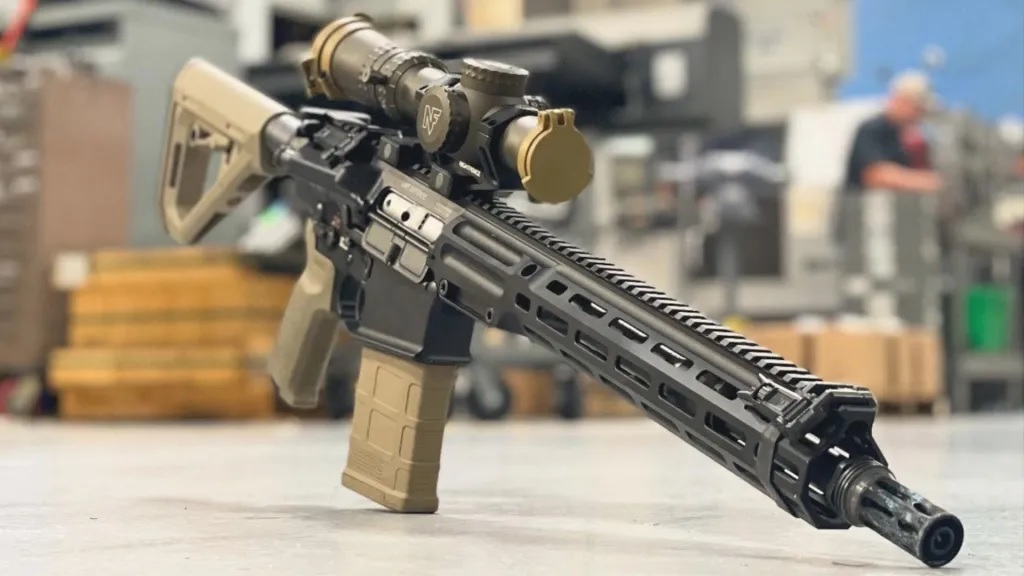
WASHINGTON, — May 23, 2026 : The United States Special Operations Command (USSOCOM), in coordination with the Naval Surface Warfare Center (NSWC) Crane, has launched the Hypervelocity Improved Capability Assault Rifle (HICAR) program to develop a next-generation individual weapon system designed to improve the combat effectiveness of U.S. special operations forces. The initiative seeks industry partners to design a new carbine platform capable of significantly extending the effective range of the standard 5.56×45 mm NATO system while maintaining compatibility with existing operational equipment.
The effort was formally announced through the U.S. government procurement platform SAM.gov under solicitation N0016426SCA004, issued on May 18, 2026. The program is intended to replace or upgrade the current M4A1 Upper Receiver Group – Improved (URG-I) while retaining interoperability with the existing M4A1 lower receiver group used across USSOCOM formations.
USSOCOM’s primary objective is to integrate advancements in materials science, weapon durability, and ammunition performance into a technically improved lightweight assault rifle capable of effective engagement at 600 meters and beyond, doubling the approximately 300-meter recognized effective range of current standard 5.56 NATO platforms.
Focus on Hypervelocity Ammunition Capability
A central objective of the HICAR program is the ability to operate reliably with both currently fielded ammunition and emerging hypervelocity 5.56 mm ammunition developed to deliver increased ballistic performance.
The system must fire and cycle standard M855A1 Enhanced Performance Round, Mk262 77-grain ammunition, and government-supplied M855A1+ hypervelocity ammunition loaded to chamber pressures of up to 82,000 pounds per square inch (82 kpsi). The rifle must also remain adaptable to future hypervelocity ammunition designs.
According to program requirements, hypervelocity ammunition is intended to improve battlefield performance through greater effective range, enhanced terminal performance, and improved penetration against body armor and hardened barriers. Increased projectile velocity allows rounds to retain energy over longer distances, providing improved lethality and engagement capability in extended-range combat scenarios.
Because chamber pressures associated with M855A1+ ammunition are substantially higher than those of conventional 5.56 mm systems, USSOCOM is requiring significant engineering improvements to gas systems, bolts, barrels, and materials to ensure reliability and durability during prolonged operational use.
Technical Requirements and Weapon Specifications
USSOCOM has outlined strict technical specifications aimed at preserving the portability and ergonomics of a standard assault rifle while significantly improving performance.
The HICAR system must be compatible with the M4A1 lower receiver without irreversible modifications, with zero modification preferred. The weapon must feature a barrel length between 11 and 12 inches, measured from the bolt face to the open muzzle, enabling compact maneuverability for special operations missions.
The unloaded weapon weight, excluding ammunition and suppressor, must remain below 8 pounds (3.63 kilograms), while a preferred target weight of 6.5 pounds (2.95 kilograms) has been identified. Overall length from the receiver extension to the muzzle device must not exceed 31 inches, with an objective target of 28 inches.
USSOCOM has also established demanding precision standards. The weapon must maintain accuracy of no worse than 1 minute of angle (1 MOA) when fired without a suppressor, while a preferred performance target of 0.5 MOA has been established. Accuracy testing will involve multiple ten-round shot groups fired from separate rifles at 100 meters using Black Hills Mk262 Mod1-C 77-grain ammunition, with no single group permitted to exceed 2.5 MOA extreme spread.
Additional system requirements include:
- Trigger pull weight below 5 pounds, with a preferred objective of under 3 pounds.
- Safe and semi-automatic fire modes as baseline requirements, with full automatic capability listed as an objective.
- A minimum 16-inch M1913 Picatinny rail at the 12 o’clock position for optics and accessories.
- Compatibility with all existing USSOCOM Visual Augmentation Systems (VAS) and Weapon Accessories (VASWA) enablers.
- Recoil impulse lower than that of the Mk17 7.62 NATO rifle.
- Compatibility with Gen3 PMAG magazines.
- M-LOK mounting points at seven radial positions on the handguard.
- Ambidextrous controls, including bolt release, charging handle, magazine release, and safety selector, as an objective requirement.
- Protective fencing around controls to reduce accidental activation during operations.
Suppressor and Signature Reduction Requirements
Until a suppressor optimized for hypervelocity ammunition becomes available, USSOCOM has specified the use of the HUXWRX Flow 556k L suppressor in the Black Magic configuration, manufactured from Inconel 718, during evaluation and testing. The suppressor will be used to reduce visual and acoustic signatures while providing a standardized baseline for prototype assessment.
The HICAR system must also include heat mitigation rail covers, a multi-point adjustable buttstock, seven Gen3 PMAG 5.56 magazines, a field maintenance kit, a cleaning kit, and both user and maintenance manuals as part of the complete weapon package.
Durability, Reliability, and Environmental Performance
Given the mechanical stress generated by 82 kpsi chamber pressures, durability and reliability remain major program priorities.
USSOCOM requires a minimum barrel life of 8,000 rounds when firing M855A1+ ammunition, while a preferred objective of 20,000 rounds has been outlined. Barrel degradation thresholds will be determined through muzzle velocity reduction and shot dispersion measurements.
Reliability requirements call for a minimum of 800 Mean Rounds Between Stoppages (MRBS), with a preferred objective of 1,600 MRBS. Additionally, the system must achieve 5,000 Mean Rounds Between Failures (MRBF) as a threshold and 10,000 MRBF as an objective.
The rifle must remain fully functional across extreme operating conditions, including temperatures ranging from –40°C to 73.9°C (–40°F to 165°F). It must also withstand submersion in three feet of seawater for up to two hours and be capable of firing within 30 seconds after immersion, with a preferred objective of firing within 10 seconds.
USSOCOM also requires corrosion-resistant, abrasion-resistant, and NBC-environment-compatible protective coatings, with self-lubricating materials preferred to reduce debris accumulation and maintenance demands in harsh operating environments.
Procurement Timeline and Industry Participation
USSOCOM has established a defined acquisition schedule for the HICAR initiative. White papers from interested industry partners are due by June 8, 2026, after which selected companies will be invited to physically demonstrate prototype systems during pitch days scheduled for September 15–16, 2026, at the U.S. Army Marksmanship Unit Parks Range at Fort Moore, Georgia.
The procurement process will be conducted under Other Transaction Authority (OTA) through a Commercial Solutions Opening (CSO) mechanism, enabling faster prototyping and development pathways with the potential for follow-on production contracts.
Program guidance also states that if a prototype is manufactured outside the United States, developers must submit a detailed industrialization plan for transitioning production to U.S.-based facilities before contract completion. Supply chains must comply with restrictions under the National Defense Authorization Act (NDAA) and avoid dependence on components sourced from adversary nations where possible.
Broader U.S. Military Rifle Modernization Context
The HICAR initiative runs parallel to wider U.S. military modernization efforts focused on next-generation infantry weapons. While USSOCOM seeks to extend the effectiveness of the 5.56 mm platform for special operations missions, the U.S. Army is separately introducing the XM8 compact rifle, a lightweight derivative of the M7 rifle chambered in 6.8×51 mm.
The Army accepted initial deliveries of XM8 carbines from Sig Sauer in April 2026, with early operational fielding expected from October 2026 among close combat formations.
However, HICAR remains distinct from the Army’s rifle transition effort, focusing specifically on improving special operations capability through enhanced 5.56 mm hypervelocity ammunition compatibility, extended range, reliability, and interoperability with existing M4A1 systems.
——— End of Article ———