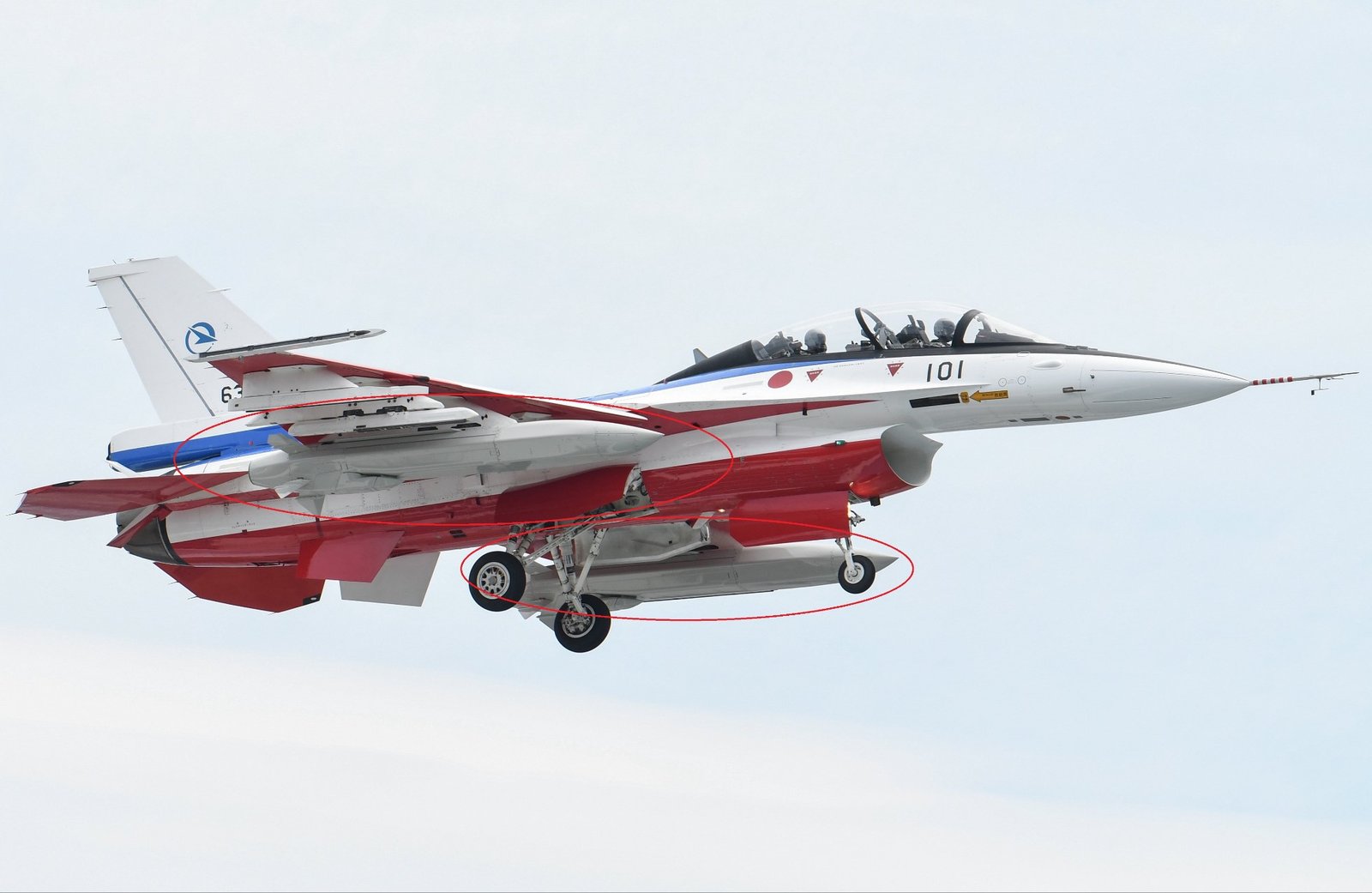
TOKYO — The Japan Air Self-Defense Force (JASDF) has begun captive-carry flight tests of its new air-launched Type 25 cruise missile on the Mitsubishi F-2 fighter, marking an important milestone in the development of Japan's next-generation stand-off strike capability.
The first flight tests took place on July 30, 2026, from Gifu Air Base, where an F-2B test aircraft (tail number 63-8101) assigned to the Air Development and Test Wing (ADTW) was photographed carrying two missiles beneath its inboard wing pylons. Images of the flight were shared on the social media platform X by the account @AKEBOVO.
An accompanying F-2A prototype (tail number 63-8501) flew alongside the test aircraft during the evaluation.
7/30 岐阜基地 RJNG 2nd
— ih168 (@ih1681) July 30, 2026
岐阜基地「夏の夕べ」で飲んで帰るだけのつもりでしたが、ラッキーでした🍻 pic.twitter.com/0N5IfXBXXH
Captive-Carry Flight Testing
The aircraft carried what appear to be inert test versions of the air-launched Type 25 missile. During captive-carry testing, missiles remain attached to the aircraft throughout the flight while engineers evaluate their effects on the aircraft's aerodynamic performance, structural loads, handling characteristics, and overall flight stability.
These tests are a standard part of missile integration before progressing to separation trials, in which the missile is safely released from the aircraft, followed by live-fire testing.
Air-Launched Version of the Type 25 Missile
The new air-launched weapon is based on Japan's Type 25 Surface-to-Ship Guided Missile (25SSM), previously known as the upgraded Type 12 (12SSM-ER) coastal defense missile.
Japan officially redesignated the ground-launched system as the Type 25 Surface-to-Ship Guided Missile in March 2026 and has already started deploying it to Japan Ground Self-Defense Force units, including Camp Kengun in Kumamoto Prefecture.
The missile is designed to engage both surface ships and land targets, providing a common long-range strike capability across multiple branches of Japan's Self-Defense Forces.
Multi-Platform Missile Family
The Type 25 missile family has been developed by Mitsubishi Heavy Industries as a standardized long-range weapon that can be launched from land-based systems, aircraft, surface ships, and submarines.
In September 2025, Mitsubishi Heavy Industries signed a contract with Japan's Ministry of Defense to produce ship- and submarine-launched cruise missiles. The contract was officially announced in October 2025.
According to current plans, submarine-launched variants will be fired through the torpedo tubes of Japan's Sōryū-class and Taigei-class submarines. A future submarine being developed by Kawasaki is also planned to feature dedicated vertical launch cells for these long-range weapons.
Missile Specifications
Public information on the air-launched Type 25 remains limited. However, the ground-launched version is reported to have a range of about 1,000 kilometers, while earlier estimates for the improved Type 12 missile family placed its range between 1,000 and 1,500 kilometers against surface ships with a displacement of up to 15,000 metric tons.
Because the air-launched variant begins its flight at altitude and does not require a launch booster, it is expected to achieve a similar or greater range.
The missile is approximately 9 meters long and carries a warhead weighing about 300 kilograms.
Its guidance system combines inertial navigation with GPS correction during the cruise phase before switching to an active radar seeker for terminal guidance. The seeker uses an active phased-array antenna, enabling improved target detection in complex environments while increasing resistance to electronic countermeasures.
Deployment Timeline
Japan has accelerated development of stand-off strike weapons in recent years as part of its broader defense modernization program.
The ground-launched Type 25 entered service in 2026, while the ship-launched and air-launched variants are scheduled for designation and deployment around fiscal year 2027.
The first operational F-2 fighters equipped with the air-launched Type 25 are planned to be based at Hyakuri Air Base.
Next Phase of Testing
The start of captive-carry flight testing represents the latest stage in integrating the Type 25 cruise missile with the F-2 fighter.
Following completion of aerodynamic and structural evaluations, the program is expected to move to missile separation tests and later live-fire trials before the weapon enters operational service.
The Type 25 is intended to provide Japan with a common long-range strike weapon capable of engaging both maritime and land targets from multiple launch platforms, including aircraft, ground launchers, surface ships, and submarines.
——— End of Article ———