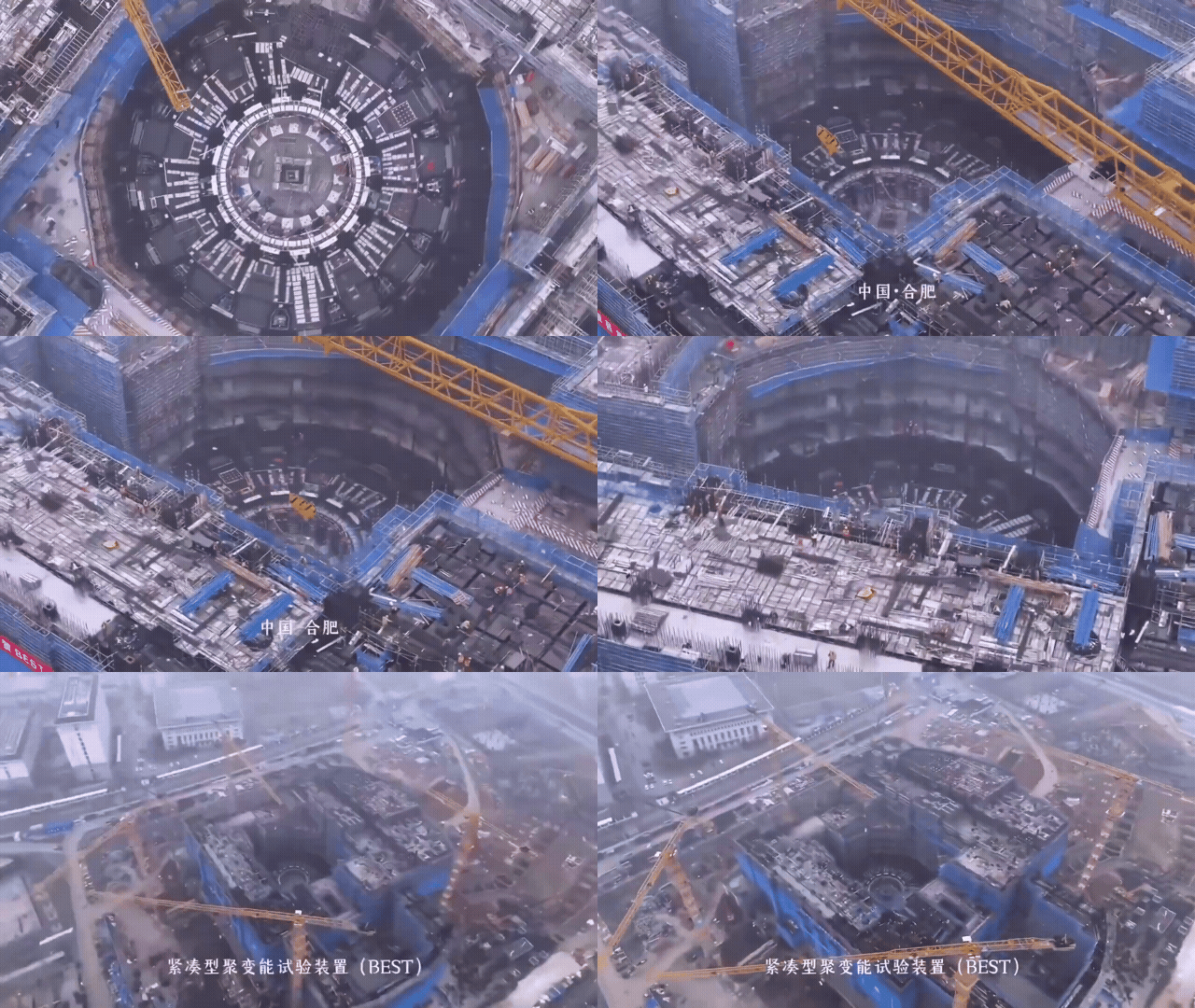
HEFEI, China — Chinese scientists have completed the construction and testing of the world's largest superconducting magnet designed for a nuclear fusion reactor, marking a key milestone for the country's next-generation fusion energy program.
The announcement was made by the Institute of Plasma Physics (ASIPP) under the Chinese Academy of Sciences in Hefei, Anhui Province. The newly completed component will support the Burning Plasma Experimental Superconducting Tokamak (BEST), China's next-generation "artificial sun" fusion reactor.
The main component is a toroidal field (TF) superconducting magnet, which is designed to confine the ultra-hot plasma required for nuclear fusion.
The D-shaped magnet measures 21 metres in length, 12 metres in width and 3.3 metres in height, and weighs 582 metric tonnes. According to ASIPP, it is the largest superconducting fusion magnet ever built.
Researchers said the magnet has 1.3 times the volume of the equivalent toroidal-field magnet being built for the International Thermonuclear Experimental Reactor (ITER) in France and can store three times more magnetic energy, enabling it to generate stronger magnetic fields.
A total of 16 toroidal-field magnets will eventually be installed around the BEST reactor to form a magnetic ring. Together, they are designed to produce a 6.5-tesla magnetic field at the centre of the plasma chamber.
Magnetic confinement for fusion
Tokamak fusion reactors are designed to reproduce the same nuclear fusion process that powers the Sun by combining light hydrogen isotopes to release energy.
To sustain fusion, hydrogen plasma must be heated to temperatures exceeding 100 million degrees Celsius, approximately six times hotter than the Sun's core.
At such temperatures, no physical material can directly contain the plasma. Instead, the toroidal-field magnet creates a powerful magnetic field that suspends the superheated plasma inside a doughnut-shaped vacuum chamber, preventing it from coming into contact with the reactor walls.
Central solenoid coil completes testing
Alongside the toroidal-field magnet, ASIPP also completed full-parameter and full-load testing of a high-temperature superconducting central solenoid coil, another key component of the BEST reactor.
Researchers compare the central solenoid to a spark plug in a car engine because it initiates and drives the plasma current required to maintain a stable fusion reaction.
During testing, the coil operated with a stable current of 60 kiloamperes and stored 6.03 megajoules of energy. According to the research team, its key performance indicators reached internationally leading levels.
Developed using a fully domestic supply chain
ASIPP said both superconducting magnet systems were developed entirely using a 100% domestic supply chain over a six-year development program.
Chinese researchers produced all core materials locally, including superconducting tapes, high-strength cryogenic stainless steel and insulation materials, eliminating reliance on foreign suppliers.
According to ASIPP Director Song Yuntao, the project achieved full localisation of core materials and manufacturing processes. The development program also resulted in 47 authorised patents and the establishment of several technical standards.
Engineers said the magnet is designed to operate for approximately 60 years at temperatures close to minus 269 degrees Celsius while carrying very high electrical currents under strong mechanical stress and radiation conditions.
Supporting China's next-generation fusion program
The newly completed magnets are intended for the Burning Plasma Experimental Superconducting Tokamak (BEST), which is designed to move beyond current laboratory research by demonstrating sustained burning plasma.
China's existing Experimental Advanced Superconducting Tokamak (EAST), often referred to as an "artificial sun," has previously achieved a world record by maintaining plasma at 100 million degrees Celsius for 1,066 seconds in steady-state high-confinement mode.
Construction of the BEST experimental reactor is scheduled to be completed by the end of 2027. If the project proceeds as planned, China aims to demonstrate experimental electricity generation from controlled nuclear fusion around 2030. The BEST program also forms part of a broader roadmap that includes the future China Fusion Engineering Demonstration Reactor.
Unlike conventional nuclear fission power plants, nuclear fusion does not produce greenhouse gas emissions during operation and generates significantly less long-lived radioactive waste. Researchers noted that while successful testing of the superconducting magnets represents a major engineering milestone, full reactor assembly and sustained operation under extreme conditions remain important steps before practical fusion power can be demonstrated.
——— End of Article ———