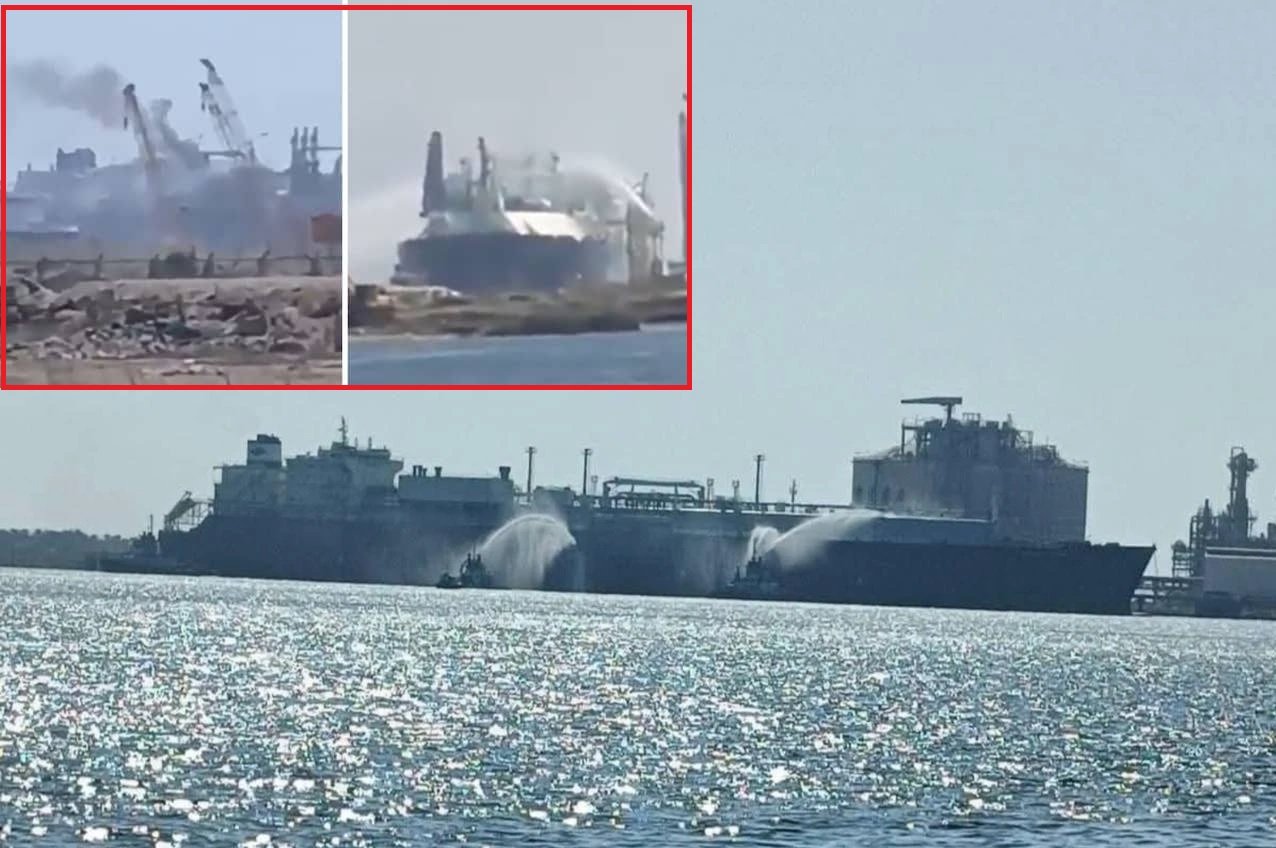
Damietta, Egypt — A drone strike on a U.S.-owned floating gas storage vessel at Egypt's Damietta Port has raised new security concerns over energy infrastructure in the eastern Mediterranean, highlighting the growing risks facing maritime energy routes amid the ongoing Middle East conflict.
The incident occurred on July 29, when an unmanned aerial vehicle struck the Energos Winter, a U.S.-owned floating storage and regasification unit (FSRU) operating under the Marshall Islands flag while it was docked at Damietta Port during cargo operations.
According to the Egyptian cabinet, a preliminary investigation confirmed that a drone caused the fire aboard the vessel. The blaze later spread to the GasLog Salem, a Bermuda-flagged liquefied natural gas (LNG) carrier.
The Egyptian Ministry of Petroleum and Mineral Resources said there were no injuries or fatalities. Firefighting and security teams quickly brought the fire under control, and both vessels were moved away from the terminal to prevent further damage. Authorities also confirmed there was no damage to the port's infrastructure, and operations at other berths were expected to resume soon.
Maritime security firm Ambrey and trading sources identified the targeted vessel as the Energos Winter, which is owned by U.S.-based Energos Infrastructure and has a storage capacity of about 138,250 cubic metres. The vessel's operations are managed by a subsidiary of Norway's Wilhelmsen Group, while it is leased by Egypt's state-owned Egyptian Natural Gas Holding Company.
The second vessel affected by the fire, GasLog Salem, is operated by a Greek shipping company.
Verified video footage released by news agencies showed emergency crews and tugboats working to extinguish the flames as smoke rose from the vessels.
Investigation Continues
No country or armed group has claimed responsibility for the attack, and Egyptian authorities said investigations remain ongoing.
The strike took place against the backdrop of the wider Middle East conflict that began in late February 2026 involving the United States, Israel and Iran. Since then, commercial shipping through the Strait of Hormuz, the Red Sea, and the Bab el-Mandeb Strait has faced repeated disruptions due to attacks and security threats, affecting regional energy exports and maritime traffic.
Saudi Arabia has adjusted some of its oil export routes in response to security risks in the Persian Gulf, while Yemen's Iran-backed Houthi movement has announced measures targeting Saudi shipping.
Two Iranian officials, speaking anonymously to The New York Times, described the Damietta explosion as a drone attack intended to demonstrate that global shipping and energy supplies could face greater disruption if the regional conflict expands further. However, they did not confirm whether Iran or any regional ally was responsible for carrying out the attack.
Iranian state media had previously listed Damietta among potential locations linked to separate tensions involving Ukraine, but no official Iranian statement has claimed responsibility for the strike.
U.S. President Donald Trump said he had been briefed on the incident and stated that Iran or its proxies were responsible, adding that the United States would respond strongly.
Strategic Importance of Damietta
Damietta Port is located on Egypt's Mediterranean coast near the northern entrance of the Suez Canal and serves as an important hub for the country's liquefied natural gas (LNG) operations.
Egypt has increasingly relied on floating storage and regasification units (FSRUs) such as the Energos Winter to support natural gas imports for electricity generation and industrial demand, alongside remaining LNG export activities at the terminal.
The attack has also drawn attention to the security of maritime routes that connect major global energy chokepoints.
The Strait of Hormuz remains one of the world's most important energy corridors, traditionally handling about 20% to 25% of global seaborne oil trade. Ongoing disruptions in Hormuz and the Bab el-Mandeb Strait have already affected commercial shipping, prompting some producers to redirect exports through alternative routes linked to the Red Sea and the Suez Canal.
Security analysts cited in reports said the Damietta incident appears intended to demonstrate that energy infrastructure along alternative export routes could also be vulnerable during the conflict. However, no official investigation has confirmed the motive behind the attack.
Shipping Security Concerns
Maritime security companies said the strike increases concerns that the conflict could spread beyond previously affected areas.
Many commercial shipping companies have already reduced or rerouted traffic through parts of the Red Sea and the Persian Gulf because of security risks. A drone strike at a Mediterranean port near the Suez Canal introduces an additional security concern for vessels operating through Egyptian facilities.
Egyptian authorities said they are continuing to investigate the incident while taking measures to safeguard national security and critical infrastructure.
Although analysts noted that the direct impact on global LNG supplies from this single incident is limited because Egypt is not a major global gas exporter, the attack adds to broader concerns over the security of regional energy transportation routes as tensions in the Middle East continue.
——— End of Article ———