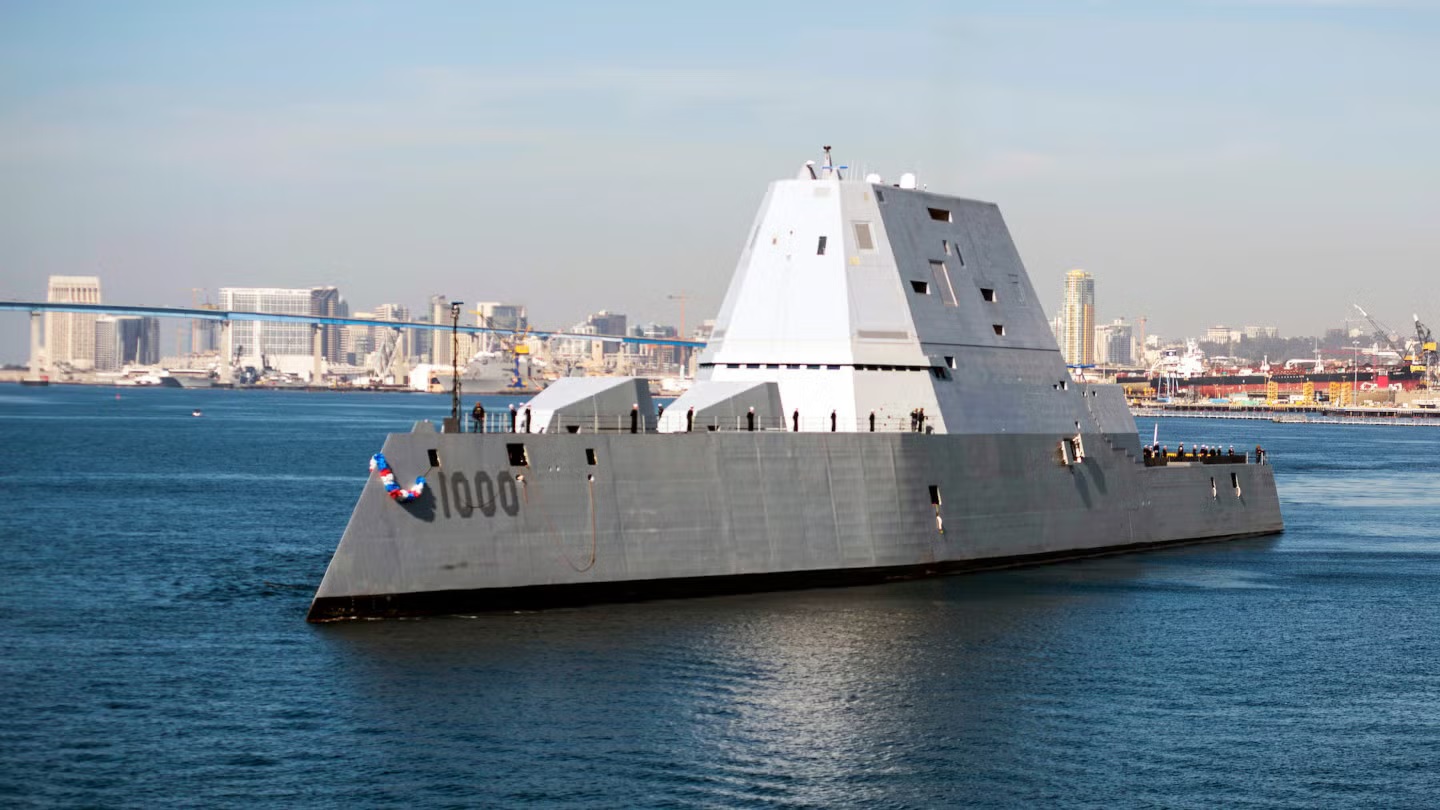
WASHINGTON — The U.S. Navy's effort to equip its three Zumwalt-class stealth destroyers with the Conventional Prompt Strike (CPS) hypersonic missile has fallen about 24 months behind schedule, according to a July 2026 report by the Government Accountability Office (GAO). The delay has been attributed to complex ship system issues, unexpected shipyard work, and production challenges affecting both the ships and the missiles.
The modernization is centered on USS Zumwalt (DDG-1000), which is set to become the Navy's first surface combatant capable of launching the CPS hypersonic weapon. The ship was originally expected to return to service with its new capability by September 2025, but that timeline has slipped to late 2026. As a result, the first live at-sea launch of the missile from the destroyer has been delayed from 2025 to 2027.
Extensive Modernization Underway
The upgrade program, known as the Build Yard Modernization Period (BYMP), involves major structural and system changes to the ship.
The most significant modification is the removal of the ship's two 155mm Advanced Gun Systems (AGS), which are being replaced with four 87-inch vertical launch tubes. Each launcher will carry three Conventional Prompt Strike missiles, giving USS Zumwalt a total capacity of 12 hypersonic missiles.
The modernization also includes converting ballast tanks into fuel tanks to increase operational range, upgrading software, improving crew accommodations, and carrying out reliability improvements across multiple ship systems.
Work on USS Zumwalt began in 2023 at Huntington Ingalls Industries' Ingalls Shipbuilding in Pascagoula, Mississippi. The destroyer completed builder's sea trials in January 2026 after leaving dry dock in December 2024. By January 2026, the modernization was reported to be 94% complete, although progress slowed because of additional work that had not been anticipated.
Integrated Power System Caused Additional Delays
According to the GAO, one of the biggest challenges emerged during the first complete shutdown and restart of the ship's Integrated Power System (IPS) since the Navy accepted the vessel.
The IPS is an integrated electric propulsion system powered by gas turbines and generators capable of producing up to 78 megawatts of electricity. The system supplies power for both propulsion and the ship's advanced sensors while providing substantial reserve electrical capacity for future technologies.
During modernization, equipment failures within the complex electrical system created delays. Engineers also discovered that significantly more electrical cabling in the forward section of the ship had to be removed and replaced than originally expected to install the new missile launchers.
To support the additional work, the Navy modified its contract with Huntington Ingalls Industries in August 2025, adding approximately 230,000 labor hours at an additional cost of $20 million.
Upgrade Costs Continue to Increase
The cost of modernizing the three Zumwalt-class destroyers has also risen.
According to the GAO, estimated modernization costs have increased from $1.8 billion to more than $2 billion for the three ships:
- USS Zumwalt (DDG-1000)
- USS Michael Monsoor (DDG-1001)
- USS Lyndon B. Johnson (DDG-1002)
The overall DDG-1000 acquisition program now costs nearly $32 billion, averaging about $10.6 billion per ship, including research and development expenses.
USS Michael Monsoor is expected to begin its modernization in February 2027 after completing fleet operations, while USS Lyndon B. Johnson, which remains under activation, is incorporating lessons learned from Zumwalt during construction. As of January 2026, its combat systems were reported to be 96% complete, mission systems 54% complete, and delivery has shifted from April 2027 to 2028.
CPS Missile Production Faces Manufacturing Challenges
The Conventional Prompt Strike (CPS) weapon is a boost-glide hypersonic missile jointly developed by the U.S. Navy and U.S. Army.
The missile uses a rocket booster to carry an unpowered hypersonic glide vehicle to high altitude before it separates and maneuvers through the atmosphere toward its target at extremely high speed. Its speed and maneuverability are intended to make interception significantly more difficult than conventional missiles.
The Army employs the same missile and glide body in its Long-Range Hypersonic Weapon (LRHW), known as Dark Eagle. While the Army launches the weapon from mobile ground launchers using a hot-launch system, the Navy will fire it from ships and future Block V Virginia-class submarines using a cold-gas launch system.
Despite sharing the same missile technology, the GAO said the Department of Defense lacks a comprehensive long-term strategy to coordinate investments across its nearly $50 billion hypersonic weapons portfolio. Because the Navy and Army manage procurement separately, the watchdog said opportunities to address common production challenges are being missed.
Missile Costs Increase as Production Slows
The GAO also highlighted continued manufacturing problems.
Prime contractor Lockheed Martin is currently producing only six to seven CPS missiles annually, well below the approximately 12 missiles per year needed to stabilize production.
According to the report, production has been affected by:
- Labor-intensive manufacturing processes
- Difficulties applying heat-resistant coatings
- Workforce turnover
- Complex engineering instructions for new workers
Program cost estimates have also increased significantly.
| Conventional Prompt Strike Program | 2020 Estimate | 2024 Estimate |
|---|---|---|
| Total Lifecycle Cost | $31 billion | $41 billion |
| Planned Missile Procurement | 262 missiles | 224 missiles |
| Estimated Unit Cost (2026) | — | About $67 million per missile |
Land-based testing of the shared missile has recorded both successful and unsuccessful test events, leading the Navy to revise its testing schedule. The first live launch from USS Zumwalt is now planned for the third quarter of fiscal year 2027, although the GAO noted program officials consider the timeline optimistic and dependent on successful testing.
Operational Limitations Remain
Although the modernization will provide the Navy with its first non-nuclear surface-launched hypersonic strike capability, the GAO noted several operational limitations.
Only three Zumwalt-class destroyers exist, making continuous deployment challenging. In addition, each ship will carry only 12 CPS missiles, and the launch tubes cannot be reloaded while at sea, requiring the destroyer to return to port once its missiles have been expended.
The report also raised concerns about long-term sustainment. The Zumwalt class uses several proprietary systems, including the AN/SPY-3 radar and specialized computing environments that are unique within the Navy's surface fleet. These systems are increasingly expensive to support, and replacing them with more common Navy equipment could cost an additional $1 billion to $2 billion.
According to the GAO, the Navy has not yet fully documented how it plans to sustain the unique destroyers throughout their expected 35-year service life, which extends into the 2050s.
Despite the delays and rising costs, the modernization is expected to give the Zumwalt class a new long-range strike role and provide the U.S. Navy with a surface-based hypersonic capability using the Conventional Prompt Strike (CPS) weapon.
Source : gao.gov
——— End of Article ———