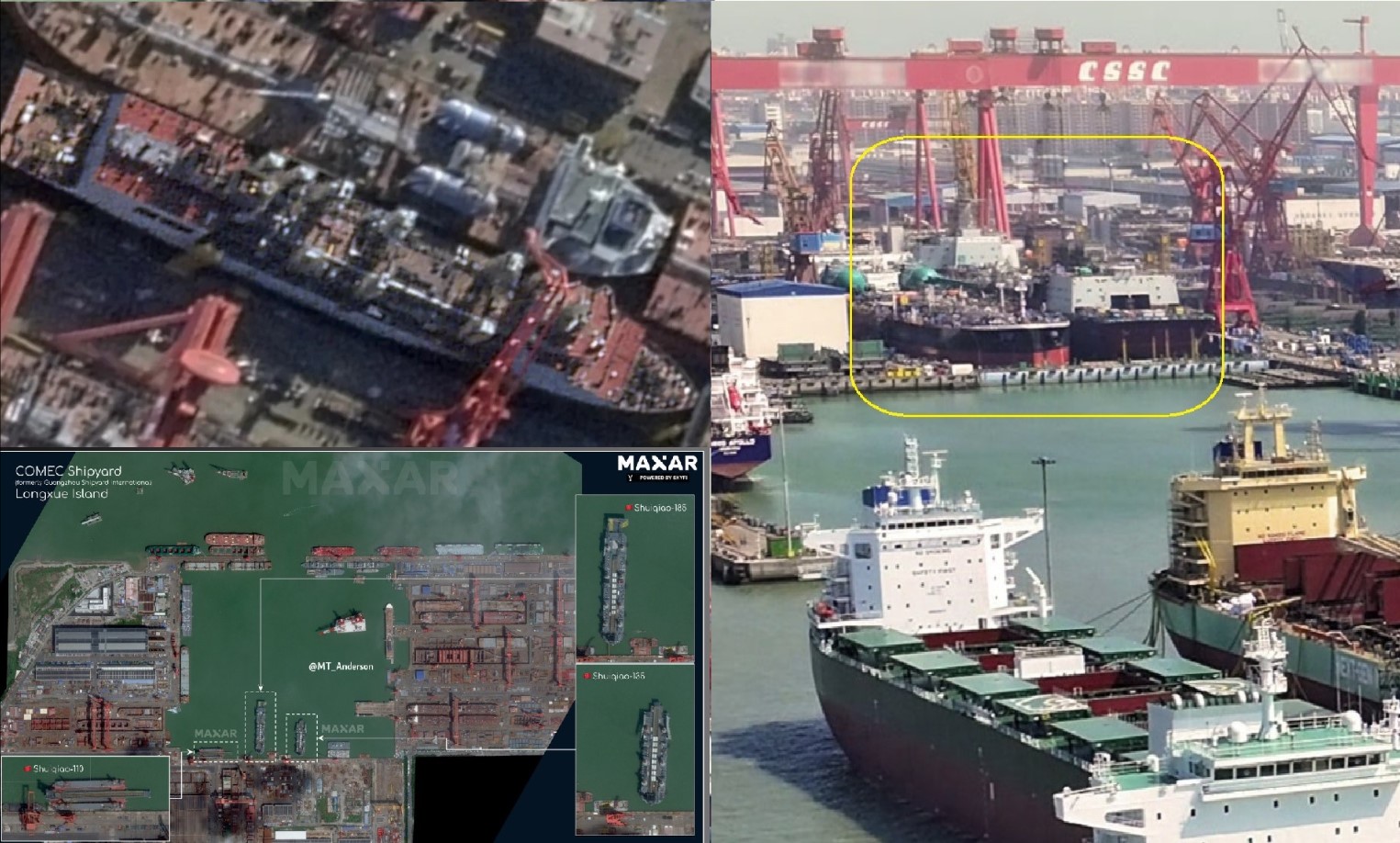
GUANGZHOU — China is advancing construction of what appears to be the world's largest naval replenishment ship, according to recent satellite imagery and defense analysis. The vessel, under construction at Longxue Island near Guangzhou, is significantly larger than China's existing fleet support ships and is expected to strengthen the People's Liberation Army Navy (PLAN) ability to sustain long-range naval operations.
The ship is being built at the CSSC Offshore and Marine Engineering Company (COMEC) shipyard, a subsidiary of the China State Shipbuilding Corporation (CSSC). The facility, formerly known as Guangzhou Shipyard International (GSI), has traditionally focused on commercial shipbuilding but has increasingly taken on military and dual-use naval projects in recent years.
🔎🇨🇳PLAN Amphibious Ambition: China’s Dual Paths to Cross-Strait Dominance Visible
— MT Anderson (@MT_Anderson) October 10, 2025
▶️PLAN Power Check: Imagery (Sept 29) from Longxue Island's COMEC Shipyard shows two strategic tracks for amphibious lift: continued production of logistics assets and high-tech combat… pic.twitter.com/VUUH96OTkO
Largest Replenishment Ship Under Construction
Satellite imagery from Planet Labs and assessments by defense analysts indicate that the vessel measures approximately 271 meters (885 feet) in length and 37 meters (121 feet) in beam, making it substantially larger than China's current Type 901 fast combat support ships.
Based on its dimensions, analysts estimate the vessel's displacement could range between 60,000 and 70,000 tons, although official specifications have not been released.
The ship's overall design closely resembles an enlarged version of the Type 901. Visible features include a forward superstructure with bridge wings and a mast, a separate stern superstructure with exhaust stacks, multiple midship replenishment stations for transferring fuel and cargo at sea, and a large stern flight deck with an integrated helicopter hangar for vertical replenishment operations.
A photograph released by CSSC in May 2026 showed the vessel's stern section with a large hangar featuring two openings. Satellite imagery captured on July 2, 2026, confirmed continued construction progress and revealed additional openings on the starboard side of the stern superstructure that may provide access for small boats or crew movement.
Open-source naval observers tracking the project have also reported that the flooded dry dock and the vessel's position alongside the berth indicate the ship was likely launched by mid-July 2026, with outfitting work expected to continue.
Built to Support Carrier Strike Groups
The new replenishment ship is expected to become a key logistics platform for the PLAN's growing blue-water fleet.
China currently operates two Type 901 fast combat support ships ' Hulunhu and Chaganhu ' along with several Type 903 and Type 903A replenishment vessels. These ships provide fuel, aviation fuel, ammunition, food, spare parts, and other supplies to naval task groups while underway.
The larger size of the new vessel suggests it will carry significantly greater quantities of fuel, dry stores, ammunition, and other supplies, allowing Chinese carrier strike groups to remain deployed for longer periods without returning to port.
This capability is particularly important for China's conventionally powered aircraft carriers, including Liaoning and Shandong, whose propulsion systems, embarked aircraft, and escort ships require continuous resupply during extended operations. The ship is also expected to support large amphibious assault vessels such as the Type 075 and the newer Type 076, both of which require substantial logistical support during long-distance deployments.
Shipyard Expands Military Construction
COMEC has historically built commercial vessels, including oil tankers, liquefied natural gas (LNG) carriers, semi-submersible heavy-lift ships, and offshore wind construction platforms.
In recent years, however, the shipyard has expanded into specialized military and dual-use projects. Previous construction work has included a stealth trimaran drone ship, modular jack-up barges designed for amphibious operations, a research vessel with carrier-like characteristics, and domestically produced Zubr-class heavy hovercraft.
The new replenishment ship represents one of the shipyard's most significant naval logistics projects to date.
Design Focused on Logistics
Defense intelligence firm Janes has described the vessel as a scaled-up evolution of the Type 901 design.
According to the firm's assessment, the ship features a broad, slab-sided hull with a large midsection optimized for carrying high volumes of fuel, ammunition, and supplies rather than maximizing speed. The visible refueling gantries positioned along both sides of the hull indicate it is designed to conduct underway replenishment of multiple vessels.
The vessel's final propulsion system, defensive armament, and full technical specifications have not been disclosed. Its predecessor, the Type 901, is equipped with four 30mm H/PJ-13 Gatling-type close-in weapon systems for self-defense.
Importance of At-Sea Replenishment
Modern naval operations depend heavily on replenishment ships to sustain deployments far from home ports. While aircraft carriers and warships can remain at sea for extended periods, they require regular deliveries of fuel, aviation fuel, ammunition, food, spare parts, and other supplies.
The importance of this capability has also been highlighted during recent U.S. Navy operations in the Middle East. Although U.S. aircraft carriers are nuclear-powered, their escort ships and embarked aircraft still require conventional fuel and logistical support.
During the Navy League's Sea-Air-Space exposition in April 2026, Robert Hein, Director of Maritime Operations for the U.S. Navy's Military Sealift Command, said logistical operations had become more challenging after traditional regional refueling options became less accessible, leading the service to establish continuous tanker rotations to keep deployed warships supplied.
The U.S. Navy has also acknowledged that its warships currently cannot reload vertical launch system (VLS) missiles while underway, requiring ships to leave operational areas and return to secure ports for rearming.
Expanding China's Blue-Water Logistics
Construction of the new replenishment ship reflects China's continued investment in naval logistics as it expands carrier operations and long-range deployments.
China has also been developing overseas port access and logistics facilities, although it still operates a much smaller overseas support network than the United States. A larger replenishment fleet allows the PLAN to reduce dependence on foreign ports by providing fuel, supplies, and ammunition directly at sea.
Construction of the vessel has progressed rapidly throughout 2026, with major hull sections added between March and May before launch preparations. If outfitting and sea trials proceed as expected, defense analysts assess the ship could enter PLAN service between 2027 and 2028, providing China with its largest and most capable fleet replenishment vessel to date.
Source : TWZ
——— End of Article ———