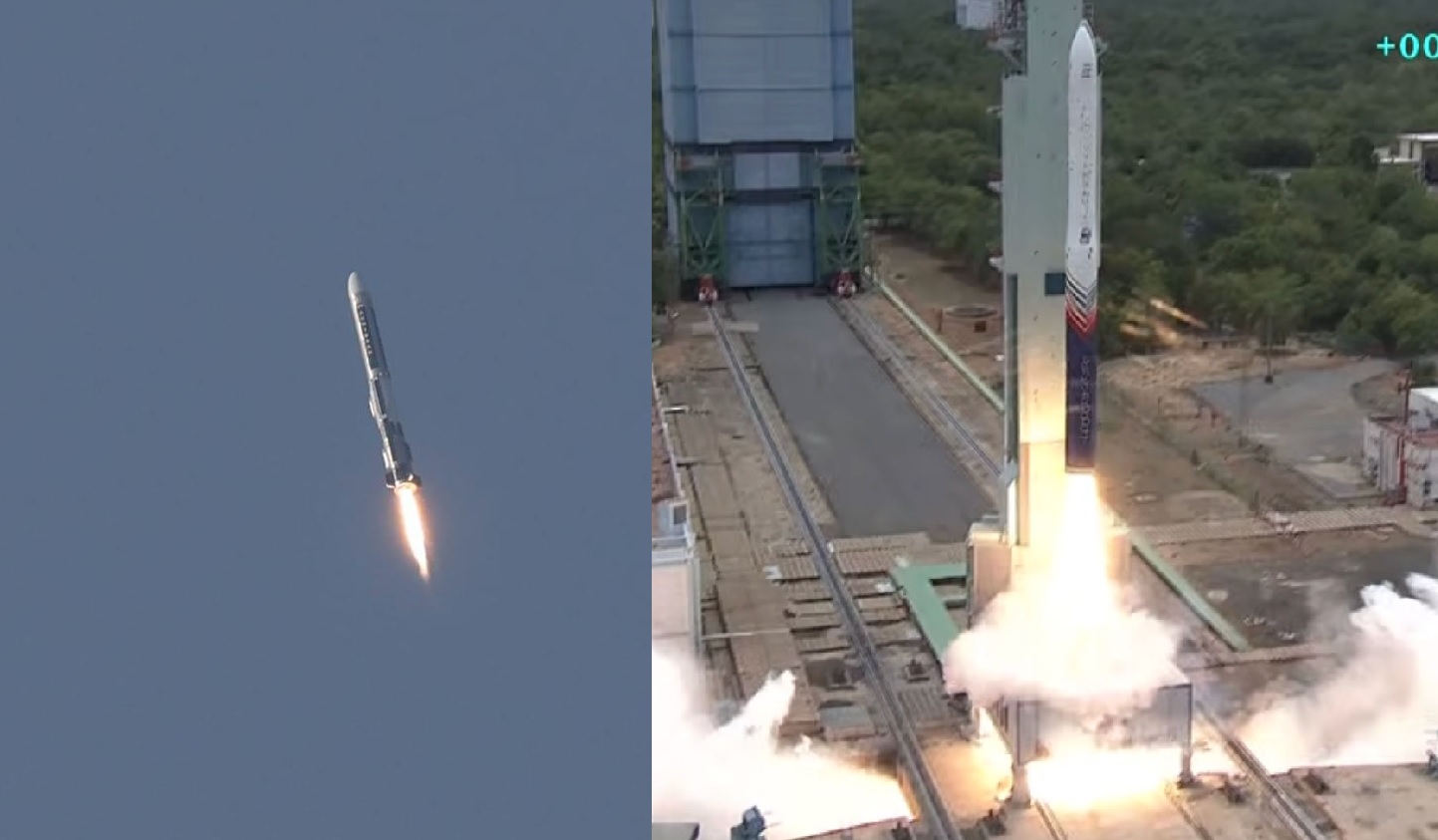
SRIHARIKOTA — Skyroot Aerospace successfully launched its Vikram-1 rocket from the Satish Dhawan Space Centre in Sriharikota on Saturday, becoming the first private Indian company to place a rocket into Earth’s orbit. The mission, named Mission Aagaman ("Arrival" in Sanskrit), marks a major milestone for India’s commercial space sector and makes India the third country after the United States and China to demonstrate private orbital launch capability.
The four-stage Vikram-1 rocket lifted off from the Indian Space Research Organisation’s (ISRO) First Launch Pad at 12:05 PM IST after a planned delay of about 35 minutes from the original 11:30 AM launch time to complete navigation-related checks. Despite cloudy weather conditions, the mission proceeded as planned.
After a flight lasting approximately 16 minutes, the rocket successfully deployed its payloads into a 450-kilometre Low Earth Orbit (LEO) with an inclination of around 60 degrees, completing its maiden orbital flight on the first attempt.
Vikram-1 Designed for Small Satellite Launches
Standing 24 metres tall, Vikram-1 is built using all-carbon composite structures to reduce weight while maintaining strength. The launch vehicle is designed to provide rapid and on-demand launch services for the growing small satellite market and is capable of carrying payloads of up to 350 kilograms to Low Earth Orbit.
The rocket uses three solid-propellant stages—Kalam-1200, Kalam-250, and Kalam-100—followed by a liquid-fuelled Orbital Adjustment Module. The upper stage is powered by a 3D-printed engine capable of performing precise orbital manoeuvres and multiple restarts in space, allowing accurate deployment of satellites.
Payloads Carried on Mission Aagaman
The maiden flight carried a mix of technology demonstration payloads, commercial satellites, international payloads, and symbolic items.
Among the commercial payloads was Skyroot's SCOPE satellite platform, which will collect flight performance data to support future missions. The rocket also deployed Grahaa Space's SOLARAS CubeSat and Cosmoserve Space's EMBRACE robotic arm demonstration, designed to test technologies for future orbital debris removal missions.
The mission also carried international payloads from Germany's DCubed, including the uD3PP and mD3RN technology demonstrations.
Several symbolic payloads were included as part of the mission. These included a handwritten postcard from Prime Minister Narendra Modi bearing the message "Vande Mataram", handwritten messages from Skyroot employees, investors, policymakers, and supporters, and "Diamond Lotus", also known as "Cosmic Bloom," a lab-grown diamond artwork created by Bengaluru-based Cosmos Diamonds to demonstrate infrastructure for high-value commercial space applications.
In addition, the rocket carried an 18-carat gold miniature rocket featuring micro-sculptures of Indian scientists C. V. Raman, Vikram Sarabhai, and A. P. J. Abdul Kalam, recognising their contributions to India's scientific and space programmes.
Eight Years of Development
Skyroot Aerospace was founded in 2018 by former ISRO engineers Pawan Kumar Chandana and Naga Bharath Daka. The development of Vikram-1 took approximately eight years and involved nearly 1,000 personnel supported by a supply chain of more than 400 companies.
The company had previously demonstrated its launch technology through the Vikram-S suborbital mission in 2022. The successful orbital launch of Vikram-1 now establishes Skyroot as India's first private company to independently reach orbit.
According to the company, Vikram-1 was fully designed and manufactured in India, supporting the country's expanding domestic space manufacturing capabilities.
Government Congratulates Skyroot Team
Following the successful launch, Prime Minister Narendra Modi congratulated the Skyroot team and described the mission as a defining moment for India's private space sector. He said the achievement reflects the innovation and entrepreneurial capabilities of India's youth and highlights the impact of the government's space-sector reforms that opened orbital launch opportunities to private companies.
The Prime Minister also spoke with Skyroot co-founders Pawan Kumar Chandana and Naga Bharath Daka after the mission.
External Affairs Minister S. Jaishankar also welcomed the successful launch, describing it as another important step in India's space journey.
Flight Data to Support Future Missions
Besides deploying its payloads, Mission Aagaman is expected to provide important flight data on the rocket's propulsion, stage separation, guidance, navigation, and control systems. The information gathered during the mission will be used to refine Vikram-1 and support future commercial launch operations.
The mission also demonstrates India's growing capability to provide dedicated launch services for small satellites, a market that continues to expand globally as demand increases for Earth observation, communications, scientific research, and technology demonstration missions.
Agnikul Cosmos Advances Reusable Launch Technology
In a separate development within India's private space industry, Agnikul Cosmos has announced plans for Mission-02, which aims to recover the first-stage booster of its Agnibaan rocket and reuse its upper stage as an in-orbit platform.
If successful, the mission would represent an important step toward reusable launch technology in India's commercial space sector, helping reduce launch costs and improve operational efficiency.
Skyroot Aerospace's successful Vikram-1 mission, together with ongoing efforts by other private companies, reflects the continued expansion of India's commercial space ecosystem as private industry takes on a larger role alongside ISRO in the country's space programme.
Source : ANI
——— End of Article ———