MOSCOW — Russia has introduced a newly modified Mi-8 helicopter equipped with an electronic warfare (EW) system designed to counter unmanned aerial systems (C-UAS) by disrupting the satellite navigation used by Ukrainian long-range strike drones.
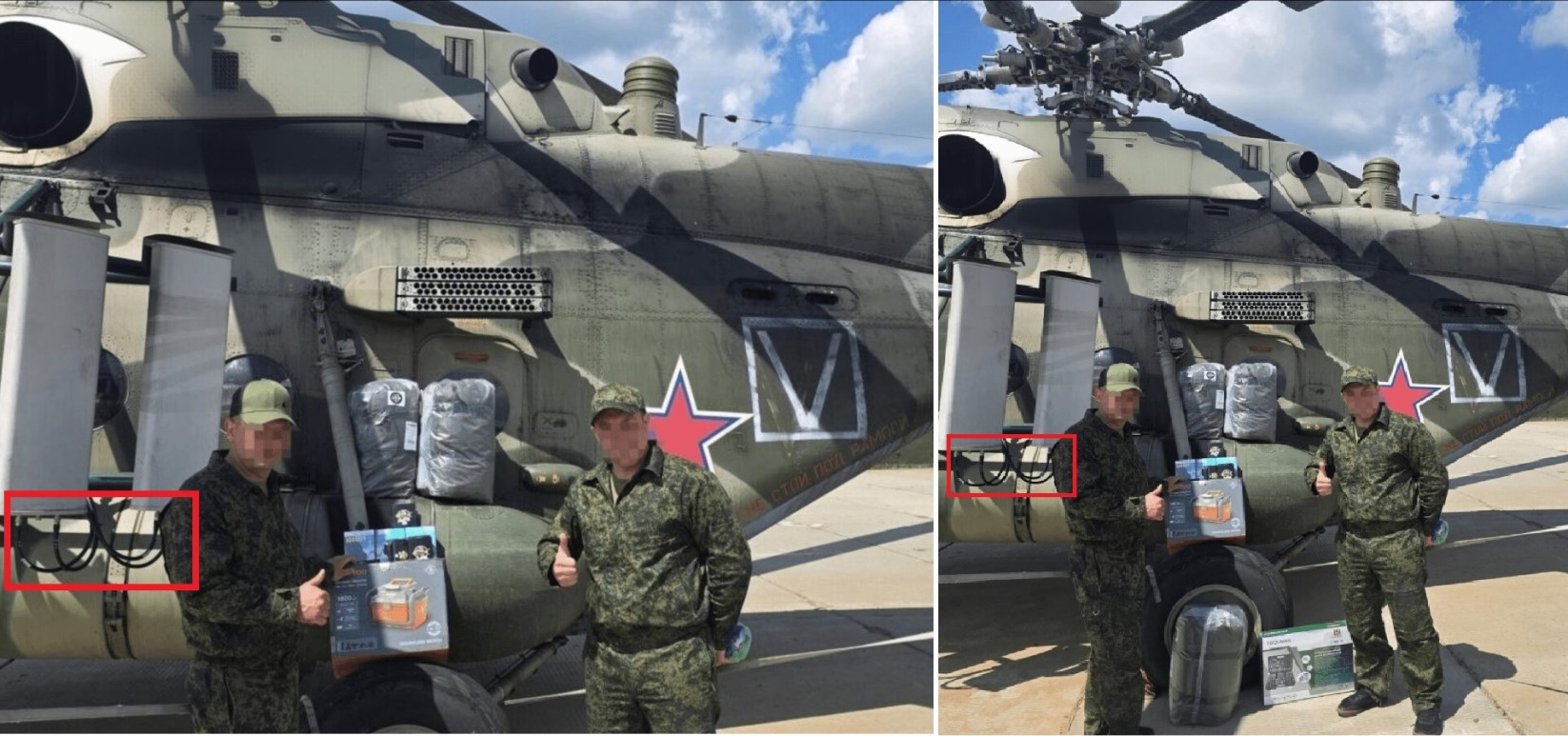
The previously undocumented configuration was first seen in photographs shared by Russian military blogger Kirill Fedorov on his Telegram channel. While Russian authorities have not officially released technical details, analysis of the images provides insight into the system's likely purpose and design.
Specialized Antenna Configuration
Images of the helicopter show several panel antennas mounted at different angles along the aircraft's fuselage. The arrangement provides approximately 180-degree coverage on one side, and analysts believe a similar installation is likely fitted on the opposite side to provide 360-degree protection.
Each antenna panel is connected by only two cables, suggesting the system operates on two separate channels or frequency bands rather than functioning as a broad-spectrum jammer.
Based on the antenna configuration, analysts believe the system is designed to target the fixed-frequency Global Navigation Satellite System (GNSS) signals used by long-range strike drones instead of the wider range of radio frequencies typically used by frontline first-person-view (FPV) drones.
Possible Operating Method
Defense analysts have proposed two primary explanations for the dual-channel configuration.
One possibility is dual polarization, where each cable controls a different antenna polarization. This would allow the system to transmit jamming signals in multiple polarizations, helping maintain effectiveness regardless of the orientation of a drone's navigation antenna.
Another theory is dual-band operation, with one channel targeting the L1 satellite navigation band (approximately 1.5–1.6 GHz) and the other covering the L2 or L5 bands (around 1.2 GHz). Such a configuration could interfere with multi-band GNSS receivers commonly installed on modern long-range strike UAVs.
Mobile Navigation Jamming Against Long-Range Drones
Many long-range drones use satellite navigation together with Inertial Navigation Systems (INS). While INS allows a drone to continue flying if satellite signals are lost, its positional accuracy gradually decreases because it calculates location based on movement rather than external navigation signals.
By installing the EW system on a Mi-8 helicopter, Russian forces can rapidly deploy the platform to areas facing potential drone attacks and create mobile zones of satellite navigation interference. Extended GNSS disruption forces drones to rely on INS for longer periods, increasing navigation errors before they reach their intended targets.
Analysts note that this concept is similar to the use of airborne electronic warfare platforms for creating mobile jamming coverage, an approach that Ukraine has also explored using light aircraft.
Different From Existing Mi-8 Electronic Warfare Variants
Russia already operates dedicated electronic warfare helicopters, including the Mi-8MTPR-1 equipped with the Rychag-AV system. Those aircraft are primarily intended for radar suppression and communications jamming over longer distances.
The newly observed configuration on a standard Mi-8 appears to serve a different role by focusing specifically on satellite navigation jamming against long-range unmanned aerial vehicles.
The exact designation, technical specifications, operational range, and deployment numbers of the new system have not been officially disclosed.
Russia Expands Mi-8 Helicopter Production
The appearance of the new EW-equipped Mi-8 comes as Russia increases production of the helicopter under its state defense program.
According to a report by the private analytical firm Dallas Analytics, the Kazan Helicopter Plant is scheduled to manufacture 72 Mi-8MTV-1 multipurpose helicopters between 2026 and 2027.
The report states that at least 37 helicopters are expected to be delivered to the Russian military during 2026, significantly exceeding earlier estimates of around 20 aircraft per year.
The Kazan facility works with suppliers including Russian Helicopters, United Engine Corporation, and Concern Radio-Electronic Technologies, which provide engines, avionics, and electronic systems for the aircraft.
The Mi-8 family continues to serve in multiple roles across the Russian military, including troop transport, logistics, attack support, search and rescue, and electronic warfare missions. The addition of a satellite navigation-jamming configuration represents another adaptation of the platform aimed at countering long-range drone operations.
Source : militarnyi
——— End of Article ———