WASHINGTON — The U.S. Navy is reviewing major design changes to its Gerald R. Ford-class aircraft carriers to make them more closely resemble earlier U.S. warships, according to current and former U.S. officials cited by The Washington Post.
One proposal would move the multi-level command island from its current aft position toward the middle of the ship. President Donald Trump has expressed a preference for the appearance of World War II-era warships.
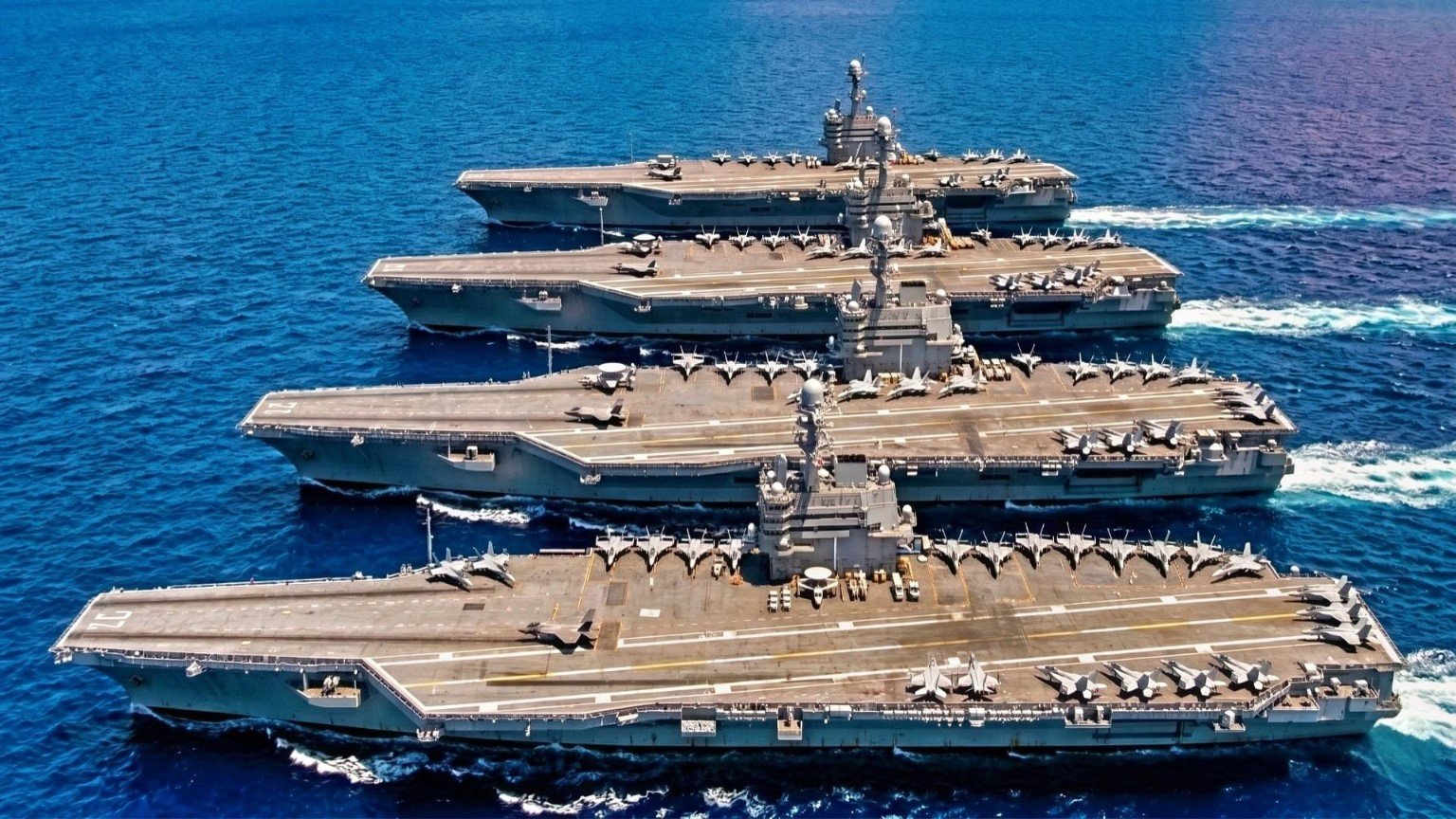
The current aft island arrangement was selected for operational reasons. It provides more deck space around the catapults, helps position aircraft for launch, and reduces turbulence around the angled landing area. A similar review during Trump's first administration concluded that moving the island would require a major structural redesign, potentially affecting the carrier's buoyancy and weight distribution and causing significant costs and delays.
The Navy has not made a final decision, and the island review remains in its early stages.
Steam Catapults Planned for Future Carrier
The review follows Trump's August 13, 2026 national security memorandum, which directs the Pentagon to develop a plan within 60 days to replace EMALS and advanced weapons elevators with conventional steam catapults and hydraulic systems, beginning with the future USS Doris Miller (CVN-81).
The first three Ford-class carriers — USS Gerald R. Ford, USS John F. Kennedy and USS Enterprise — will retain their electromagnetic systems. The Doris Miller, the fourth ship of the class, is being built by Huntington Ingalls Industries' Newport News Shipbuilding.
The Navy selected EMALS in 2009, and the USS Gerald R. Ford had completed more than 36,000 EMALS launches by March 2026. The proposed change has raised cost, schedule and integration concerns because the Doris Miller is already under construction and EMALS production is reportedly nearly 50 percent complete. General Atomics, EMALS' manufacturer, has warned of additional integration and schedule risks.
Ford-Class and $275 Billion Battleship Program
The lead USS Gerald R. Ford took about 17 years to construct, while future Ford-class carriers have been estimated at roughly $22 billion each.
Meanwhile, the administration is pursuing the proposed Trump-class, or BBG(X), nuclear-powered guided-missile battleships as part of the proposed "Golden Fleet." Trump announced the concept in December 2025, with the first ship planned as USS Defiant.
The Congressional Budget Office estimates that building 15 ships between 2028 and 2056 would cost about $275 billion. The lead ship is projected at $23.4 billion, with subsequent ships averaging about $18 billion.
Earlier congressional material describes the proposed battleships as 840 to 880 feet long and more than 35,000 tons at full load. Planned weapons include long-range missiles, hypersonic weapons, nuclear-armed cruise missiles, high-powered lasers and a railgun. The Navy describes the BBG(X) as a large surface combatant intended for long-range offensive fires, integrated air and missile defense, and command-and-control capabilities.
The programs come as the Navy faces continuing shipbuilding capacity, labor, cost and schedule challenges. Adding a new battleship class while continuing other major warship programs would place additional demands on the U.S. shipbuilding industrial base, while any Ford-class redesign would have to be integrated into an already established carrier construction program.
——— End of Article ———