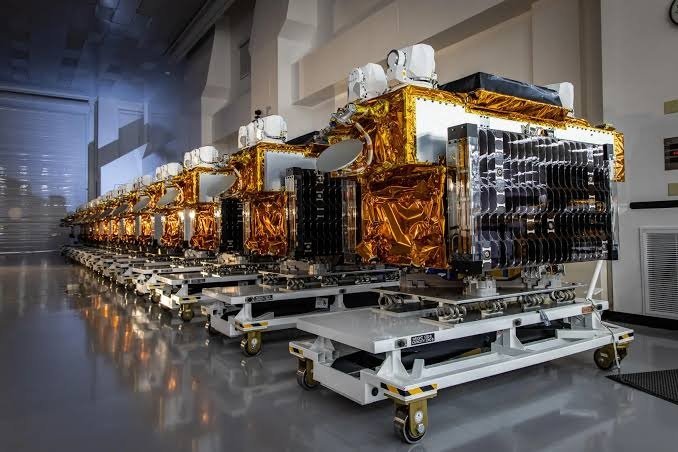
VANDENBERG SPACE FORCE BASE, Calif. — Northrop Grumman has delivered 21 military communications satellites to Vandenberg Space Force Base in California, marking its first batch of spacecraft for the Space Development Agency’s (SDA) Tranche 1 Transport Layer.
The satellites are part of the Pentagon’s Proliferated Warfighter Space Architecture (PWSA), a planned low-Earth-orbit network designed to rapidly move targeting data and other military information around the world. The Transport Layer will also support data transport for the SDA’s Tracking Layer, which is focused on missile warning and tracking.
126 Transport Layer satellites planned
The Tranche 1 Transport Layer will consist of 126 satellites. Northrop Grumman is building 42, while Lockheed Martin and York Space Systems are each producing 42. The companies received contracts in 2022 as part of awards totaling about $1.8 billion.
The satellites are designed to provide secure, resilient and low-latency communications between military forces on the ground, in the air and at sea. They also include Link 16 capability, allowing tactical data to be transmitted directly to existing military systems.
The network is designed around open architecture standards so satellites, payloads and ground systems from different providers can operate together. Optical inter-satellite links will allow spacecraft to exchange data in orbit and form an interconnected mesh.
Launches to begin in October
The first Tranche 1 satellites are expected to launch aboard a SpaceX Falcon 9 from Vandenberg as early as October 2026.
Northrop Grumman said several dozen additional PWSA spacecraft are expected to launch over the next six months, supporting both secure communications and missile-tracking missions. The company said the 21 delivered satellites are the first batch from a larger pipeline of about 150 spacecraft it is producing for the overall effort.
SDA plans to deploy Tranche 1 across 10 orbital planes. The broader plan includes 126 Transport Layer satellites, 28 Tracking Layer satellites and four additional demonstration spacecraft. SDA expects the Transport and Tracking satellites to reach orbit and form their interconnected network within roughly six to eight months.
63 Transport satellites already in orbit
So far, 63 Transport Layer satellites are already on orbit. York Space Systems supplied 42 through two launches, while Lockheed Martin supplied 21. Earlier launches faced technical and operational challenges that resulted in a pause, with launches resuming in July 2026 with another group of York satellites.
Northrop Grumman said dozens of additional spacecraft have been fully integrated and are undergoing final checks. The company is using part of its roughly 7 million square feet of space-program manufacturing facilities, including advanced manufacturing systems and artificial intelligence tools, to support higher-volume production.
Keith Matthews, Northrop Grumman’s Tranche 1 Transport Layer program manager, said the production approach is supporting scalability. Lou Christen, senior director of proliferated systems, said the company is focused on integrating its spacecraft into the wider architecture supporting national defense requirements.
Once deployed, the Tranche 1 Transport Layer is intended to provide the initial warfighting capability of the PWSA, while expanding the Pentagon’s low-Earth-orbit communications and missile-tracking network.
——— End of Article ———