WASHINGTON, — May 20, 2026 : The U.S. Navy’s MQ-25A Stingray uncrewed aerial refueling aircraft has officially received Milestone C approval, allowing the program to transition into Low-Rate Initial Production (LRIP) and marking a major advancement toward operational carrier deployment.
Acting Secretary of the Navy Hung Cao announced the decision during a Senate Armed Services Committee hearing on May 19, less than a month after the aircraft completed its first production-representative flight.
According to the Navy’s Portfolio Acquisition Executive for Aviation, the first LRIP contract covering three MQ-25A aircraft is expected to be awarded this summer. The agreement will also include priced options for three additional aircraft under Lot 2 and five aircraft under Lot 3.
“Unmanned refueling extends our reach against any adversary,” Cao said during the hearing. He stated that moving the MQ-25A Stingray into production would strengthen the operational capability and flexibility of U.S. carrier strike groups while increasing the availability of combat aircraft within the carrier air wing.
Vice Adm. John E. Dougherty IV, Portfolio Acquisition Executive for Aviation, described Milestone C approval as a critical step for the program, stating that the aircraft would provide persistent aerial refueling capability and expand operational capacity across the air wing.
Capt. Daniel Fucito, manager of the Unmanned Carrier Aviation Program Office (PMA-268), stated that the aircraft, production infrastructure, and supporting program elements are prepared to advance fleet capability, readiness, and operational capacity.
Boeing, the prime contractor for the program, welcomed the approval. Troy Rutherford, vice president of Boeing’s MQ-25 program, stated that the company remains focused on delivering the aircraft to the fleet and integrating the system into carrier air wing operations.
First Production Aircraft Completes Maiden Flight
The production-representative MQ-25A completed its maiden flight on April 25, 2026, from MidAmerica St. Louis Airport in Mascoutah, Illinois. The aircraft flew for approximately two hours and successfully demonstrated basic flight controls, engine performance, autonomous taxiing, takeoff, landing, and handling characteristics during a pre-planned mission profile.
Both Boeing and Navy Air Vehicle Pilots controlled the aircraft using the Unmanned Carrier Aviation Mission Control System (UMCS) MD-5 ground control station, which integrates Lockheed Martin’s MDCX control system.
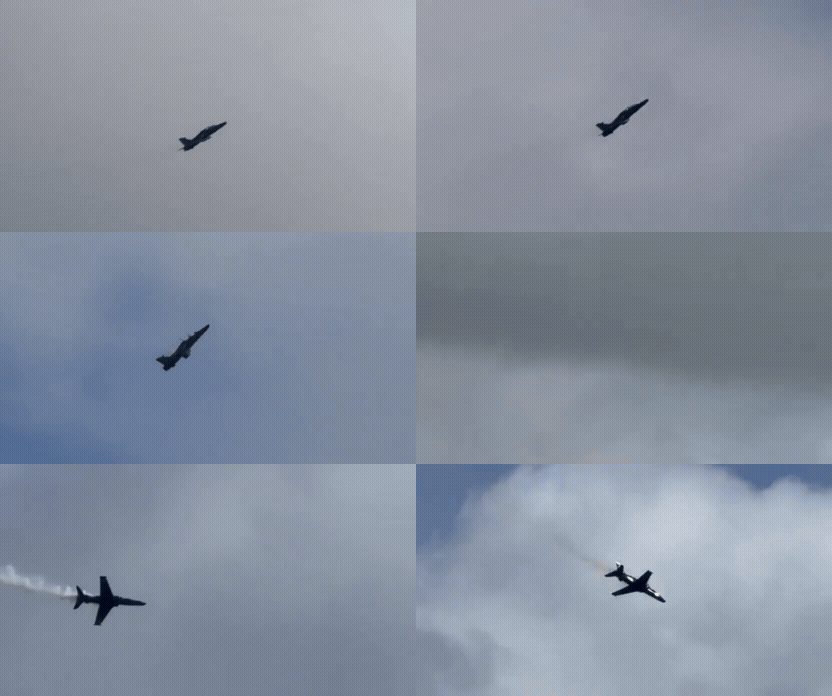
The sortie was supported by a company-owned TA-4J Skyhawk and a U.S. Navy UC-12M Huron operating as chase aircraft.
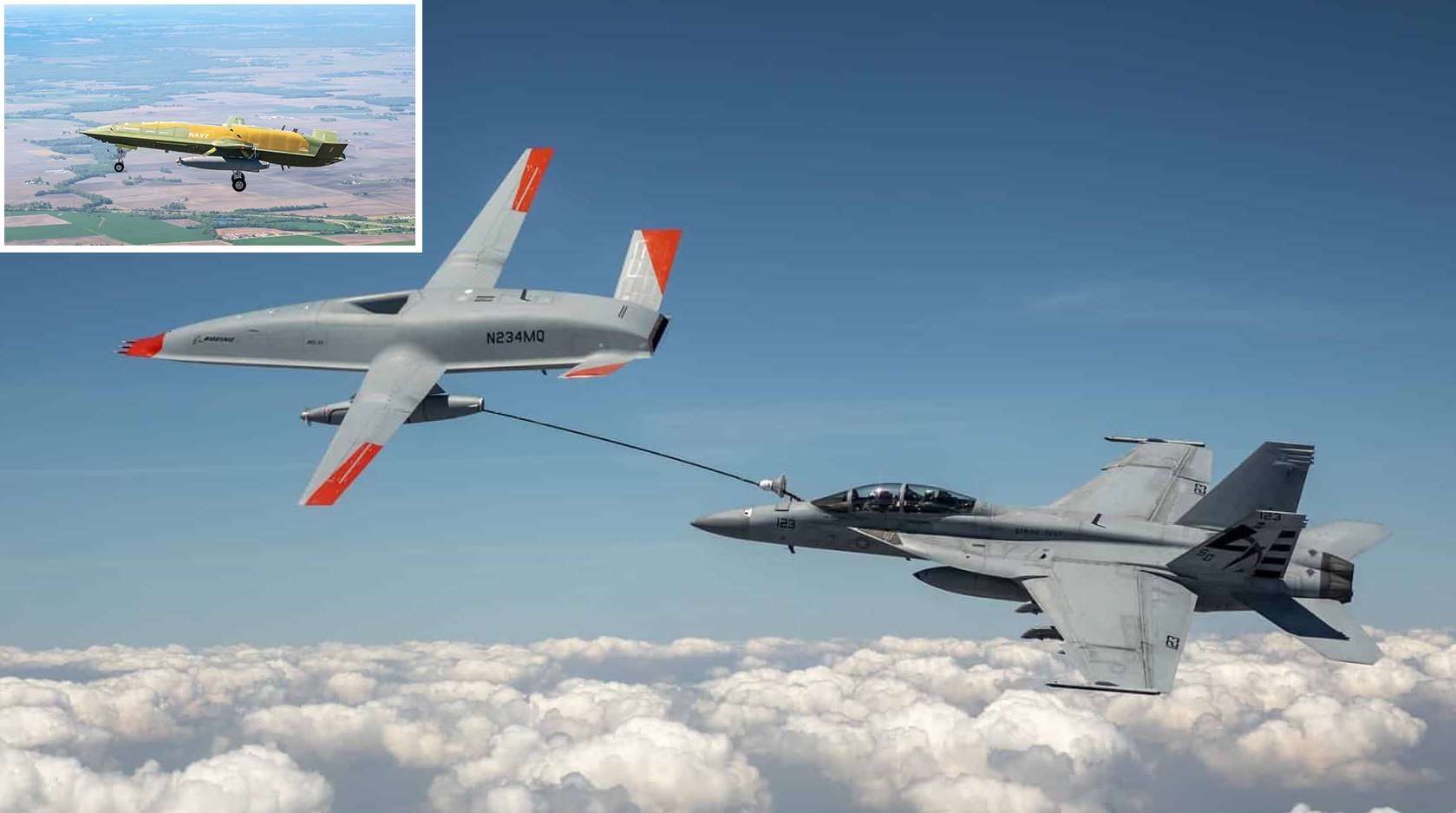
The production-standard MQ-25A incorporates several modifications compared with the earlier T1 demonstrator, including a redesigned engine air inlet, a straight-wing configuration, and folding wings optimized for carrier deck handling and storage operations aboard aircraft carriers.
The aircraft carried a Cobham Aerial Refueling Store (ARS) pod, the same system currently used by the Navy’s F/A-18 fleet. According to a Navy report submitted to Congress in August 2025, the MQ-25A is expected to deliver between 14,000 and 16,000 pounds of fuel at a range of 500 nautical miles while maintaining endurance exceeding 12 hours.
The first flight of the production-representative aircraft occurred nearly seven years after the initial flight of the Boeing-owned MQ-25 T1 test asset in September 2019.
Production Structure and Procurement Plans
The aircraft used during the maiden flight is the first of four Engineering Development Model (EDM) aircraft being produced under an $805 million contract awarded to Boeing in 2018.
The complete MQ-25 test fleet will include four Engineering Development Model aircraft, five System Demonstration Test Articles, and two dedicated ground test articles for static and fatigue testing.
Assembly work is being conducted at Boeing’s 300,000-square-foot production facility in Mascoutah, Illinois.
The U.S. Navy plans to procure a total of 76 MQ-25A aircraft, including EDM and System Demonstration aircraft. Current Navy estimates place the total program cost for 72 production aircraft at approximately $13 billion.
Expanding Carrier Strike Group Reach
The MQ-25A Stingray is designed primarily to provide carrier-based aerial refueling support for U.S. Navy aircraft operating from carrier strike groups.
The aircraft will assume the aerial refueling mission currently performed by F/A-18E/F Super Hornets assigned to carrier air wings. By shifting this role to the MQ-25A, the Navy intends to free Super Hornets for combat and strike missions while reducing structural fatigue on the fighter fleet and improving aircraft availability.
The Stingray will also become the first operational carrier-based uncrewed aircraft in U.S. Navy service, establishing a foundation for future manned-unmanned teaming operations aboard aircraft carriers.
In addition to aerial refueling, the MQ-25A will support recovery tanking missions and provide intelligence, surveillance, and reconnaissance (ISR) capabilities for carrier strike groups.
The Navy previously demonstrated the platform’s aerial refueling capability in 2021, when the Boeing-owned MQ-25 T1 test asset successfully transferred fuel to a U.S. Navy F/A-18F Super Hornet during the first air-to-air refueling mission conducted between an uncrewed tanker and a manned receiver aircraft.
Fleet Integration and Carrier Qualification
The Fleet Replacement Squadron for the MQ-25A, Unmanned Carrier-Launched Multi-Role Squadron Ten (VUQ-10), was established at Naval Air Station Patuxent River in October 2022. The Navy also plans to establish two operational squadrons, VUQ-11 and VUQ-12.
Following completion of the initial flight-test series, the first production-representative aircraft is scheduled to relocate later this year to Naval Air Station Patuxent River to begin carrier qualification testing.
Carrier qualification operations are expected to take place aboard the USS Theodore Roosevelt (CVN-71) as the Navy prepares the MQ-25A for operational integration into future carrier strike group deployments.
——— End of Article ———