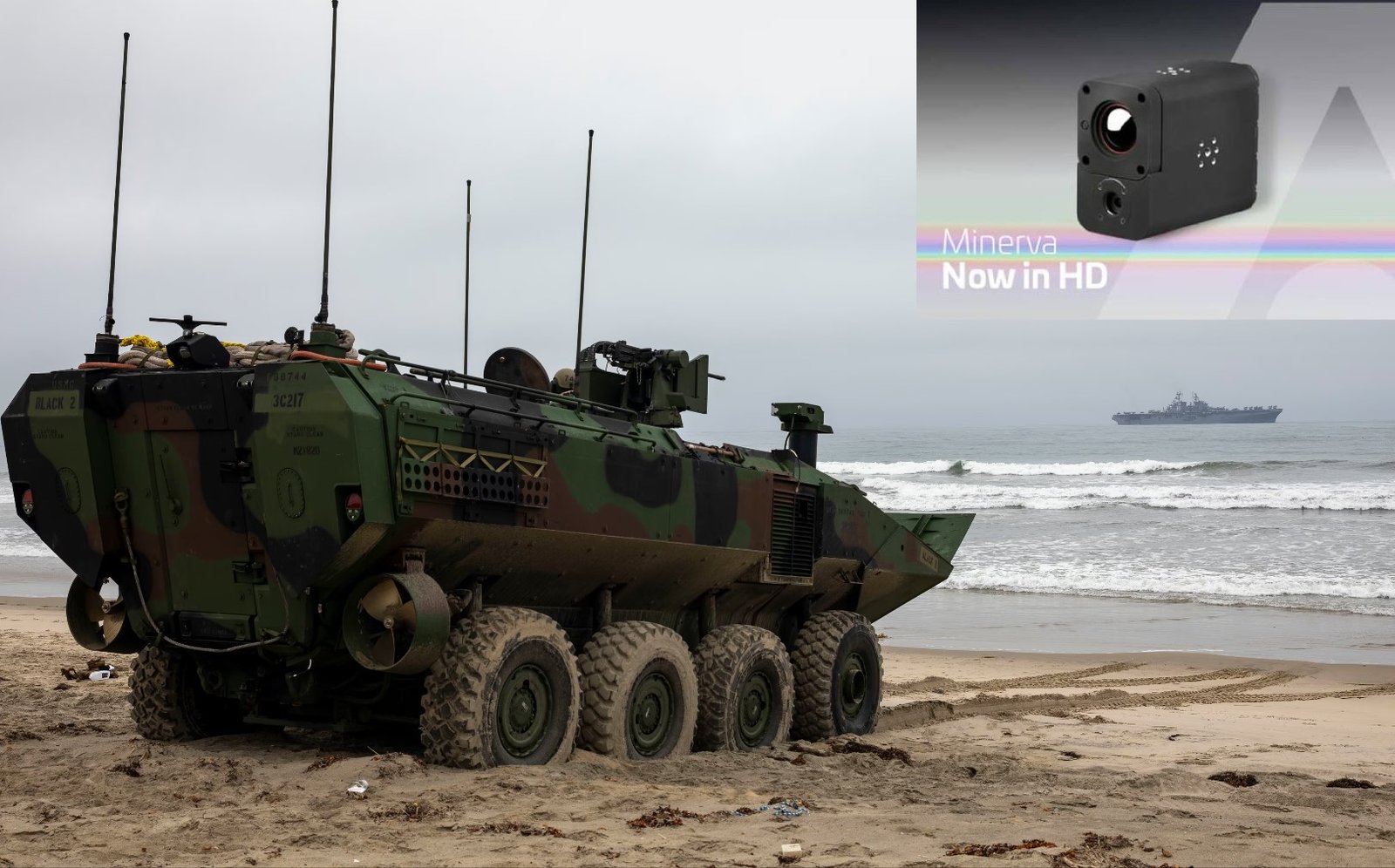
WASHINGTON — Thales Defense & Security, Inc. (TDSI) has received an order to supply the U.S. Marine Corps with more than 400 SharpView Dual Camera – Minerva imagers for its Amphibious Combat Vehicles (ACVs).
The cameras will be installed on the ACV-P Personnel and ACV-C Command variants, replacing legacy imaging systems and improving crew visibility and situational awareness in conditions such as darkness, dust, smoke, glare and adverse weather.
Minerva combines an uncooled Long Wave Infrared (LWIR) thermal detector and a visible-light camera in one compact housing. It features a 1280 × 1024 LWIR detector with a 12-micron pixel pitch and a 1920 × 1080 full-HD visible module. The system provides digital 60 Hz video through 3G-SDI, with low-latency output and automatic image processing.
The dual-band system is designed to help crews detect obstacles, navigate and maintain situational awareness during day and night operations. Its integration with existing vehicle systems also allows the Marine Corps to replace legacy cameras without developing a new vehicle imaging architecture.
The Minerva camera is designed and manufactured by Thales in Canada and was launched in 2022. Thales said its combat imaging systems are used by more than 50 armed forces worldwide, building on more than 30 years of experience in cooled and uncooled thermal imaging.
“Marines depend on cutting-edge and robust technology to make rapid decisions in highly demanding and dynamic environments,” said Chris Beauparant, Vice President of Sensors and Missile Systems at Thales Defense & Security, Inc. He said Minerva provides crews with a more complete picture of the battlefield and helps them identify hazards sooner and maneuver more effectively.
Thales confirmed the order in an announcement published on August 11, 2026. The cameras will be used on both new and existing ACV-P and ACV-C vehicles.
The Minerva system has also been selected for evaluation and testing under the U.S. Army's XM30 program, which focuses on next-generation combat vehicles with improved crew protection and situational awareness.
The Marine Corps' ACV program, led by BAE Systems, includes the ACV-P, ACV-C, ACV-30 fire-support variant and ACV-R recovery variant, with current plans calling for around 632 vehicles. Thales already supplies related electro-optical systems for U.S. Marine Corps ground vehicles, including cooled SharpView cameras for the Marine Air Defense Integrated System (MADIS) and Catherine thermal imagers for the ACV-30.
——— End of Article ———