PATUXENT RIVER, Maryland, — May 23, 2026 : A United States Marine Corps F-35B Lightning II fighter jet has conducted its first integration and carriage flight tests with the British-developed SPEAR 3 small-diameter air-to-ground cruise missile, marking an early milestone in efforts to equip the fifth-generation stealth aircraft with a new stand-off precision weapon.
The milestone was confirmed by the official F-35 Lightning II program and follows flight trials carried out earlier in 2026 at Naval Air Station Patuxent River by the F-35 Integrated Test Force. The tests were conducted jointly by specialists from the aerospace manufacturer Lockheed Martin and British missile developer MBDA UK as part of a broader engineering effort to formally integrate the SPEAR 3 into the Royal Air Force (RAF) and Royal Navy F-35B fleets.
Internal Weapons Bay Configuration and Stealth Preservation
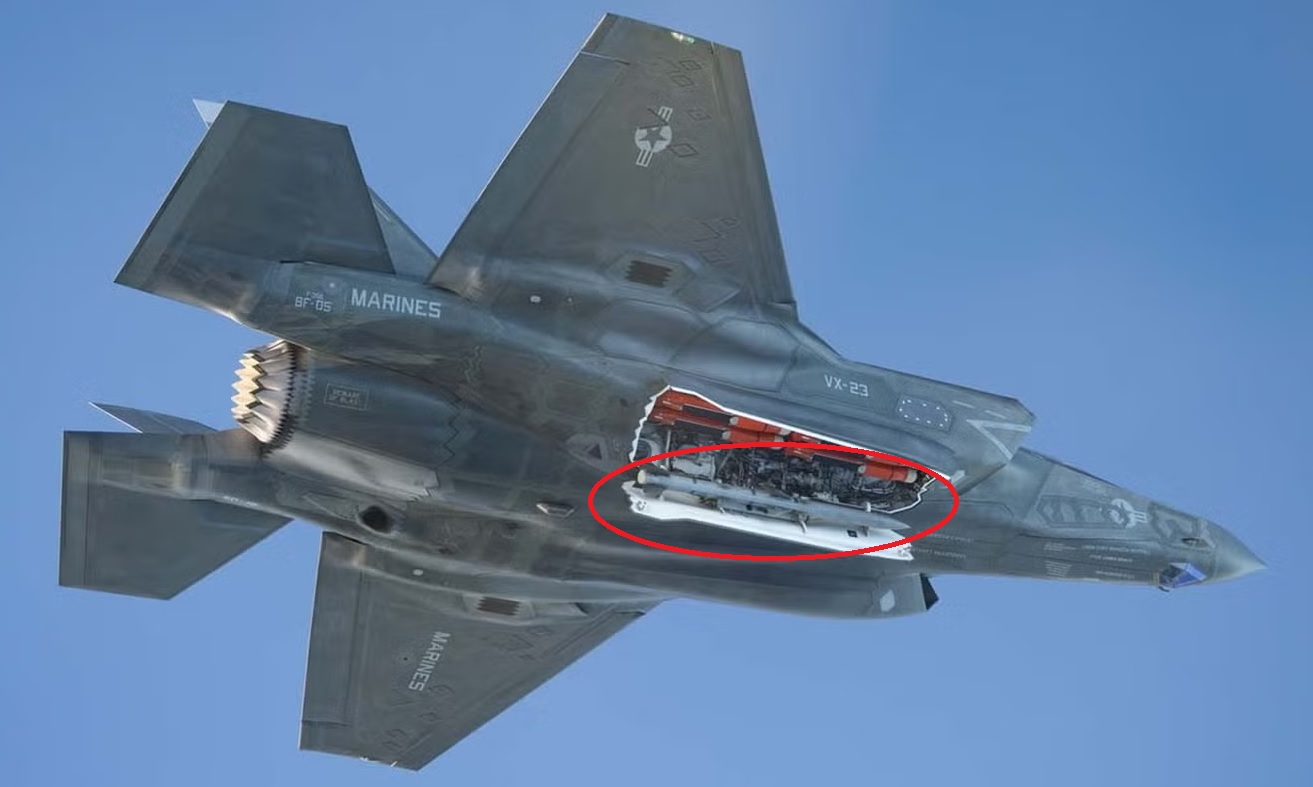
Official photographs released during the trials showed a U.S. Marine Corps F-35B carrying four SPEAR 3 missiles fitted inside one internal weapons bay alongside a single AIM-120 Advanced Medium-Range Air-to-Air Missile (AMRAAM). Under an operational configuration, the aircraft is expected to carry up to eight SPEAR 3 missiles across both internal bays while maintaining air-to-air armament.
The internal carriage arrangement enables the aircraft to preserve its low-observable stealth characteristics by avoiding the use of external hardpoints, which can increase radar visibility. The integration is also expected to expand future export prospects for the missile, with countries including Italy and Germany evaluating the SPEAR 3 for potential use on F-35 and Eurofighter Typhoon aircraft.
UK Sovereign Weapons Integration Program
The SPEAR 3 integration forms part of a wider United Kingdom Ministry of Defence effort to strengthen sovereign missile and precision-strike capabilities while reducing dependence on U.S.-produced weapons systems. Alongside SPEAR 3, British authorities are also progressing plans to integrate the Meteor Beyond Visual Range Air-to-Air Missile (BVRAAM) onto the F-35 platform.
The UK’s F-35B fleet already employs domestically integrated weaponry, including the ASRAAM short-range air-to-air missile and the Paveway IV laser-guided precision bomb. Britain’s ability to independently integrate such systems originates from its position as the sole Tier 1 partner in the original Joint Strike Fighter program, which later evolved into the F-35 Lightning II program.
This role granted the United Kingdom technical access and integration capabilities not available to most countries procuring the aircraft through standard U.S. Foreign Military Sales (FMS) channels. In addition, the country operates as one of Europe’s largest maintenance and support centers for F-35 variants, particularly the short takeoff and vertical landing (STOVL) F-35B.
Building on Previous Typhoon Trials in Sweden
The current F-35B integration effort builds upon earlier SPEAR 3 guided firing tests conducted in November 2024 at the Vidsel military range in northern Sweden. During those trials, a Royal Air Force Eurofighter Typhoon from the 41st Test and Evaluation Squadron, operating alongside a BAE Systems test team, launched a telemetry-equipped missile in place of a live warhead.
The missile autonomously navigated its flight path and successfully engaged a target during guided firing evaluations. Data gathered during these Typhoon trials is currently being used to support software development and compatibility work required for full F-35B integration.
SPEAR 3 Missile Technical Specifications
The SPEAR 3 (Selective Precision Effects At Range Capability 3) is a compact air-launched cruise missile derived from the Brimstone anti-armor missile family. Measuring approximately 1.8 meters in length and 180 millimeters in diameter, and weighing under 90 kilograms, the missile replaces a traditional rocket motor with a PBS TJ150 turbojet engine and deployable wings.
This propulsion system enables high subsonic flight and extends the missile’s launch range to approximately 150 kilometers. During mid-course flight, the weapon relies on an inertial navigation system (INS) combined with GPS guidance to track position and trajectory.
For terminal engagement, SPEAR 3 uses a modular seeker package that can be configured with active radar, semi-active laser, or anti-radiation guidance depending on mission requirements. This flexibility enables the missile to engage armored targets, radar stations, and enemy air defense systems.
Due to its compact size, the missile can also be mounted on triple-launch configurations, theoretically allowing a Eurofighter Typhoon to carry up to 18 SPEAR 3 missiles. However, under current operational planning, the F-35B remains the primary integration platform, maximizing both stand-off strike range and low-observable combat characteristics.
Future Integration Timeline
Data collected during the recent carriage flight tests is expected to support future mission systems integration, weapons separation and jettison testing, and software validation activities. According to current program expectations, the SPEAR 3 is anticipated to enter operational service with the UK F-35B fleet in the early 2030s, further expanding the aircraft’s precision stand-off strike capabilities.
——— End of Article ———