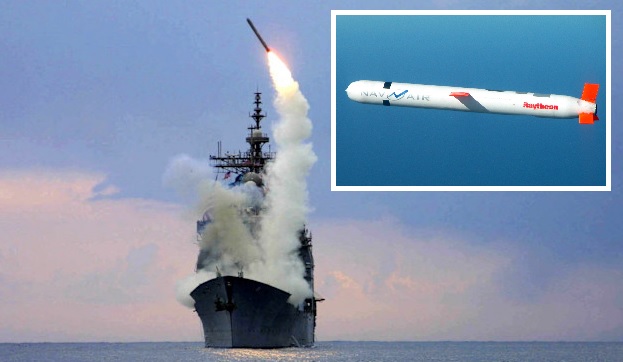
WASHINGTON/TOKYO, — May 24, 2026 : The United States has indefinitely suspended the planned delivery of 400 RGM-109 Tomahawk cruise missiles to Japan following significant shortages in U.S. Navy munitions caused by the 39-day military campaign against Iran. The delay affects Japan’s $2.35 billion missile acquisition program and is expected to slow Tokyo’s efforts to field a long-range counterstrike capability.
U.S. Secretary of Defense Pete Hegseth formally informed Japanese Defense Minister Shinjiro Koizumi earlier in May that delivery of the missiles would be postponed indefinitely. The contract for the 400 Tomahawk missiles was signed in January 2024 and originally scheduled deliveries between fiscal years 2025 and 2027.
The Tomahawk acquisition was intended to serve as an interim capability while Japan develops indigenous long-range strike systems. The suspension now raises operational and procurement challenges for Japan’s evolving military posture, particularly as the country accelerates plans to expand its ability to strike hostile targets at greater distances.
Rapid Depletion of U.S. Missile Stockpiles
The suspension comes after heavy consumption of U.S. precision munitions during operations against Iran. By the final week of March, Pentagon estimates suggested the U.S. Navy had expended nearly 1,000 Tomahawk cruise missiles from a pre-conflict inventory estimated at between 3,000 and 4,500 missiles.
During the opening phase of the campaign, U.S. forces reportedly struck more than 6,000 Iranian targets in the first 10 days, relying extensively on beyond-visual-range precision weaponry. Pentagon officials and defense analysts subsequently raised concerns over the pace of munitions expenditure and the strain it placed on U.S. readiness and replenishment timelines.
The Tomahawk remains the U.S. Navy’s principal medium- and long-range land-attack missile and is deployed aboard destroyers, cruisers, and attack submarines. Since the late 2010s, the system has increasingly been adapted for ground-based launchers, further expanding its operational role.
Historically, the U.S. Navy procured Tomahawk missiles at relatively low annual rates of approximately 50 units. Although Washington has expanded agreements with RTX Corporation to significantly increase manufacturing, defense officials note that restoring depleted stockpiles will likely take several years due to industrial production constraints and lead times that may extend up to two years.
The munitions shortage extends beyond Tomahawk cruise missiles. U.S. stockpiles of Precision Strike Missiles (PrSM), Patriot and THAAD interceptors, SM-3 and SM-6 air-defense interceptors, and GBU-57 penetrative bombs were also heavily depleted during the conflict, with several categories reportedly exhausted at even faster rates than Tomahawks.
Impact on Japan’s Defense Transition
The delay directly affects Japan’s ongoing transition toward deploying long-range offensive strike capabilities. In March 2026, the Japanese Maritime Self-Defense Force destroyer JS Chokai (DDG-176) became the first Japanese vessel to complete the required modifications and crew training to operate Tomahawk Block IV and Block V missiles.
The destroyer underwent integration work and operational training at Naval Base San Diego beginning in October 2025. Japan intends to eventually deploy Tomahawk missiles across its eight Aegis-equipped destroyers, including four Kongō-class, two Atago-class, and two Maya-class vessels, while two additional Aegis system-equipped ships are scheduled to enter service in 2027 and 2028.
For decades, Japanese naval doctrine focused primarily on anti-submarine warfare and missile defense missions rather than long-range strike operations. However, Tokyo gradually shifted policy beginning in the late 2010s to develop capabilities aimed at striking hostile military infrastructure if necessary.
The transition has generated domestic political debate because of restrictions associated with Japan’s pacifist constitution, although the move has received considerable support from Western security partners. Regional allies such as the United States and Australia have long operated Tomahawk-equipped AEGIS destroyers, while South Korea maintains domestically developed cruise missile systems.
Wider Foreign Military Sales Delays
Japan is among several U.S. defense clients facing procurement disruptions linked to post-conflict shortages. In January 2026, a Japanese government audit found that 118 defense procurement contracts worth approximately 1.14 trillion yen ($6.9 billion), purchased under the U.S. Foreign Military Sales (FMS) system, had remained undelivered more than five years after signing.
On May 22, Acting U.S. Navy Secretary Hung Cao confirmed that deliveries of approximately $14 billion in defense equipment to Taiwan had also been temporarily suspended. The delay adds to a broader backlog of undelivered U.S. military equipment to Taiwan that had already exceeded $21.45 billion by December 2025.
Washington had also previously informed several European allies to expect delays in military deliveries as depleted inventories forced the Pentagon to prioritize replenishment. Reports from late March further indicated that equipment originally designated for Ukraine had been redirected to support operations against Iran, with Secretary Hegseth stating that restoring U.S. military stockpiles would take precedence.
Strategic Repositioning and Regional Implications
The Iran conflict also prompted adjustments in U.S. overseas force deployments. During the campaign, THAAD and Patriot air-defense systems stationed in South Korea were reportedly withdrawn and redeployed to the Middle East to support regional operations.
The move contributed to renewed debate in Seoul regarding long-term reliance on Washington for national defense under the administration of President Lee Jae-myung, with calls increasing for stronger domestic military self-reliance.
Asia security expert Zack Cooper of the American Enterprise Institute stated that despite repeated assurances regarding Indo-Pacific priorities, the Pentagon’s immediate focus had shifted toward Middle East requirements, adding that Asian allies could continue to experience the effects of wartime munitions shortages due to lengthy production timelines.
——— End of Article ———