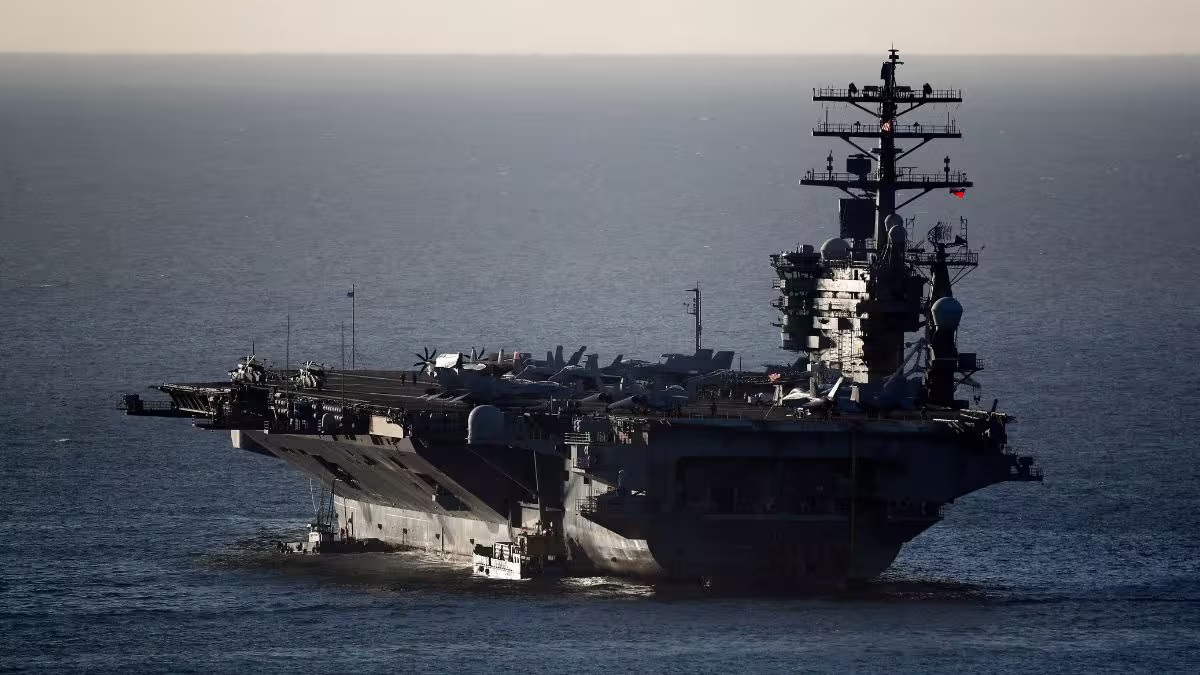
WASHINGTON, — May 21, 2026 : The United States has deployed the USS Nimitz Carrier Strike Group into the Caribbean Sea as the U.S. Department of Justice unsealed a federal indictment against former Cuban leader Raúl Castro and five former Cuban officials over the 1996 shootdown of two civilian aircraft operated by the Miami-based exile organization Brothers to the Rescue.
The coordinated timing of the naval deployment and legal action reflects an expanded U.S. pressure campaign against Cuba, combining military positioning, sanctions enforcement, intelligence monitoring, and judicial measures amid broader regional tensions involving Venezuela and Caribbean maritime security.
Indictment Over 1996 Shootdown
The indictment, announced on May 20 during a press conference at Miami’s Freedom Tower, accuses Castro and the co-defendants of murder, conspiracy to kill U.S. nationals, and destruction of aircraft in connection with the February 24, 1996 incident in which Cuban Air Force MiG-29 and MiG-23 fighter aircraft shot down two unarmed Cessna 337 Skymaster planes over international waters south of Florida.
The aircraft belonged to Brothers to the Rescue, a Miami-based exile organization known for conducting humanitarian and reconnaissance flights over the Florida Straits. Four individuals were killed in the incident, including three U.S. citizens.
According to U.S. officials, Castro was serving as Cuba’s defense minister at the time and oversaw the military chain of command responsible for authorizing the interception operation. Acting U.S. Attorney General Todd Blanche stated that the United States would continue pursuing accountability for attacks on American citizens regardless of the time elapsed since the incident.
Jason Reding Quiñones, U.S. Attorney for the Southern District of Florida, stated that investigators concluded the Cuban military command structure approved the operation before the aircraft were intercepted and destroyed.
Cuban authorities rejected the charges and defended the 1996 operation, maintaining that the Brothers to the Rescue aircraft had repeatedly violated Cuban airspace. Cuban President Miguel Díaz-Canel criticized the U.S. action and reiterated Havana’s longstanding position regarding the incident.
USS Nimitz Carrier Strike Group Enters Caribbean
At the same time, United States Southern Command confirmed that the USS Nimitz Carrier Strike Group entered the Caribbean Sea following completion of the Southern Seas 2026 deployment.
The strike group includes the aircraft carrier USS Nimitz, Carrier Air Wing 17, the guided-missile destroyer USS Gridley, and the fleet replenishment oiler USNS Patuxent.
The deployment marks the first major U.S. carrier presence in the Caribbean in 2026 and significantly increases American airborne surveillance, electronic warfare, and maritime monitoring capabilities across the northern Caribbean and surrounding sea lanes.
Unlike previous regional operations, the current deployment does not include amphibious assault ships or Marine Expeditionary Units, indicating the mission is centered on deterrence, maritime security, intelligence collection, and sanctions enforcement rather than preparations for ground operations.
Carrier Air Wing 17 operates F/A-18E/F Super Hornet multirole fighters, EA-18G Growler electronic attack aircraft, E-2D Advanced Hawkeye airborne early warning aircraft, and MH-60 Seahawk helicopters assigned to anti-submarine warfare and maritime patrol missions.
Final Operational Transit for USS Nimitz
The USS Nimitz departed Bremerton, Washington, on March 7 for its final operational transit ahead of planned inactivation and reactor defueling in Norfolk, Virginia.
Because the carrier cannot transit the Panama Canal due to size limitations, the strike group sailed around Cape Horn and through the Strait of Magellan before entering the Atlantic Ocean.
Prior to arriving in the Caribbean, the strike group conducted multinational exercises and interoperability operations with Brazil, Argentina, Chile, and Colombia during Southern Seas 2026, a pre-planned deployment focused on maritime security coordination and regional naval cooperation.
USS Nimitz remains the longest-serving active aircraft carrier in the U.S. Navy. The nuclear-powered carrier displaces approximately 100,020 long tons at full load, measures 332.8 meters in length, and is capable of speeds exceeding 31 knots.
Pressure Campaign on Cuba and Venezuela
The deployment coincides with broader U.S. sanctions enforcement efforts targeting maritime fuel shipments between Venezuela and Cuba.
Since early 2025, Washington has increased restrictions on tanker traffic supplying Cuban ports, particularly following the January 2026 U.S. operation that resulted in the capture of Venezuelan leader Nicolás Maduro.
The Cuban government stated earlier this month that national diesel and oil reserves had been largely exhausted, contributing to severe fuel shortages and repeated electrical grid failures across Havana, Santiago de Cuba, Holguín, and Matanzas.
Power outages lasting between 12 and 18 hours have disrupted transportation, telecommunications, industrial operations, and public services throughout the island.
U.S. officials have also linked the current pressure campaign to wider geopolitical concerns involving Cuba’s reported security cooperation with China and Russia. Secretary of State Marco Rubio recently referenced Cuban links to Chinese intelligence activity and Russian military coordination in the region.
CIA Director John Ratcliffe reportedly warned Cuban officials earlier this month that the timeline for diplomatic engagement with Washington was narrowing as U.S. sanctions and maritime enforcement measures intensified.
President Donald Trump also publicly referenced Cuba during remarks on Wednesday, underscoring the administration’s continued focus on Havana as part of its broader regional security strategy.
U.S. officials stated that the current operation remains focused on maritime domain awareness, intelligence collection, sanctions enforcement, and regional deterrence, with no amphibious or expeditionary ground forces currently assigned to the mission.
——— End of Article ———