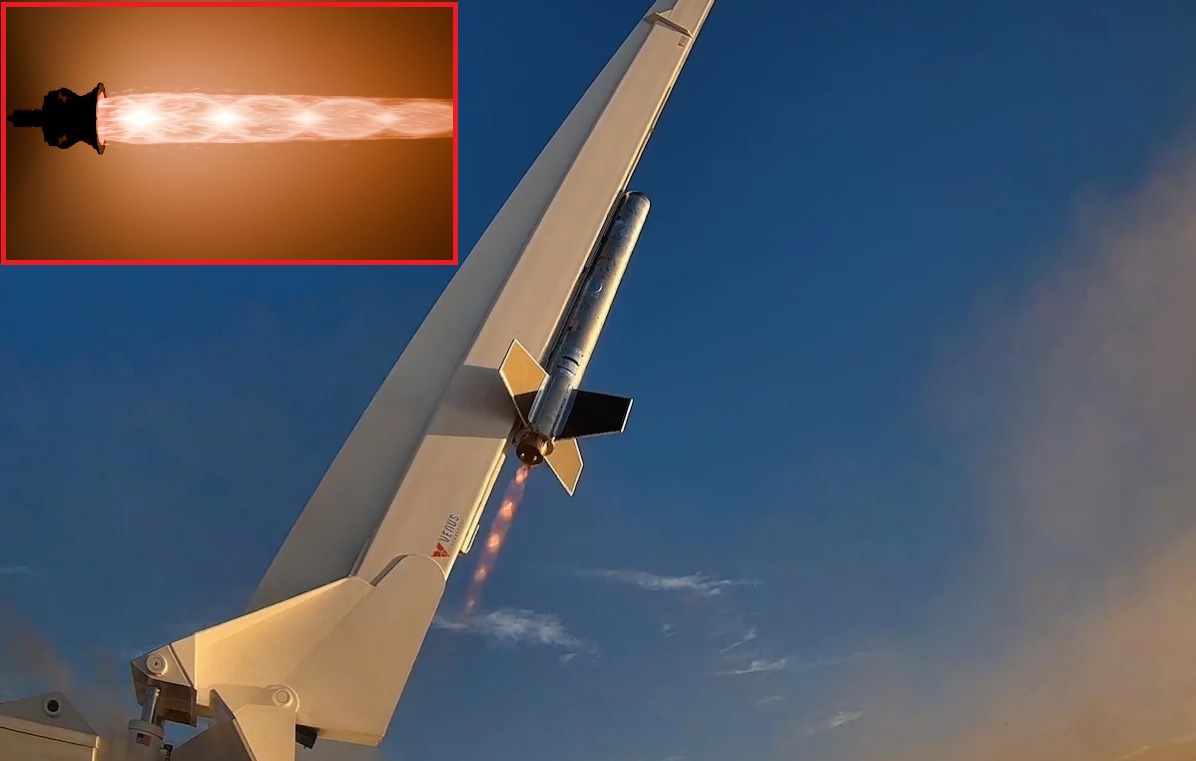
SEMBACH, Germany, — May 23, 2026 : The U.S. Army’s 52nd Air Defense Artillery Brigade (52d ADA Brigade) is testing and evaluating the IonStrike low-cost kinetic interceptor developed by DZYNE Technologies in Europe this spring as part of efforts to strengthen layered air and missile defense against one-way attack drones and other unmanned aircraft systems (UAS).
The evaluation is focused on determining whether IonStrike can provide a mid-range kinetic air defense capability capable of countering low-cost aerial threats while integrating into existing U.S. Army and NATO air defense networks. Senior leaders from U.S. Army Europe and Africa (USAREUR-AF) and NATO’s Allied Land Command observed recent demonstrations of the interceptor, while soldiers from the brigade conducted hands-on assessments to evaluate how the system integrates with equipment already used in operational environments.
Army Evaluates Cost-Effective Response to Drone Threats
The assessment comes amid increasing concerns over the growing battlefield use of low-cost unmanned aircraft systems. Since 2022, conflicts in Eastern Europe, particularly the war in Ukraine, have demonstrated how inexpensive one-way attack drones—often costing only a few hundred dollars—can strike armored vehicles, logistics infrastructure, and fixed military installations.
Military planners have identified a significant economic challenge in defending against such threats, as traditional missile interceptors frequently cost far more than the drones they are used to destroy. During saturation attacks involving multiple aerial threats, reliance on expensive missile systems can become increasingly difficult to sustain.
IonStrike is being evaluated as a low-cost kinetic alternative intended to address this cost imbalance by offering an interceptor designed to cost less than the threats it defeats while expanding available defensive options within the Army’s layered air defense structure.
The interceptor is positioned between electronic warfare systems, gun-based defenses such as M-SHORAD, and higher-end missile interceptors, providing an additional engagement layer intended to increase operational flexibility against evolving aerial threats.
Designed for Flexibility During Swarm Attacks
Unlike conventional fire-and-forget interceptors that commit fully to a target immediately after launch, IonStrike incorporates a precision terminal infrared seeker paired with a proximity-fuzed warhead, enabling operators to adjust engagements after launch if operational conditions change.
According to Army officials, operators can abort an engagement or redirect the interceptor toward another target if a threat is reclassified or battlefield priorities shift. The capability is viewed as particularly important during swarm attacks, where commanders may need to adapt rapidly as multiple drones enter defended airspace.
Maj. Cody Davis, operations officer for the 52d ADA Brigade, stated that IonStrike provides an additional kinetic option without requiring soldiers to learn an entirely new engagement process. He said the interceptor integrates into approved command-and-control systems, uses existing radar feeds, and supports commanders within established air defense architectures.
Integration With Existing Army Networks
A key feature of IonStrike under evaluation is its ability to function without requiring a separate radar system. Instead, the interceptor receives targeting cues from radars already connected to approved Army command-and-control networks, including the Forward Area Air Defense (FAAD) system and the Integrated Battle Command System Maneuver (IBCS-M).
This integration is intended to reduce operational complexity by enabling soldiers to employ the system using existing kill chains and familiar battlefield management systems rather than introducing entirely new infrastructure.
The interceptor currently launches from a multi-interceptor pallet equipped with four interceptors, though the brigade is working with DZYNE Technologies to develop a 12-interceptor launcher configuration aimed at increasing magazine depth during saturation attacks involving multiple incoming drones.
Army planners view greater launcher capacity as necessary for maintaining defensive endurance in scenarios where adversaries attempt to overwhelm defenses through mass aerial attacks.
Linked to NATO Eastern Flank Defense Efforts
The ongoing evaluation is tied to the Eastern Flank Deterrence Initiative (EFDI), a warfighting concept designed to strengthen NATO’s eastern flank through integrated command systems supported by unmanned and minimally manned technologies.
Headquartered in Sembach, Germany, the 52nd Air Defense Artillery Brigade, assigned to the 10th Army Air and Missile Defense Command, conducts air and missile defense operations across the areas of responsibility of both the U.S. European Command and U.S. Africa Command.
Because the brigade operates in regions where drone threats continue to evolve, Army officials view the formation as well positioned to assess emerging counter-unmanned aircraft capabilities under operational conditions.
Summer Operational Assessment to Measure Performance
A larger operational assessment planned for summer 2026 will evaluate multiple aspects of IonStrike’s performance under realistic battlefield conditions. The testing will assess command-and-control integration, radar cueing performance, launcher configuration, reload procedures, lethality against representative one-way attack drones, and the reliability of the system’s abort and retasking capabilities.
Maj. Benjamin Bowman, the brigade’s forward operations officer, stated that the assessment will determine whether IonStrike can function as a repeatable and sustainable combat layer in operational environments. He said evaluators will focus on whether the system can integrate into existing command structures, extend defended areas, be redirected in flight, and remain sustainable for soldiers during field operations.
The Army stated that the 52d ADA Brigade continues to identify, test, and integrate capabilities intended to strengthen layered air defense and provide commanders with additional options against increasingly complex aerial threats, particularly the growing use of low-cost drones in modern combat operations.
——— End of Article ———