Marietta, Georgia — The U.S. Air Force has awarded Lockheed Martin a $142.9 million contract to maintain and update the software systems of the C-5M Super Galaxy, ensuring the Air Force's largest transport aircraft continues to operate safely and effectively in the coming years.
Announced on July 6, 2026, the contract focuses on the aircraft's digital systems rather than physical upgrades. While the C-5M fleet has already received modernization improvements, including new General Electric engines and updated avionics hardware, the new agreement is aimed at sustaining the software that supports navigation, communications, flight instruments, and other mission-critical systems.
The contract is structured as an indefinite-delivery, indefinite-quantity (IDIQ) agreement, allowing the Air Force to order software support services as required instead of committing to a fixed schedule of work. The contract has a maximum value of $142.9 million, with $19.3 million in fiscal year 2026 operations and maintenance funding initially obligated to begin the program.
Software sustainment work will be carried out at Lockheed Martin facilities in Marietta, Georgia, and Greenville, South Carolina, with performance scheduled to continue through May 20, 2032. The contract is being managed by the C-5 Contracting Branch at Robins Air Force Base, Georgia.
The Air Force awarded the contract to Lockheed Martin through a sole-source acquisition. As the original manufacturer of the C-5 aircraft and the company responsible for its modernization program, Lockheed Martin possesses the proprietary technical knowledge required to maintain and update the aircraft's software architecture.
Software Sustainment Scope
Under the agreement, Lockheed Martin will provide software sustainment services for the Air Force's fleet of 52 C-5M Super Galaxy aircraft. The work includes:
- Delivering routine software patches, updates, and cybersecurity improvements.
- Maintaining certification records to ensure the aircraft continues to meet current safety and performance requirements.
- Operating ground-based systems integration laboratories where software changes are tested before being installed on operational aircraft.
- Providing engineering and technical support to identify and resolve software issues before they affect flight operations.
These updates help ensure the aircraft remains compatible with modern air traffic management systems, satellite navigation services, and military communication networks.
Strategic Heavy Airlift Capability
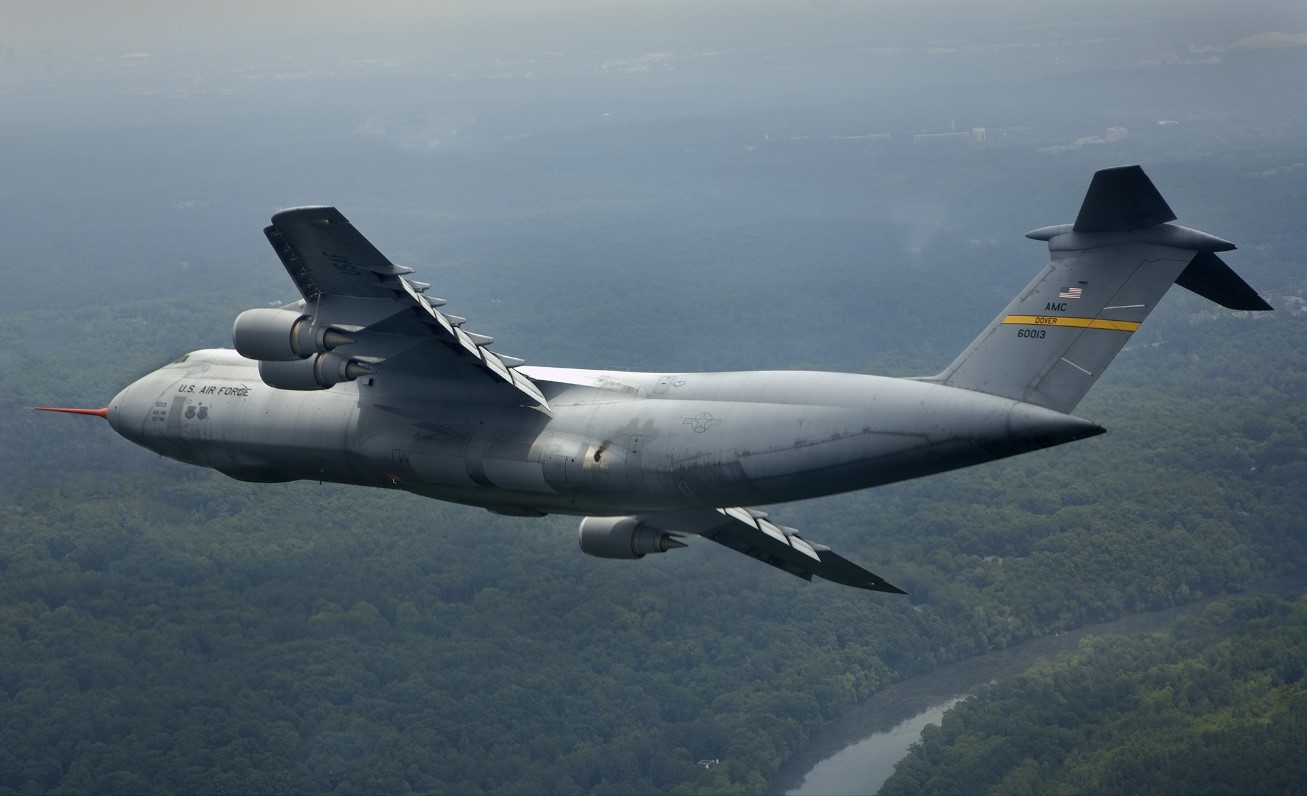
The C-5M Super Galaxy is the largest aircraft in the U.S. Air Force inventory and serves as one of its primary strategic airlifters. It is designed to transport oversized military equipment, vehicles, troops, and humanitarian cargo over intercontinental distances.
Each aircraft can carry up to 281,000 pounds (127,460 kilograms) of cargo, enough to transport two M1 Abrams main battle tanks, three CH-47 Chinook helicopters, or 36 standard cargo pallets in a single mission. With its maximum payload, the aircraft has an unrefueled range of approximately 2,150 nautical miles.
The current fleet of 52 C-5M aircraft is based at Dover Air Force Base, Delaware; Travis Air Force Base, California; Lackland Air Force Base, Texas; and Westover Air Reserve Base, Massachusetts.
The aircraft has supported U.S. military operations since entering service in the 1970s, including strategic airlift missions during the 1973 Yom Kippur War and the 1991 Gulf War. It also continues to support humanitarian relief operations and global logistics missions.
Today, the C-5M plays an important role in the Air Force's Agile Combat Employment (ACE) concept, which emphasizes dispersing personnel and equipment across multiple smaller and remote airfields to improve operational flexibility, particularly in the Indo-Pacific region.
Service Life Through the 2040s
The Air Force plans to keep the C-5M Super Galaxy in service into the 2040s. Although planning is underway for a Next-Generation Airlifter that will eventually replace both the C-5M Super Galaxy and the C-17 Globemaster III, procurement of the future aircraft is not expected to begin before 2038.
Until that replacement program moves forward, maintaining the C-5M's software and avionics will remain essential for preserving the U.S. military's heavy airlift capability. The latest contract ensures the aircraft's digital systems continue to support safe, reliable, and efficient operations as the fleet remains a key part of the Air Force's global transportation network.
——— End of Article ———