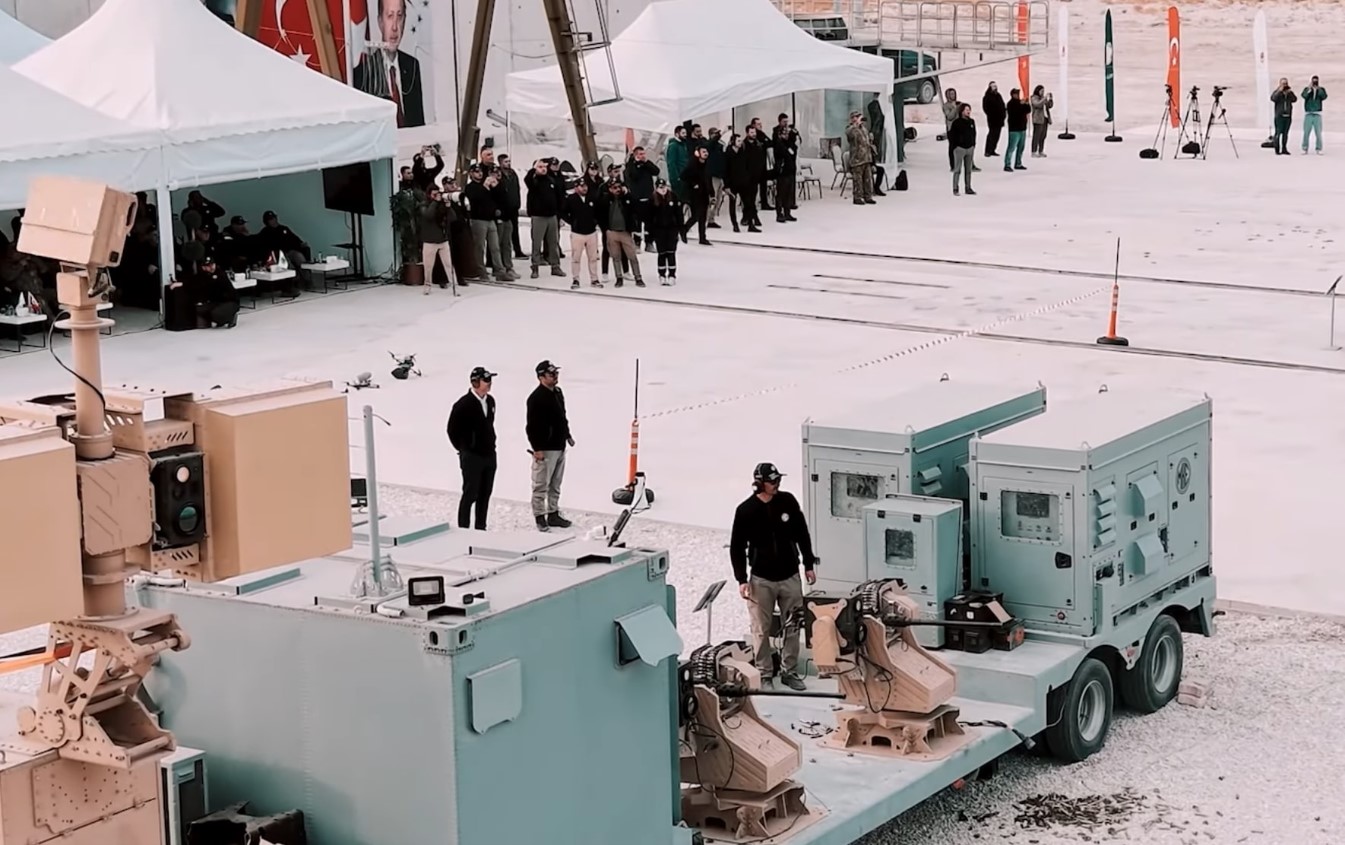
KONYA, Türkiye — Turkish defense company Makine ve Kimya Endüstrisi (MKE) has demonstrated its TOLGA Short-Range Air Defence (SHORAD) System during a live-fire event attended by an international delegation of 64 military attachés, government representatives, and civilian participants from 24 countries.
The demonstration was held on July 3 at the Turkish Ministry of National Defense's Karapınar Firing Test and Evaluation Group Command in Konya. Representatives from NATO members and Gulf states, including the United States, Lithuania, Egypt, Qatar, and Romania, attended the event to observe the system's operational performance.
During the live-fire demonstration, the TOLGA system was tested in seven operational scenarios designed to reflect modern aerial threats. The exercises included engagements against loitering munitions, drone swarms, and fixed-wing unmanned aerial vehicles (UAVs). According to MKE, the system successfully neutralized all designated targets, achieving a 100% success rate throughout the demonstration.
The event also highlighted TOLGA's role as an inner-layer air defense system within larger integrated air defense networks, including Türkiye's planned "Steel Dome" architecture. The demonstration allowed international observers to assess the system's layered defense capabilities under realistic operational conditions.
MKE General Manager İlhami Keleş said the infrastructure required for serial production of the TOLGA system has been completed. He stated that the system strengthens Türkiye's defense capabilities while also providing a competitive option for international customers.
Modular Short-Range Air Defense System
Developed under MKE's "Effective – Simple – Affordable" design philosophy, TOLGA is a modular short-range air defense system designed to counter drones, loitering munitions, cruise missiles, and other asymmetric aerial threats. Its modular architecture allows different sensors, weapons, and electronic warfare systems to operate together through a centralized command and control unit.
The system integrates several domestically developed components, including the GÖKBÖRÜ AESA radar, electro-optical and infrared sensors, an Acoustic Detection System, electronic countermeasure (jammer) equipment, and 12.7 mm, 20 mm, and 35 mm weapon systems. These components are coordinated through a single command and control infrastructure that supports manual, semi-autonomous, fully autonomous, and remote operating modes.
The sensor suite can detect and track aerial threats at ranges of up to 10 kilometers, enabling operators to respond to different types of airborne targets.
Soft-Kill and Hard-Kill Defense Layers
TOLGA uses a layered defense approach that combines electronic warfare with kinetic weapons.
The first layer relies on the Electronic Countermeasure (Jammer) System to disrupt an incoming drone's command, telemetry, or satellite navigation links. This soft-kill capability can neutralize threats at distances of up to 10 kilometers without using ammunition.
If electronic countermeasures are ineffective, such as against autonomous or fiber-optic-guided drones, the system switches to its hard-kill layer. This layer uses programmable fragmentation ammunition designed to release a dense cloud of metal fragments around the target to improve the probability of interception.
The 35 mm weapon system provides engagements at ranges of up to 3,000 meters, while the 20 mm system is effective up to 1,000 meters. The 12.7 mm weapon system is intended for very short-range threats at distances of up to 300 meters.
The hard-kill capability is further strengthened by the Dual PMT-76 Platform Machine Gun System mounted on the Mobile Vehicle Platform (MAP DUAL). MKE has also developed new 7.62 mm fragmented anti-drone ammunition that enables infantry personnel to engage low-altitude drones using standard service rifles without requiring additional weapon platforms.
Future Capability Development
MKE stated that future upgrades to the TOLGA system will include the integration of a Laser Weapon System and the ENFAL-17 missile, adding further engagement options against emerging aerial threats.
The command and control unit, available in both mobile and fixed configurations, enables all sensors and weapon systems to be managed from a single command center, allowing the system to adapt to different operational environments and mission requirements.
Source: edrmagazine
——— End of Article ———