CHANGWON, South Korea — South Korea has unveiled its first domestically developed aviation engine prototypes for unmanned aircraft, marking a major milestone in the country's efforts to build an independent aircraft engine industry.
The prototypes were revealed on July 6 during a ground test launch ceremony at Hanwha Aerospace's Changwon Plant 1 in South Gyeongsang Province. The event was attended by around 300 officials from the Defense Acquisition Program Administration (DAPA), the Agency for Defense Development (ADD), the Republic of Korea Air Force, and Hanwha Aerospace.
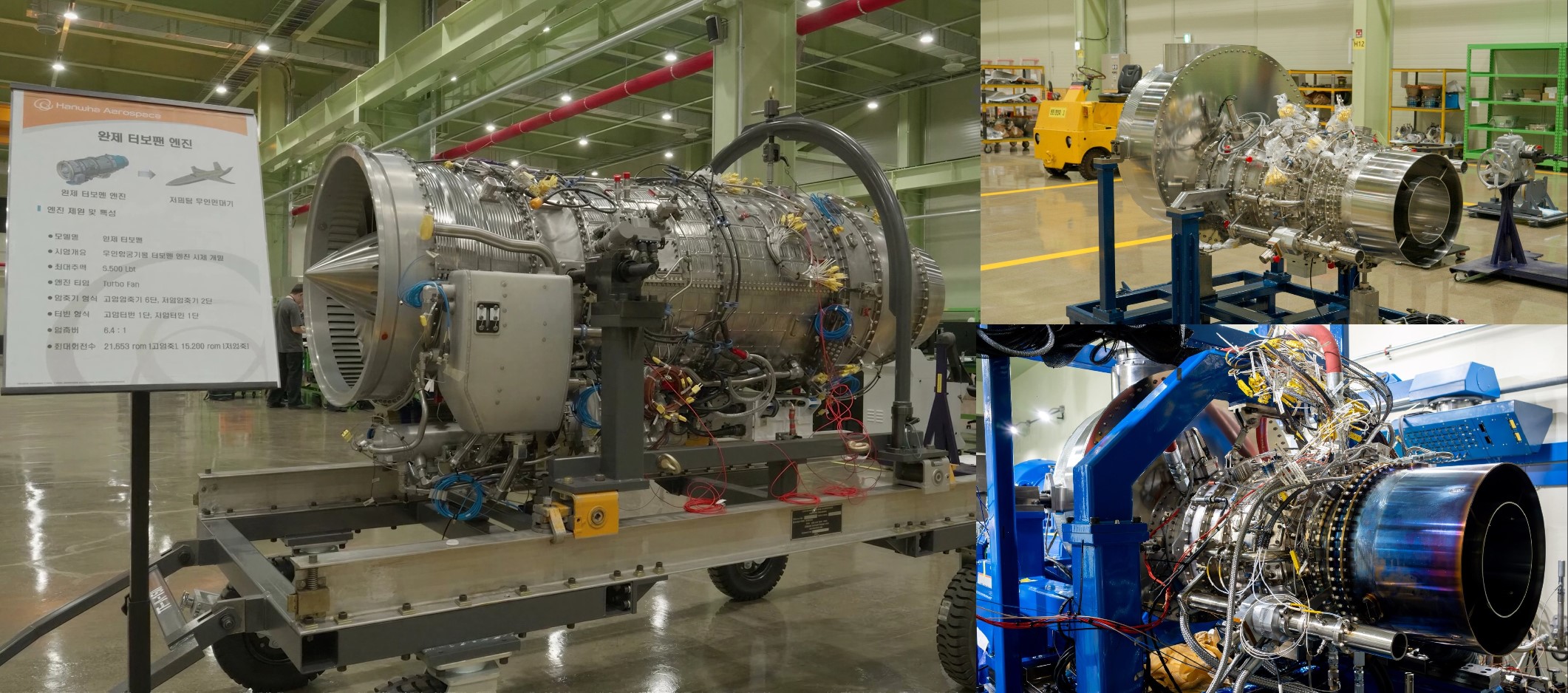
Developed jointly by DAPA, ADD, and Hanwha Aerospace with support from domestic companies, the new engines include the 5,500-pound-force (lbf) class KTF5500 turbofan and the 1,400-horsepower class KTP1400 turboprop.
Two Engines for Different Unmanned Aircraft
The KTF5500 turbofan has been designed for low-observable unmanned combat aircraft, commonly referred to as loyal wingmen. These aircraft are intended to operate alongside manned fighter aircraft, including South Korea's KF-21 fighter, as part of manned-unmanned teaming operations.
The KTP1400 turboprop is intended for medium-altitude unmanned reconnaissance aircraft, including platforms such as the MQ-105K. It is designed to support long-endurance surveillance missions and replaces previously imported Canadian-made engine components used in similar systems.
Both engines have completed assembly and are now undergoing ground testing at Hanwha Aerospace's Changwon facility. During testing, specialized equipment and digital sensors are collecting real-time data on engine acceleration, deceleration, performance, and durability.
First Long-Life Domestic Aviation Engines
The new prototypes represent South Korea's first domestically developed long-life aviation engines capable of operating continuously for thousands of hours. Until now, the country's engine manufacturing experience had largely been limited to short-life, single-use missile engines.
Hanwha Aerospace said it has invested nearly 2 trillion won over the past decade to establish the infrastructure and technologies required for aircraft engine development.
Kim Jin-hyung, principal researcher at ADD, said the completion of the first domestic aircraft engine prototypes and the start of ground testing mark the beginning of South Korea's effort to secure indigenous aircraft engine technology.
Reducing Dependence on Foreign Engine Suppliers
South Korea has traditionally relied on foreign manufacturers to supply engines for many of its advanced aircraft, including the FA-50 light attack aircraft and the KF-21 fighter, which currently uses engines produced by General Electric.
While imported engines provide proven performance, they can also affect defense exports because engine-producing countries often require approval before aircraft equipped with their engines can be sold to third-party nations. These controls are governed through export regulations and international frameworks such as the International Traffic in Arms Regulations (ITAR) and the Missile Technology Control Regime (MTCR).
By developing domestic aircraft engines, South Korea aims to reduce reliance on foreign suppliers, increase flexibility in defense exports, and strengthen long-term maintenance, repair, and overhaul (MRO) capabilities.
Domestic Development of Key Engine Technologies
The program has also enabled South Korean engineers to develop several critical aircraft engine technologies domestically.
These include precision casting techniques for heat-resistant turbine blades, advanced thermal barrier coating technologies that protect engine components from high operating temperatures, and other materials designed to improve engine durability and fuel efficiency.
The localization of propulsion systems also supports the integration of domestically developed airframes, flight control systems, mission equipment, and engines into future unmanned aircraft.
Future Engine Development Plans
The newly unveiled prototypes form the first stage of South Korea's broader aircraft engine development roadmap.
Later this year, the government and Hanwha Aerospace are expected to begin work on a 10,000-lbf-class turbofan engine for long-endurance unmanned aircraft and small passenger aircraft.
The longer-term objective is to develop a 24,000-lbf-class aircraft engine for future advanced variants of the KF-21 fighter and other applications, including naval platforms.
Between August this year and early 2027, the South Korean government is expected to review a 5.5 trillion won investment plan for the larger engine program. The plan aims to produce at least 1,500 engines by 2060.
Kim Jong-ho, head of Hanwha Aerospace's Advanced Engine Business Team, said the company will use the experience and technologies it has accumulated to continue narrowing the technology gap with leading aviation engine manufacturers while advancing South Korea's goal of achieving self-reliance in aircraft engine development.
The successful development of the KTF5500 and KTP1400 prototypes represents an important step in South Korea's efforts to strengthen its domestic aerospace industry and expand indigenous capabilities for future unmanned and manned aircraft programs.
Source: asiae.co.kr
——— End of Article ———