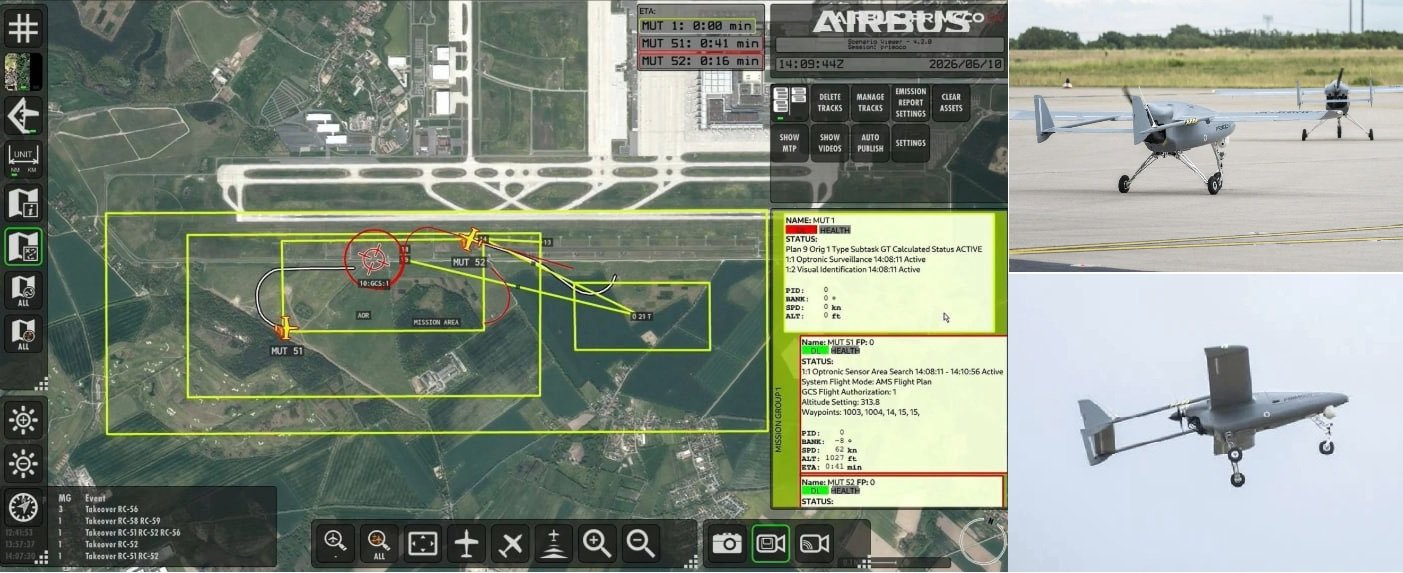
BERLIN — Airbus has successfully completed Europe's first live public demonstration of an autonomous collaborative drone operation during the ILA Berlin Air Show 2026, showcasing two Primoco One 150 uncrewed aerial vehicles (UAVs) operating together as a coordinated team using the company's MARS Autonomy software.
The demonstration took place on 10 and 11 June 2026 at Berlin ExpoCenter Airport, marking the first time autonomous collaborative operations involving multiple uncrewed aircraft have been performed live at a major public aerospace trade show in Europe.
Instead of requiring separate commands for each aircraft, the two UAVs operated as a single coordinated network using shared distributed intelligence. The demonstration highlighted how multiple drones can work together under the supervision of a single operator, reducing the need for continuous manual control while keeping humans responsible for critical decisions.
MARS Autonomy Enables Coordinated UAV Operations
The demonstration was powered by MARS (Multiplatform Autonomous Reconfigurable and Secure) Autonomy, Airbus' artificial intelligence-based software suite designed to coordinate multiple crewed and uncrewed platforms in real time.
The software enables connected platforms to exchange information automatically. If one UAV detects an object or target of interest, that information is immediately shared across the network, allowing the entire team to respond without requiring additional operator input.
According to Thomas Schmitt, Programme & Product Manager for Crewed-Uncrewed Teaming & Autonomy at Airbus Defence and Space, the operator only needs to assign the mission objective, while the software distributes tasks among the connected platforms.
"In a real-world operation, the operator's command is very simple. Do locate all surface-to-air missile systems in a specified area, do transmit their coordinates and video feed. After that, the Airbus system autonomously distributes tasks among the platforms, which are connected into a single network."
During the ILA Berlin demonstration, the two Primoco One 150 UAVs completed two autonomous missions:
- Teamed multi-role surveillance
- Teamed surveillance for accelerated response
Throughout both missions, MARS Autonomy managed non-critical flight operations, dynamic task allocation, and flight management. The human operator remained in continuous supervision of the mission and retained authority over all critical decisions and the ability to intervene whenever necessary.
Primoco One 150 UAV Used for Demonstration
The aircraft used for the demonstration was the Primoco One 150, a Czech-built mid-size UAV designed for multiple mission types.
The platform has a maximum take-off weight of 150 kilograms, can carry a payload of up to 30 kilograms, and cruises at approximately 120 km/h.
Its other specifications include:
- Maximum take-off weight: 150 kg
- Payload capacity: Up to 30 kg
- Flight endurance: Up to 15 hours
- Ground control range: Up to 200 km
- Ferry range: Up to 2,000 km
The Primoco One 150 is primarily used for reconnaissance missions. Airbus also confirmed that testing is underway on a version equipped with miniature air-to-air missiles.
Designed for Multiple Mission Types
Airbus said MARS Autonomy has been developed as a platform-agnostic software architecture, allowing integration with both Airbus and third-party crewed and uncrewed systems.
The software is intended to support a broad range of missions, including:
- Automated surveillance and data fusion
- Suppression and destruction of enemy air defence systems
- Joint combat and precision strike operations
- Communications relay
- Autonomous cargo logistics for troop resupply
- Convoy protection
The system also supports both crewed-uncrewed teaming and fully uncrewed operations.
Operational Deployment Planned Later in 2026
Airbus said the first operational deployment of MARS Autonomy on the Primoco One 150 is scheduled for later in 2026.
Before the public demonstration in Berlin, Airbus had conducted testing of the teaming software with Primoco UAVs during 2024 and 2025 at Písek-Krašovice Airport in the Czech Republic. The successful flights at ILA Berlin demonstrated the system's readiness for operational use in collaborative autonomous missions.
MARS Autonomy is part of Airbus' broader MARS Mission System, which is being developed to support future collaborative uncrewed combat aircraft, including the U740 Valkyrie, which Airbus plans to bring to operational capability by 2029.
——— End of Article ———