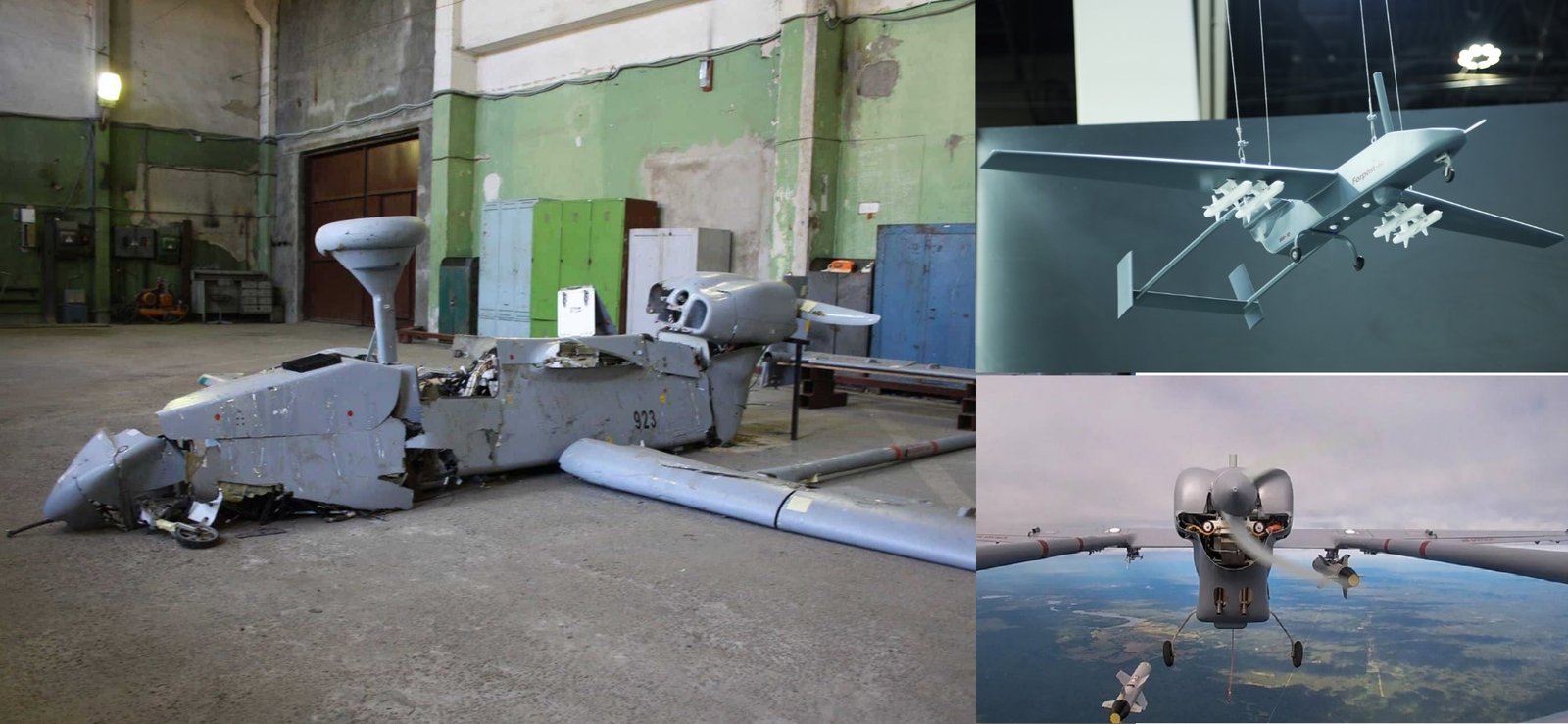
KYIV, Ukraine — Ukrainian forces have shot down a Russian Forpost-R multirole unmanned aerial vehicle (UAV) over Russia's Kursk region using a domestically developed Chaklun-KM interceptor drone, marking another confirmed loss of one of Russia's relatively rare reconnaissance and strike drone platforms.
According to Ukraine's Unmanned Systems Forces, the interception took place on July 27, 2026, during an operation carried out by drone pilots from the 7th Battalion "Topota" of the 414th Separate Unmanned Systems Brigade, commonly known as "Magyar's Birds." Commander of Ukraine's Unmanned Systems Forces, Robert Brovdi, known by the callsign "Magyar," said the Chaklun-KM interceptor successfully engaged the target at an altitude of 4.3 kilometers (approximately 14,100 feet) over Russia's Kursk region. Video of the interception was later released by the brigade.
⚡️A Russian Forpost-R has been hunted down and shot down – a heavy, high-value strike and reconnaissance UAV capable of carrying guided munitions.
— 414 Magyar's Birds (@414magyarbirds) July 27, 2026
The platform, capable of carrying KAB-20 laser-guided aerial bombs, was detected and destroyed on July 27, 2026, over Russia’s Kursk… pic.twitter.com/kCViSek7aC
The downed aircraft was identified as a Forpost-R, a reconnaissance and strike UAV capable of carrying guided aerial munitions. According to available records, this is the sixth visually confirmed destruction of a Forpost-R since the start of Russia's full-scale invasion of Ukraine and the second such drone destroyed by the 414th Brigade, following an earlier interception in April 2025.
The successful engagement highlights the increasing use of dedicated interceptor drones by Ukrainian forces to counter Russian reconnaissance and strike UAVs operating at higher altitudes.
Russian Forpost-R Drone
The Forpost is a Russian reconnaissance and strike unmanned aerial system produced under license from the Israeli IAI Searcher Mk II, originally developed by Israel Aerospace Industries.
Russia first acquired the platform in 2009, purchasing two Searcher II UAVs for evaluation at a cost of US$12 million. In 2010, Russia signed a US$300 million agreement to assemble the drones from Israeli-supplied kits at the Kazan Helicopter Plant. Localized production began in 2012 at the Ural Civil Aviation Plant, where the aircraft entered service under the name Forpost.
Each Forpost system consists of the unmanned aircraft and a ground control station. The original version is equipped with electro-optical and infrared imaging systems that enable day-and-night reconnaissance missions. It has an operational range of up to 250 kilometers when using a directional antenna and an endurance of up to 18 hours.
Russia introduced the upgraded Forpost-R in 2019. The newer version is powered by the domestically produced APD-85 engine and has a maximum take-off weight of 500 kilograms. Its service ceiling is 5 kilometers, and unlike the original model, it can carry light guided munitions for strike missions.
KAB-20 Guided Bomb
One of the primary weapons carried by the Forpost-R is the KAB-20 guided aerial bomb, which is also used by Russia's Orion unmanned aerial system.
The KAB-20 measures 900 millimeters in length, has a 130-millimeter body diameter, and a 350-millimeter wingspan. The munition weighs 21 kilograms, including a 7-kilogram high-explosive fragmentation warhead. When released from high altitude, its maximum stand-off range is up to 8 kilometers.
The bomb is produced in two known variants. The KAB-20L uses laser guidance, while the KAB-20S employs a satellite navigation guidance system and was officially accepted into Russian service in April 2023.
There have also been reports suggesting Russia has been developing a version capable of targeting mobile phone signals. However, no confirmed information has been released regarding its adoption or operational use.
Previous Ukrainian Interceptions
Ukrainian forces have been engaging Forpost-family drones since the Anti-Terrorist Operation (ATO) in the Donbas.
The first confirmed interception occurred in August 2014, when an Israeli-made IAI Searcher UAV with board number 920 was shot down near Vilkhivchyk (then known as Novopetrivske). Later that year, additional IAI Searcher drones with board numbers 905 and 916 were also shot down.
On May 4, 2015, reports indicated that another IAI Searcher had been destroyed, although further details were limited. On May 20, 2015, Ukrainian forces confirmed the destruction of a Russian Forpost UAV with board number 923. The last known interception during the ATO period occurred in October 2016, when an IAI Searcher carrying board number 915 was shot down.
The latest interception over the Kursk region adds another confirmed loss to the Forpost-R fleet and demonstrates the continued use of Ukrainian-developed interceptor drones against Russian reconnaissance and strike UAVs operating near the battlefield.
——— End of Article ———