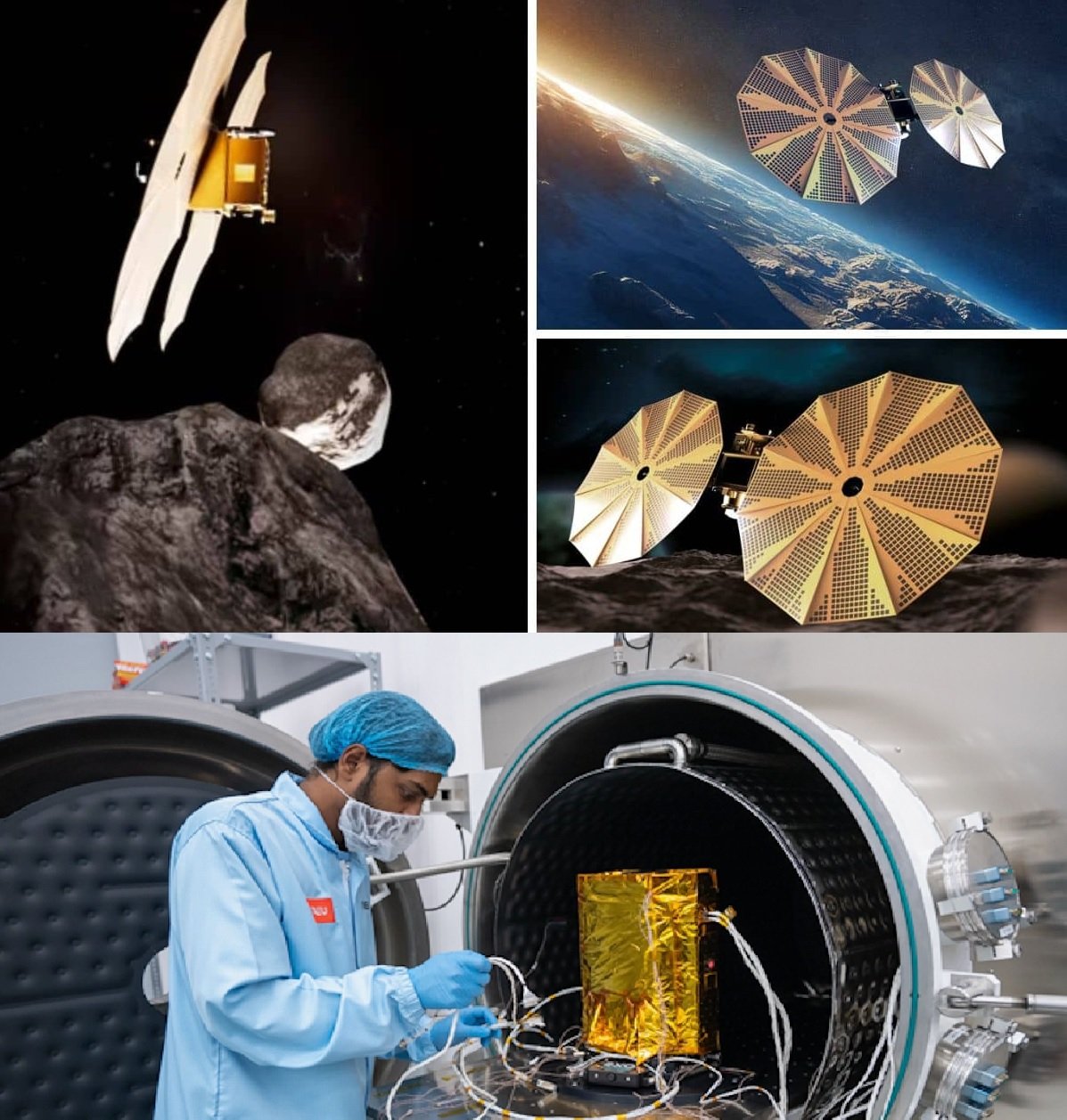
ABU DHABI — The United Arab Emirates (UAE) has unveiled new technical details and a scale model of its MBR Explorer spacecraft and autonomous lander for the Emirates Mission to the Asteroid Belt (EMA). The mission is scheduled to launch in March 2028 from Japan’s Tanegashima Space Center aboard an H3 rocket, beginning a journey of approximately 5 billion kilometres to study seven asteroids and attempt a landing on 269 Justitia in 2036.
Named after Sheikh Mohammed bin Rashid Al Maktoum, the 2.8-tonne MBR Explorer is the UAE’s second major interplanetary mission after the Hope Mars orbiter, which has operated at Mars since 2021. It is also the country’s first interplanetary spacecraft designed, engineered, assembled and tested entirely within the UAE. The launch window will last three weeks, and missing it would prevent the planned trajectory from following the same sequence of targets.
Journey to Seven Asteroids
The spacecraft will use solar electric propulsion and gravity assists from Venus in mid-2028, Earth in spring 2029 and Mars later in the journey to reach the main asteroid belt between Mars and Jupiter.
During its journey, it will fly past six asteroids: 10253 Westerwald, 623 Chimaera, 13294 Rockox, 88055 Ghaf, 23871 Ousha and 59980 Moza. Its four primary science instruments include high-resolution and thermal infrared cameras, along with mid-wavelength and infrared spectrometers, to examine surface composition, geology and physical properties, including estimates of interior density.
The spacecraft is expected to reach its main target, 269 Justitia, around 2035–2036.
Justitia and the Autonomous Lander
Justitia measures approximately 50–58 kilometres across and has an unusually red surface spectrum resembling that of some objects in the Kuiper Belt beyond Neptune. Scientists believe it may have formed in the outer solar system before migrating inward. Studying the asteroid could provide insights into the early solar system and the distribution of water and organic materials.
The MBR Explorer is expected to orbit Justitia for about seven months, gradually moving closer to map its surface and measure its gravitational field before deploying a UAE-built lander weighing approximately 10 kilograms.
Developed by the Technology Innovation Institute (TII) in Abu Dhabi, the lander has no propulsion system. It will separate during a low-altitude pass and follow a ballistic descent lasting two to three hours, with an expected impact speed of 15–27 metres per second. Engineers do not expect it to survive the impact.
The planned hard landing is intended to expose material beneath the asteroid’s surface. Images transmitted during descent could help researchers investigate subsurface material, complex organic compounds and water-rich minerals.
Because communication delays prevent real-time control, the lander will operate autonomously using onboard systems, including artificial intelligence, to select, rank and transmit the most useful images without waiting for commands from Earth.
Development and Testing
The lander was designed, built and tested in Abu Dhabi by TII’s Propulsion and Space Research Center, in collaboration with the UAE Space Agency, HEX20, Khalifa University and the National Space Science and Technology Center at UAE University. It reached flight readiness in less than two years.
The probe has completed vibration testing and is undergoing thermal testing. It is scheduled to travel to the Laboratory for Atmospheric and Space Physics at the University of Colorado Boulder for integration with the main spacecraft.
More than 150 engineers and scientists are involved in the national mission team, with approximately half of the project work allocated to UAE-based private-sector companies.
The mission aims to improve understanding of asteroid composition, water-rich materials and organic compounds while strengthening the UAE’s capabilities in spacecraft engineering, autonomous systems and deep-space exploration. If the planned surface encounter succeeds, Justitia will become one of a small number of asteroids reached by a spacecraft at the surface.
——— End of Article ———