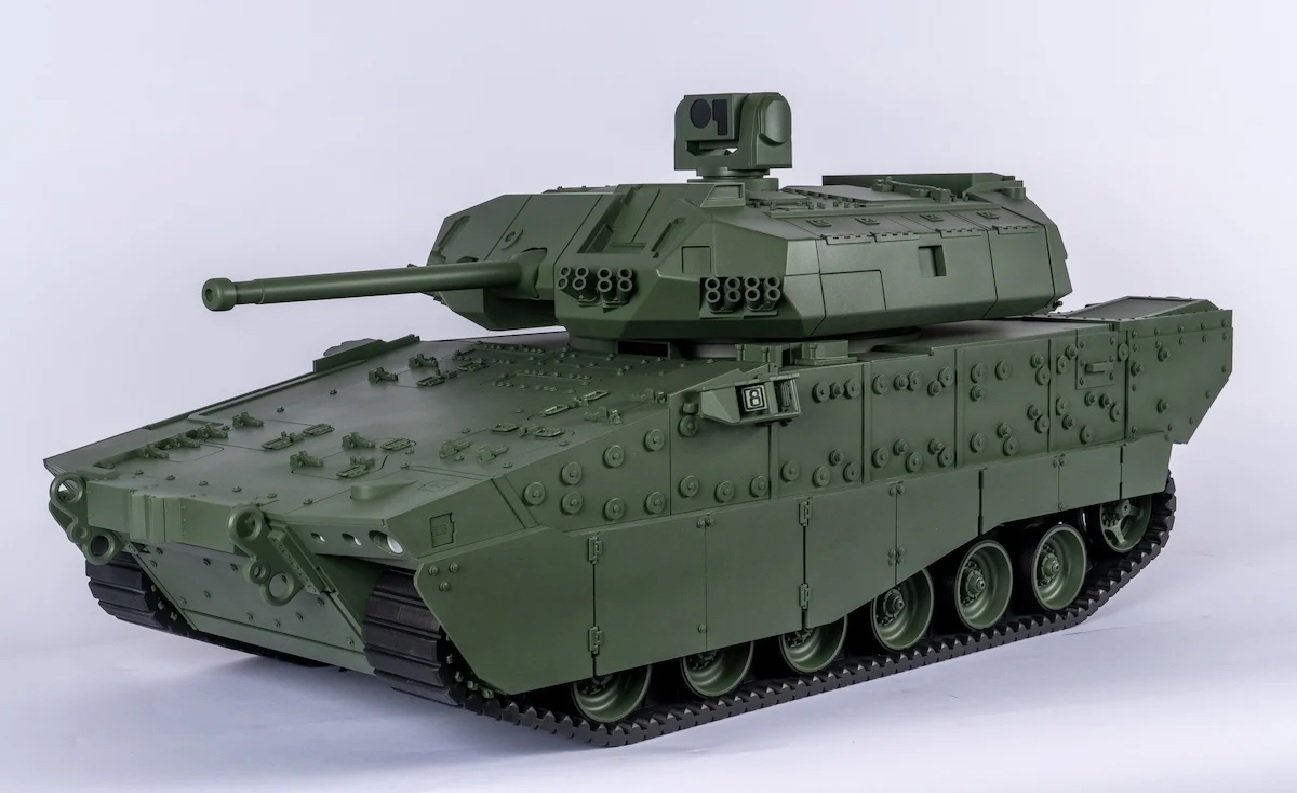
WASHINGTON, — General Dynamics Land Systems (GDLS) is displaying a one-eighth-scale model of its XM30 Wolf infantry fighting vehicle at the Association of the United States Army (AUSA) 2026 exhibition in Washington, D.C., as full-size prototypes undergo testing with the U.S. Army. The vehicle is being developed to replace the M2 Bradley infantry fighting vehicle and M3 cavalry fighting vehicle.
The Army selected GDLS and American Rheinmetall as finalists for the XM30 Mechanized Infantry Combat Vehicle program in June 2023. GDLS is offering the Wolf, while American Rheinmetall is competing with a version of its Lynx vehicle. The combined design and prototype phase is valued at approximately $1.6 billion.
GDLS delivered its first functional Wolf prototype to Aberdeen Proving Ground, Maryland, on August 21, 2026. The company has reported additional prototype deliveries to Fort Hood, Texas, along with a ballistic hull and turret at Aberdeen and another vehicle for software integration. GDLS plans to deliver all eight prototypes by the end of November.
“This on-time delivery will allow Soldiers to start putting the Wolf through its paces, with the ultimate goal of getting it fielded into armored brigades as quickly as possible,” said Geoffrey Norman, GDLS director of strategy. Soldier evaluations are expected to begin in late November or December, supporting the Army’s planned selection decision in 2027.
Warning: There has been a Wolf sighting at AUSA 2026! The Wolf XM30 mechanized infantry combat vehicle is purpose-built as a leap-ahead replacement for the Bradley fighting vehicle, with improved survivability, lethality, mobility and fightability. Shown at AUSA as a one-eighth-scale model, the Wolf XM30 implements the Army’s imperative for a Modular Open Systems Approach (MOSA) to software and hardware architectures from inception. With a born-digital design, the Wolf XM30 carries a digital thread beyond engineering and into verification, production, support and sustainment. Its mission is to deliver Soldiers to a point of positional advantage and provide decisive lethality in support of Infantry squads and Cavalry scouts. #AUSA2026 #ThePowerToWin #ArmyModernization
— General Dynamics Land Systems (@GD_LandSystems) October 12, 2026
XM30 Wolf Features and Capabilities
The Wolf is designed to carry a two-person crew and up to six fully equipped soldiers in its rear troop compartment. It features a lower-profile, uncrewed turret armed with a 50 mm XM913 cannon developed by Northrop Grumman. The weapon fires 50×228 mm ammunition, including programmable high-explosive air-bursting rounds, and has a dual-feed capability.
Other features include roof-mounted electro-optical equipment, smoke-grenade launchers and an all-round observation system. The vehicle uses hybrid-electric propulsion designed to retain power reserves for future upgrades. Its total power output has not been disclosed.
The design builds on GDLS’s Griffin III demonstrator, unveiled at AUSA in 2018 and based on a modified European ASCOD 2 platform. The Wolf retains a broadly similar chassis arrangement but incorporates updated running gear, lighter composite tracks, side armor and additional observation and protection features.
GDLS has applied the U.S. Army’s Modular Open Systems Approach (MOSA) to the vehicle’s hardware and software from the beginning. Its born-digital design maintains a digital thread across engineering, verification, production, support and sustainment, with the aim of simplifying future technology integration and upgrades. The company identifies improved survivability, lethality, mobility and fightability as key design objectives.
Army Evaluation and Production Plans
The Army plans to evaluate both competing designs through soldier feedback, unit-level experimentation and operational assessments. The 1st Cavalry Division is expected to play a central role, with testing planned at the National Training Center in Fort Irwin, California.
The Bradley has been in service since 1981, making its replacement a major Army modernization priority. The fiscal year 2027 budget request includes $547 million for 19 additional XM30 prototypes, while program plans include purchasing 108 vehicles by fiscal year 2031.
The Army is expected to select between the GDLS Wolf and American Rheinmetall’s Lynx XM30 in 2027, based on testing results, performance and operational assessments. The AUSA exhibition runs from October 12 to 14, 2026, with GDLS presenting the scale model while full-size prototypes continue through the evaluation process.
——— End of Article ———