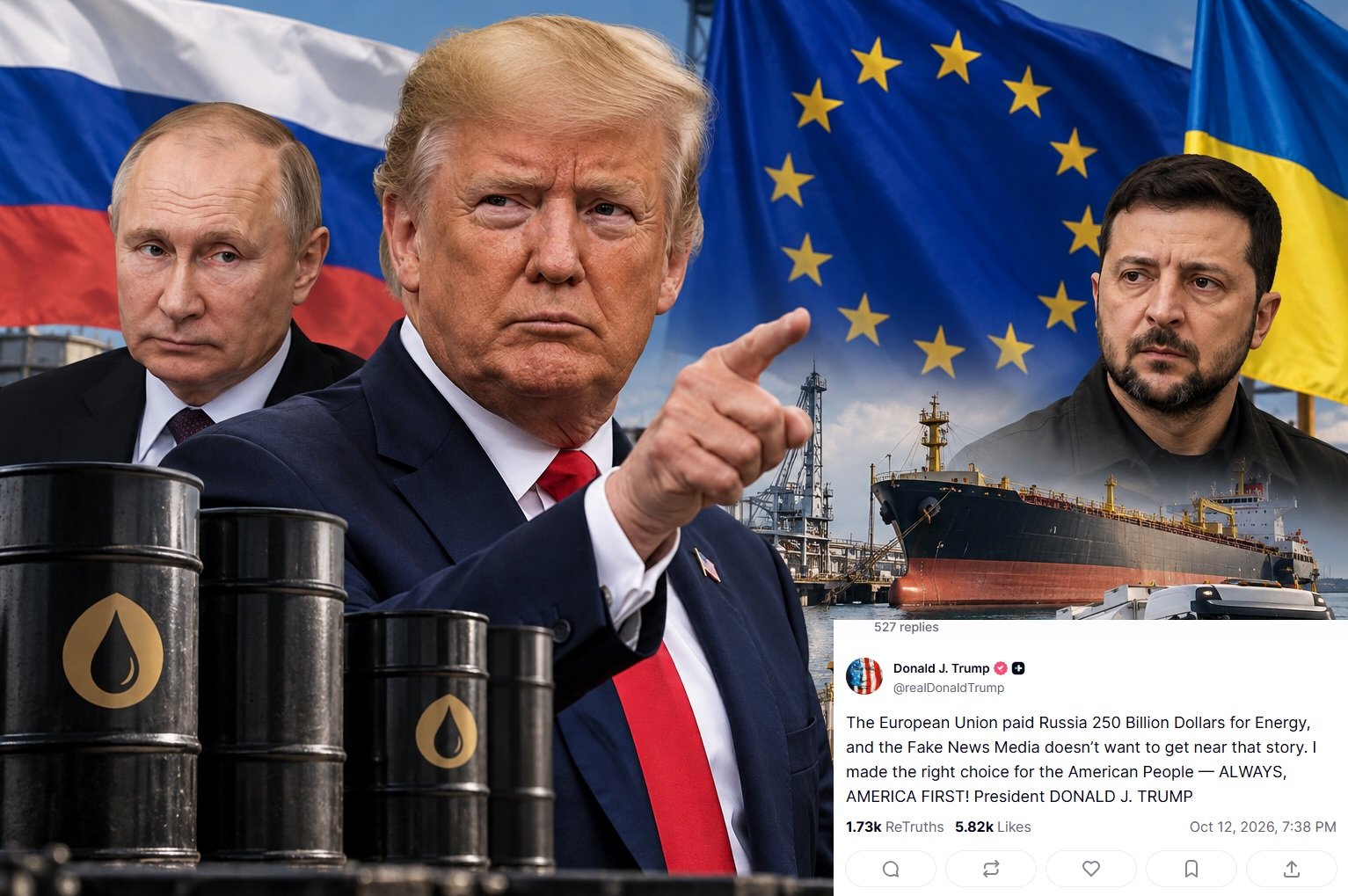
WASHINGTON, — U.S. President Donald Trump has defended his decision to allow Russian diesel fuel into U.S. and global markets, citing the European Union’s past energy purchases from Russia and saying the move is in the economic interests of Americans.
Trump Cites EU Energy Payments
In a post on Truth Social, Trump said the European Union had paid Russia $250 billion for energy and criticised the media for not focusing on the issue.
“I made the right choice for the American People — ALWAYS, AMERICA FIRST!” Trump wrote.
Data from the Centre for Research on Energy and Clean Air shows that EU payments to Russia for energy since February 2022 have exceeded €200 billion, equivalent to roughly $230–250 billion depending on exchange rates. The figure covers Russian oil, natural gas and coal. EU purchases have declined substantially since the start of the war but have continued in areas including liquefied natural gas and limited pipeline oil.
Russian Diesel Supply Agreement
The decision followed a October 9 phone call between Trump and Russian President Vladimir Putin. Trump announced that Russia would immediately supply more than 300,000 metric tons of diesel to U.S. and global markets.
The planned deliveries include:
-
More than 300,000 tons immediately
-
500,000 tons in November
-
1 million tons shortly afterward
-
A further 3 million tons, depending on Russian refinery conditions
Russian officials have said production is sufficient to meet domestic demand and the planned exports, with future monthly supplies potentially reaching 3 million tons.
U.S. Treasury Suspends Diesel Restrictions
The U.S. Treasury Department issued a temporary license allowing the sale, supply and import of Russian-origin diesel. The authorization remains valid until April 7, 2027.
Russia had previously restricted diesel exports because of domestic supply concerns and Ukrainian attacks on its refineries. Moscow subsequently partially lifted those restrictions following the agreement.
The Trump administration has described the arrangement as a way to increase fuel supplies and reduce diesel costs for American consumers, farmers, ranchers and truckers.
Bipartisan Opposition
The agreement has faced criticism from lawmakers in both major U.S. political parties.
Republican Senators Susan Collins, Lisa Murkowski, Thom Tillis and John Curtis, along with Democratic Senators Jeanne Shaheen, Richard Blumenthal and Ron Wyden, urged Trump to reverse the decision.
The senators argued that Congress banned Russian energy imports in 2022 to prevent American money from supporting Russia’s war in Ukraine. They also said the administration should not provide Moscow with additional revenue while the conflict continues and questioned the lack of congressional consultation.
Zelenskyy Criticises the Deal
Ukrainian President Volodymyr Zelenskyy also condemned the agreement, calling it a “weak decision” and saying it amounted to an investment in a war that should be ended rather than prolonged.
Zelenskyy proposed that the United States establish a diesel and energy partnership directly with Ukraine instead of Russia. His criticism followed earlier disagreements between Washington and Kyiv over Ukrainian attacks on Russian oil and diesel refineries.
The Trump administration had urged Ukraine to stop such attacks because of concerns about their potential impact on global fuel supplies.
Impact on U.S. Fuel Prices
The effect of the Russian diesel supplies on U.S. fuel prices will depend on the timing and volume of deliveries, Russian refinery production and shipping availability.
The Treasury authorization is limited to permitted transactions involving Russian-origin diesel and does not remove all U.S. sanctions on Russia.
——— End of Article ———