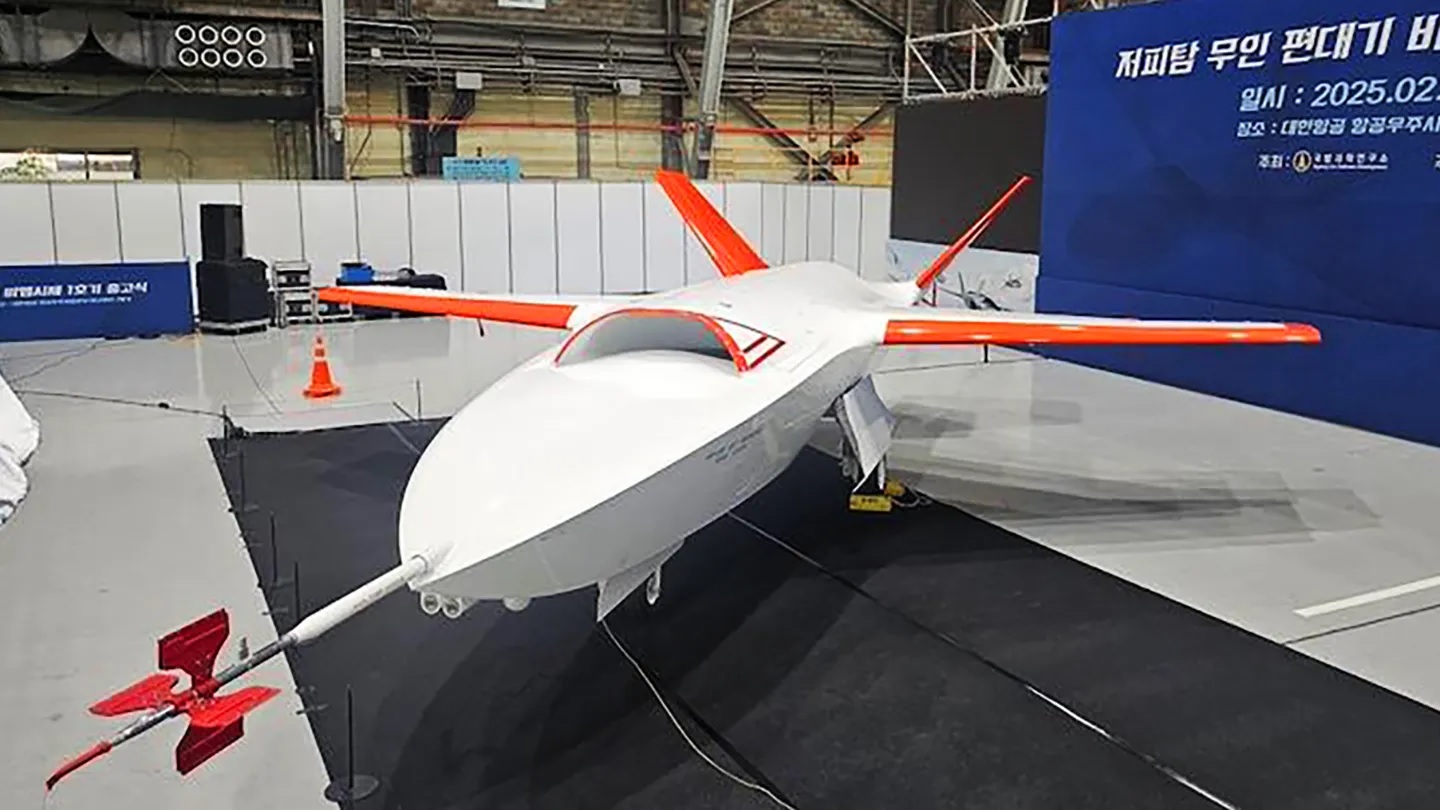
In a major leap toward futuristic air combat, South Korea is developing a cutting-edge AI-powered unmanned aerial vehicle (UAV)—nicknamed "Teamind"—designed to fly alongside the country’s KF-21 Boramae fighter jet as a loyal wingman. This next-gen drone is part of a bold vision by Seoul to boost the Republic of Korea Air Force’s firepower and survivability using advanced human-machine teaming.
A recent concept video released by Korea Aerospace Industries (KAI) showed just how this “loyal wingman” system could work in real combat. The simulation featured four stealthy UAVs flying in formation with the KF-21, taking off from a transport aircraft, identifying enemy air defenses, and then launching precision strikes—all while the human pilot stayed at a safer distance, issuing commands through a mission display. The drones were sleek, low-observable in shape to minimize radar detection, and operated almost like intelligent extensions of the manned aircraft.
The pilot inside the KF-21 uses an on-screen interface to assign tasks to the drones—like scouting, jamming radars, or attacking targets. In the simulation, once the drone squad neutralized enemy radar installations, the manned fighter moved in to drop bombs. The whole idea is to let the drones take the first hit, break enemy defenses, and keep human pilots out of immediate danger.
The aircraft shown in the demo was a technology demonstrator version, easily spotted with its white body and red accents. It's still under development on the ground, with engineers testing its aerodynamics, stealth features, and electro-optical sensors. Flight testing is expected to begin later this year, with joint test missions alongside the KF-21 fighter jet possibly kicking off in 2026.
KAI launched the program in 2021, naming it "Teamind"—a combination of “Team” and “Mind”—to represent AI-driven teamwork between manned and unmanned aircraft. The system is expected to be fully developed by 2027, and become operational in real missions around 2030.
For South Korea, this marks more than just a technical milestone. The KF-21, which is the country’s first indigenously developed supersonic fighter, is already seen as a game-changer. Now, pairing it with AI drones not only boosts its combat punch but also makes it a far more attractive product on the global arms market.
Officials believe that the "Teamind" drone will multiply the effectiveness of each KF-21 by allowing one pilot to command several drone wingmen in complex missions—cutting down risk, increasing flexibility, and expanding strike options.
This move aligns South Korea with a growing international trend. The United States, Australia, and several European nations are also working on similar manned-unmanned teaming strategies. But South Korea’s approach focuses on AI integration, rapid deployment, and affordability—qualities that are becoming critical in an era of rising tensions and drone-dominated warfare.
As the regional security environment becomes more unpredictable, South Korea is betting that “Teamind” could be the edge its air force needs—not just to keep up, but to lead.
——— End of Article ———