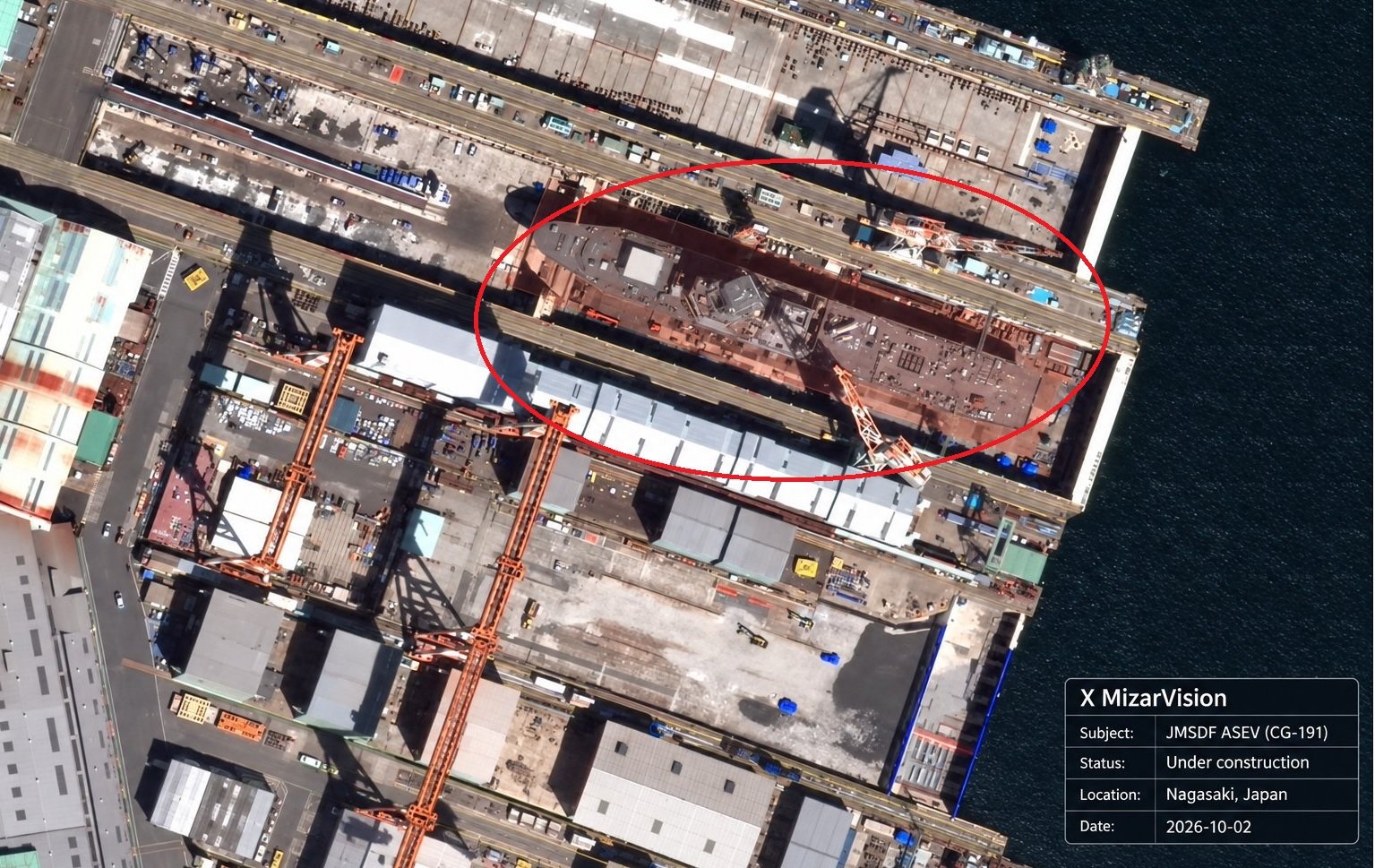
NAGASAKI, Japan — Satellite imagery dated October 2 shows significant progress in the construction of Japan’s first Aegis System Equipped Vessel (ASEV), identified as CG-191, at Mitsubishi Heavy Industries’ Nagasaki shipyard. The hull and superstructure are increasingly taking shape as Japan prepares to introduce one of its largest surface combatants.
Dimensions and Design
The vessel is expected to measure approximately 190 meters long and 25 meters wide, with a standard displacement of around 12,000 tonnes. Some reports estimate its full-load displacement at 14,000–16,000 tonnes. This would make it substantially larger than Japan’s Maya-class Aegis destroyers, which measure about 170 meters and have a standard displacement of approximately 8,200 tonnes. The new ships are expected to receive the CG (guided-missile cruiser) designation rather than the DDG classification used for existing Aegis destroyers.
The ASEV design is reported to include a CODLAG propulsion system with two Rolls-Royce MT30 gas turbines, diesel engines and electric motors, providing a planned speed of approximately 30 knots. The expected crew is around 240, with automation intended to reduce personnel requirements.
JAPAN — Japan’s first Aegis System Equipped Vessel is rapidly taking shape in Nagasaki.
— MizarVision (@MizarVision) October 2, 2026
Satellite imagery dated October 2, 2026 provides a fresh overhead look at the lead JMSDF Aegis System Equipped Vessel, commonly identified as CG-191, under construction at Mitsubishi Heavy… pic.twitter.com/fVFmSRwmKt
Radar and Missile Systems
The vessel’s primary sensor will be Lockheed Martin’s AN/SPY-7(V)1 radar, integrated with the Aegis Combat System. Four fixed radar arrays are designed to provide 360-degree coverage and track multiple threats, including ballistic missiles and airborne targets, with the system intended to support defense against emerging hypersonic threats.
In August 2026, Lockheed Martin confirmed that the first complete ASEV radar and Aegis combat-system shipset had completed validation testing in the United States and was being prepared for shipment to Japan for installation and integration.
The ships are planned to carry 128 Mk 41 vertical-launch cells, with 64 forward and 64 aft, compared with 96 cells on Maya-class destroyers. Planned weapons include SM-3 Block IIA ballistic-missile interceptors and SM-6 missiles. Potential future weapons include Tomahawk land-attack cruise missiles and enhanced versions of Japan’s Type 12 anti-ship missiles; their installation should not be assumed until officially confirmed.
Programme Background and Timeline
Japan pursued the ASEV programme after cancelling its land-based Aegis Ashore missile defense project in 2020. The ship-based programme is intended to provide persistent ballistic-missile defense coverage and allow existing Aegis destroyers to focus on a wider range of naval missions. The combined programme cost has been reported at approximately 1 trillion yen.
The first vessel was laid down at Nagasaki on July 18, 2025. Its launch is targeted for fiscal year 2026, with commissioning planned for March 2028. The second vessel, CG-192, was laid down at Japan Marine United’s Isogo shipyard in Yokohama on February 5, 2026. It is scheduled for launch in fiscal year 2027 and commissioning in March 2029.
The October 2 imagery shows CG-191 progressing from its initial construction blocks toward a recognizable major surface combatant. Upcoming work includes completing the structure, installing and integrating the combat systems, and conducting testing ahead of service entry.
——— End of Article ———