WASHINGTON, — The U.S. Department of Defense has awarded contracts to aerospace startups Overview Energy and Katalyst Space to develop two different technologies for collecting solar energy in space and transmitting it to Earth. The projects aim to provide electricity to remote military bases and forward-deployed locations while reducing dependence on fuel deliveries and vulnerable supply routes.
The initiatives are funded through the Pentagon’s Operational Energy Capability Improvement Fund (OECIF), which supports the development and demonstration of technologies for military energy requirements. The two companies are pursuing near-infrared light and microwave transmission, respectively.
Overview Energy Develops Near-Infrared Technology
Overview Energy, founded in 2022 and based in Ashburn, Virginia, received an OECIF contract to design, build and test a homing beacon system for its space-based solar satellites.
The system will allow satellites to identify authorized ground receivers, locate them precisely and direct near-infrared light toward designated sites. Ground crews will install beacons at receiving locations, while authentication mechanisms are intended to prevent signal spoofing or unauthorized redirection.
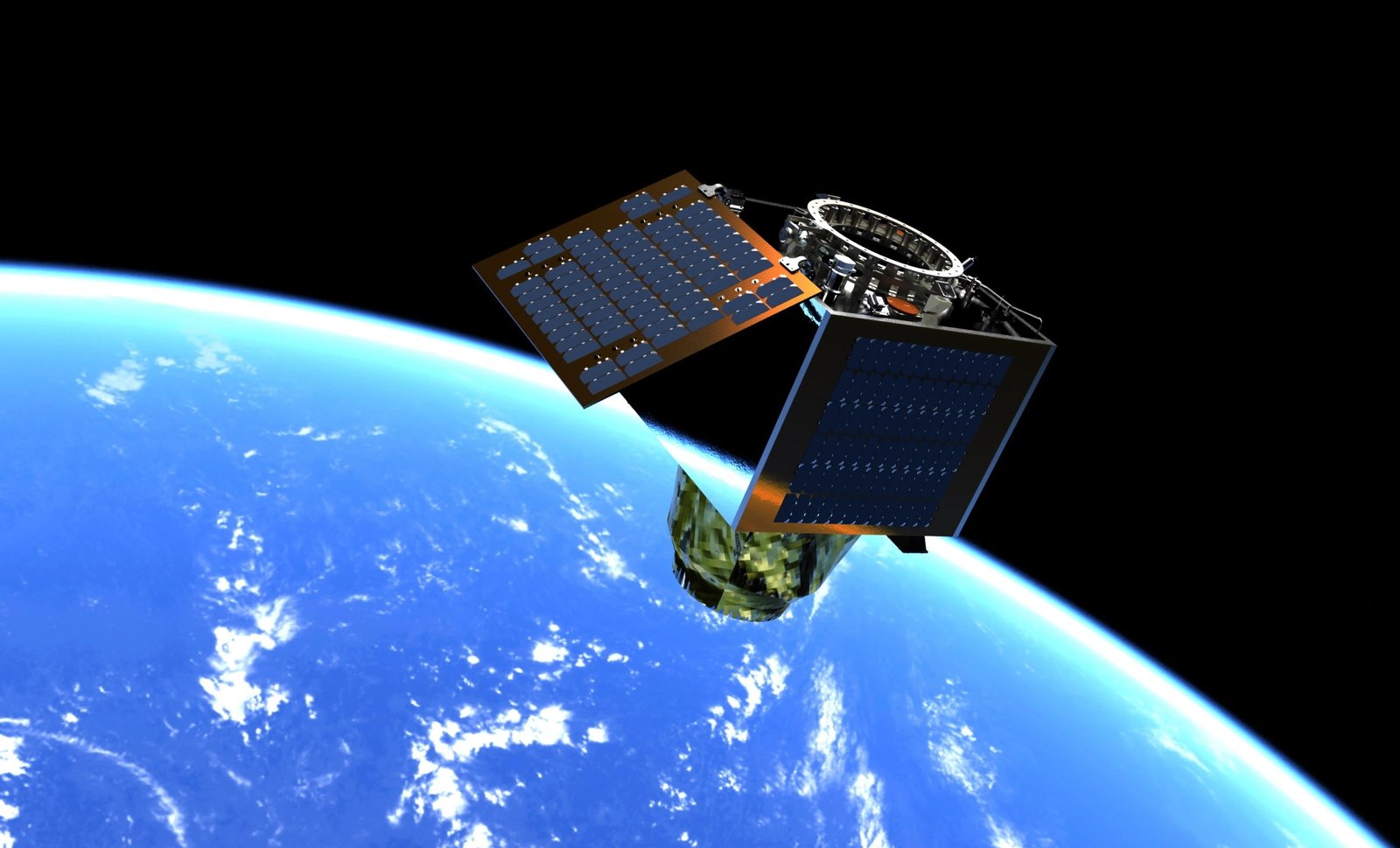
The company’s satellites are designed to collect sunlight in orbit and convert it into near-infrared light for transmission through the atmosphere. Existing utility-scale solar panels on Earth will absorb the beam and convert its energy into electricity, potentially allowing power generation at night when natural sunlight is unavailable.
Overview Energy has already demonstrated power transmission from a moving aircraft to ground-based solar panels over several kilometers. The test validated key tracking, pointing and transmission technologies intended for orbital use.
Hardware developed under the new contract will be integrated into the company’s first satellite, with a low Earth orbit demonstration planned for 2028. Overview intends to use this system as the basis for a larger constellation of satellites in geosynchronous orbit, with deployment targeted to begin in 2030. Satellites in this orbit can remain approximately fixed relative to a point on Earth and receive sunlight for extended periods.
The company’s longer-term concept includes redirecting power beams between regions to meet changing electricity demand and military requirements.
Earlier in 2026, Overview received a separate U.S. Air Force contract worth less than $1 million to study space-based solar power for military installations operating under difficult or contested logistics conditions. The study includes Eielson Air Force Base in Alaska and Andersen Air Force Base in Guam, where fuel transportation can present logistical challenges.
Overview has also signed a capacity-reservation agreement with Meta for up to 1 gigawatt of power from its planned system, with commercial delivery targeted for 2030.
Katalyst Space Develops Microwave Power Transmission
The Pentagon is also supporting Katalyst Space, a Colorado-based company founded in 2020 that specializes in robotic space operations.
On September 21, 2026, the OECIF awarded the company a separate contract under the Advanced Scalable Growth Architecture for Robotic Deployment (ASGARD) program to demonstrate the on-orbit assembly of a large-scale power-beaming system.
Katalyst plans to deploy its NEXUS autonomous robotic spacecraft into low Earth orbit. Its robotic arms will assemble modular power-beaming tiles developed by the U.S. Naval Research Laboratory (NRL) into a large solar-collection structure.
The system will collect solar energy, convert it into radio-frequency microwave energy and transmit it to a dedicated receiving station on Earth. Unlike Overview Energy’s approach, which is designed to use conventional solar panels, Katalyst’s system will require specialized ground receivers.
Its modular design is intended to allow additional hardware to be delivered and assembled by robotic vehicles, expanding capacity over time from an initial output measured in kilowatts to megawatts of continuous power.
Pentagon Tests Two Approaches
The two projects address the same military logistics challenge through different technologies. Overview Energy is developing near-infrared transmission compatible with existing solar infrastructure, while Katalyst Space is testing microwave transmission combined with robotic assembly in orbit.
Both approaches aim to supply electricity to remote locations where fuel transportation and conventional power infrastructure are limited. Their potential applications could extend to civilian electricity networks, although practical deployment will depend on the results of demonstrations and further technological development.
The OECIF contracts support the evaluation of both technologies in parallel. Overview’s first space-based demonstration is planned for 2028, while Katalyst will demonstrate robotic assembly of its microwave power system in low Earth orbit.
The dollar values of the two contracts have not been disclosed.
——— End of Article ———